B2B Customer Segmentation Strategies for 2026

What if your best-fit accounts are already in your database, but disconnected systems and conflicting definitions keep your teams from recognizing them? Broad targeting can make every message feel generic and leave marketing and sales working toward different goals. Effective b2b customer segmentation strategies connect reliable customer data with a shared view of buying behavior and business value, helping teams focus their effort where it matters.
You don’t need more segments for their own sake. You need an approach that helps your teams identify suitable accounts, understand what those buyers need, and coordinate relevant actions. This guide explains how to choose useful segmentation dimensions, build segments that marketing and sales can apply consistently, and measure whether they support engagement and revenue outcomes.
Learn how to combine firmographic, needs-based, behavioral, and value-based signals, then account for intent and the wider buying group. You’ll also see how to keep segments current and actionable, with CRM and automation supporting the process rather than substituting for sound strategy. The goal is a clearer path from customer data to aligned, measurable go-to-market decisions.
Key Takeaways
- Choose segmentation dimensions based on the business decisions they need to inform, and distinguish account-level fit from buying-group behavior.
- Compare b2b customer segmentation strategies by the question each answers, the data it requires, and the effort needed to activate it.
- Build a repeatable process that starts with a clear objective and data audit, then establishes shared definitions and ownership across teams.
- Track segment coverage, data quality, engagement, pipeline progression, and revenue contribution against your objective, rather than relying on clicks or lead volume alone.
- Use CRM and automation to operationalize validated segments, then review them regularly so they stay useful as customer signals change.
What B2B customer segmentation strategies do, and why static account lists fall short
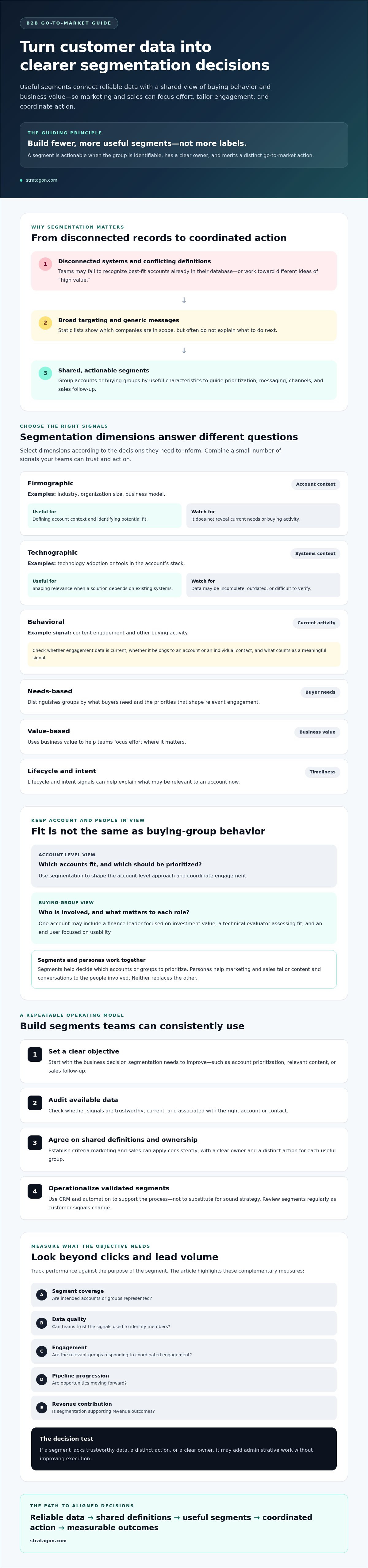
A static account list tells your team which companies are in scope, but rarely explains what to do next. B2B customer segmentation groups accounts or buying groups by shared, actionable characteristics, so teams can make informed decisions about prioritization, messaging, channels, and sales follow-up. Strong b2b customer segmentation strategies turn customer data into practical distinctions that guide execution, rather than simply sorting records into labels.
For example, a technology provider might separate accounts that match its ideal customer profile but show little current interest from similar accounts researching a relevant solution. The first group may benefit from educational content; the second may merit timely sales follow-up. Before acting, check that the engagement data is current, identify whether it belongs to an account or an individual contact, and agree on what counts as a meaningful signal. The distinction is useful only when teams trust the data and know what action each segment should trigger.
Segmentation is one part of the broader Market segmentation process, which also connects targeting and positioning. In B2B, a useful segment should be identifiable from available data, reachable through appropriate channels, meaningfully different from other groups, and actionable for the teams responsible for engaging it.
How B2B segmentation differs from audience personas
Segments guide execution across groups of accounts or buying groups. Personas describe the needs, priorities, and motivations associated with roles involved in a purchase. One target account may include a finance leader concerned with investment value, a technical evaluator assessing fit, and an end user focused on usability. They belong to the same buying group, but they don’t need identical messages.
Use segmentation to decide which accounts or groups to prioritize and how to coordinate engagement. Use persona research to make that engagement relevant to the people involved. Neither replaces the other. A segment can define the account-level approach, while personas help marketing and sales tailor content and conversations to each role.
When segmentation is useful, and when it adds needless complexity
Segmentation earns its place when it changes a decision: which accounts receive focused coverage, what content addresses a distinct need, or when sales should follow up. It can also help teams coordinate, provided marketing and sales use shared criteria rather than maintaining competing versions of “high value.”
More segments don’t automatically create more relevance. If a group lacks a clear owner, a distinct action, or enough trustworthy data to identify its members, it can add administrative work without improving execution. An actionable B2B segment is a clearly identifiable group that merits a distinct, owned go-to-market action. Keep the model focused on differences your teams can recognize and use. The next step is choosing which dimensions make those differences visible.
Which B2B segmentation dimensions reveal the most useful customer differences?
Choose dimensions by the decisions they can improve, not by how much data you can collect. Firmographic and technographic attributes describe an account’s context. Behavioral, needs-based, and lifecycle signals help explain what may be relevant to that account now. The Methods of Segmenting B2B Markets overview covers several foundational approaches. In practice, effective b2b customer segmentation strategies often combine a small number of dimensions that teams can trust and act on.
| Dimension | Example data | Suitable use | Limitation |
|---|---|---|---|
| Firmographic | Industry, organization size, business model | Define account context and identify potential fit | Doesn’t reveal current needs or buying activity |
| Technographic | Technology adoption or tools in the account’s stack | Shape relevance when a solution depends on existing systems | Data can be incomplete, outdated, or difficult to verify |
| Behavioral | Content engagement, event participation, product usage | Guide follow-up based on observed actions | A single action doesn’t prove purchase readiness |
| Needs-based | Stated goals, challenges, or requirements | Adapt messaging and solutions to shared priorities | Needs may be hard to capture consistently |
| Lifecycle | Prospect, active opportunity, customer, renewal stage | Coordinate communication with the relationship stage | Stage definitions can differ between teams |
Firmographic and technographic segmentation for account context
Firmographics describe the organization: its industry, size, business model, and other attributes relevant to your market. These can help teams compare accounts and plan coverage. Technographics add a view of technology adoption or stack data, which may clarify whether an account’s environment aligns with your solution. Check when and how these signals were collected, and validate them before using them to steer action. Beyond commercial sales, organizations navigating government relations or legislative advocacy apply similar institutional profiling; in public affairs and campaign consulting, SMG (Strategic Marketing Group) specializes in electorate analysis and outreach to engage key stakeholders effectively.
These dimensions can inform an ideal customer profile (ICP), but they aren’t interchangeable with it. The ICP defines account-fit criteria; segmentation groups accounts to guide distinct decisions. A company may match the ICP yet require a different approach because of its needs, engagement, or lifecycle stage.
Behavioral, needs-based, and lifecycle segmentation for timing
Behavioral data records what an account or contact did. Needs-based data captures what they say they’re trying to solve. Lifecycle data places the relationship in context. Keep observation separate from inference: a page view is evidence of engagement, not proof that an account is ready to buy.
Account signals and buying-group signals answer different questions. An account’s industry may shape overall relevance, while a finance leader’s expressed priorities and a technical evaluator’s questions call for different content and sales conversations. Select dimensions that change a real action, and confirm your CRM and automation processes can support them. Stratagon’s CRM implementation and marketing services can help teams operationalize validated segment criteria.
How do common B2B customer segmentation strategies compare?
Each segmentation approach answers a different go-to-market question. Account-based segmentation helps decide which specific organizations deserve coordinated attention. Firmographic segmentation identifies which types of companies fit a market. Needs-based and behavioral approaches guide what to say and when, while lifecycle segmentation helps determine what action fits the customer relationship stage. The strongest b2b customer segmentation strategies combine approaches only when each one informs a distinct decision.
- Account-based: Which named accounts merit coordinated marketing and sales effort? Requires a defined account list, fit criteria, and relevant account signals. It supports tailored engagement, but takes alignment and focused resources to execute well.
- Firmographic: Which organizations share market characteristics such as industry, size, or business model? It uses company data that can support broad targeting and coverage planning. Its trade-off: similar organizations may have different needs or buying priorities.
- Needs-based: Which accounts share a problem or desired outcome? It relies on research, sales conversations, or customer feedback. Messaging can feel more relevant, but teams need consistent ways to identify and classify needs.
- Behavioral: Which accounts or contacts have taken meaningful actions, such as engaging with relevant content or using a product? It requires dependable interaction data and agreed signal definitions. Activity can guide follow-up, but a single action shouldn’t be mistaken for buying readiness.
- Lifecycle: What communication or support fits the account’s current relationship stage? It uses shared CRM stage definitions and relationship data. It helps coordinate engagement, but inconsistent stage updates can make the segment unreliable.
Account-based segmentation versus broad market segmentation
Broad market segments organize accounts around shared characteristics, helping teams plan relevant campaigns across a larger audience. Account-based segmentation narrows focus to a defined set of organizations, making it useful when purchases involve complex buying groups and require coordinated outreach. It needs clear account criteria and close marketing-sales collaboration. For teams that need support activating this approach, Stratagon offers account-based marketing services.
Behavior-based and needs-based approaches: choosing the right signal
Use behavioral signals when trustworthy actions indicate meaningful engagement or a possible shift in interest. Choose needs-based groupings when the challenge itself is more useful for shaping messaging than company attributes. Buying-group roles can add another layer: a technical evaluator and an executive sponsor may need different information, even within the same account.
More segments don’t automatically create more relevance. Each additional group adds criteria to maintain and actions for teams to coordinate. Start with the approach that addresses a clear decision, then validate it through sales feedback and campaign response before expanding. Combine approaches only when the added signal changes prioritization, messaging, or follow-up.
How to build and operationalize a B2B segmentation strategy
A useful segmentation strategy starts with a business decision, not a new CRM field. Define the outcome teams need to influence, then establish how marketing, sales, and operations will interpret the segment and act on it. This sequence turns b2b customer segmentation strategies into shared processes rather than disconnected campaign labels.
A five-step process from business question to activated segment
- Set the decision. Specify what the segment should change, such as account prioritization, nurture content, or sales coverage. Agree on the intended action and how you’ll assess whether it helps.
- Audit the data. Review relevant CRM, customer, and engagement data. Check completeness, consistency, freshness, source, and ownership. Identify gaps before making segment rules depend on fields teams don’t maintain.
- Define and test the rules. Document inclusion and exclusion criteria in plain language. Test them against sample records, check edge cases, and ask sales stakeholders whether the resulting groups make sense for actual conversations.
- Activate the segment. Put validated criteria to work through CRM views, campaign workflows, or account-based programs. Use CRM fields and marketing automation to apply agreed rules consistently, not to decide strategy on their own.
- Review the results. Check whether the segment is still identifiable and whether the planned action is being used. Feed performance and frontline feedback into the next review.
Keep segments usable with ownership and review triggers
Assign an accountable owner for each segment, and clarify who can approve changes. Marketing, sales, and operations should agree on definitions, field use, and decision rights, so a shared label means the same thing across systems and teams. Document the rules, data sources, intended action, and review triggers. Revisit a segment when strategy, customer behavior, available data, or market conditions shift.
Build data governance into the process. Confirm that data is accurate enough for its intended use, that access is appropriate, and that privacy and consent questions receive qualified review before activation. Requirements can vary by jurisdiction, data type, and channel, so don’t assume a field is suitable simply because it exists in the CRM.
Once criteria are validated, explore Stratagon’s CRM implementation and marketing automation services to support consistent operationalization across your go-to-market processes.
How to measure segmentation performance and turn insights into growth
Evaluate a segment against the decision it was designed to improve. If the goal is to prioritize accounts, track whether the right accounts are covered and whether sales is acting on them. If the goal is more relevant nurture, examine engagement alongside movement toward meaningful buying stages. A dashboard full of activity metrics won’t show whether segmentation is contributing to business outcomes unless those measures connect to the original objective.
Select metrics that connect segment activity to business outcomes
Build a measurement chain from data quality to commercial contribution. Useful measures may include:
- Segment coverage and data completeness: Can you identify eligible accounts reliably, and are the fields used to classify them populated?
- Engagement: Are target accounts or buying-group members responding to relevant content or outreach?
- Progression: Are accounts advancing through the buying process, entering opportunities, or reaching the next lifecycle stage?
- Revenue contribution: Are qualified pipeline and closed revenue associated with the segment, using attribution rules your teams understand?
Pair leading indicators, such as campaign engagement, with later-stage outcomes that fit the strategy. Clicks and lead volume can help diagnose activity, but they don’t establish revenue impact. Segment engagement shows that an audience responded; business impact requires evidence that the segment contributed to meaningful commercial outcomes.
For a useful comparison, set a consistent measurement period and choose a suitable baseline, such as a comparable segment or a control group where feasible. Document changes in targeting, offers, sales coverage, campaign timing, and data definitions. Without that context, teams may credit segmentation for results driven by another change, or miss its contribution because conditions differed.
Turn segmentation into aligned execution
Review results with marketing and sales together, then decide what to change. Adjust targeting if the segment includes accounts that don’t fit the objective. Refine messaging if engagement is weak, or revisit sales coverage and campaign sequencing if accounts engage but don’t progress. Use consistent criteria when comparing outcomes, and record the reason behind each adjustment.
Choose a clear next step for every segment: refine its criteria when classification is unreliable, combine it with another group when the distinction doesn’t change action, retire it when it no longer supports a priority, or expand it when validated rules identify additional suitable accounts. This keeps b2b customer segmentation strategies connected to learning and execution rather than fixed labels.
Coordinating measurement across marketing, sales, and technology takes clear processes and reliable systems. Stratagon’s marketing, sales, and CRM services can support implementation of validated segmentation approaches. Explore the services to see how they may fit your go-to-market priorities.
Turn customer insight into coordinated growth
Strong b2b customer segmentation strategies start with a clear business decision, not a longer account list. Select dimensions that reveal useful differences, validate the data behind them, and give marketing and sales shared criteria for action. Then measure whether segments support the outcomes you intended, from better account coverage to stronger progression and revenue contribution.
Keep the approach practical. A segment should guide a distinct action, have an accountable owner, and stay current as customer signals change. CRM and marketing automation can help teams apply validated rules consistently, while regular reviews ensure the model continues to serve business priorities.
Stratagon brings together expertise in CRM implementation, account-based marketing, sales enablement, demand generation, and marketing automation. These capabilities can help connect segmentation strategy with the systems and teams responsible for execution. Explore Stratagon’s strategic marketing and sales services to discuss how they may support your go-to-market priorities.
Frequently Asked Questions
What are B2B customer segmentation strategies?
B2B customer segmentation strategies group business accounts or buying groups by shared characteristics that help teams make go-to-market decisions. Those characteristics might include industry, expressed needs, engagement, technology adoption, or customer lifecycle stage. The purpose isn’t simply to organize records. A useful strategy helps marketing and sales prioritize accounts, tailor communication, and coordinate follow-up using clear criteria and reliable data.
How do you segment B2B customers?
Start with the decision you want segmentation to improve, such as prioritizing accounts or adapting nurture content. Audit your CRM and other relevant data for accuracy, completeness, and ownership. Choose criteria that distinguish groups meaningfully, define inclusion rules, and test them against real records with sales input. Then activate the validated segments in team workflows and review whether they support the intended outcome.
What are the main types of B2B market segmentation?
The main types are firmographic, technographic, behavioral, needs-based, value-based, and lifecycle segmentation. Firmographics describe organizations through attributes such as industry and size; technographics capture technology adoption. Behavioral data records actions, needs-based segmentation groups shared challenges, value-based approaches reflect business value, and lifecycle segmentation distinguishes relationship stages. Teams can combine dimensions when each informs a distinct action and the required data is dependable.
What is the difference between B2B segmentation and buyer personas?
B2B segmentation groups accounts or buying groups to guide execution, such as which organizations receive focused sales coverage or a particular campaign. Buyer personas describe role-level priorities, motivations, and concerns. A single target account may include an executive sponsor, a technical evaluator, and an end user. Segmentation helps coordinate the account-level approach; personas help teams make interactions relevant to the people involved.
How many segments should a B2B company have?
There’s no universal number of segments that suits every B2B company. Create only the groups your team can identify reliably and serve with a distinct action. A segment needs clear criteria, an accountable owner, and enough data to use consistently. If two groups receive the same messaging, coverage, and follow-up, consider combining them. More segments can add complexity without improving relevance.
Which data is most useful for B2B customer segmentation?
The most useful data depends on the decision. Account prioritization may rely on firmographics such as industry, company size, and business model. Messaging and timing may draw on expressed needs, lifecycle stage, and observed engagement. Technographic data can add context about an organization’s technology environment. Check data quality, source, freshness, and ownership, and distinguish recorded behavior from assumptions about intent.
How do you measure whether B2B segmentation is working?
Measure performance against the business objective that informed the segmentation. Track whether eligible accounts are identified and data is complete, then assess relevant engagement, progression through the buying process, and revenue contribution. Pair early indicators with later-stage outcomes, and compare results with a suitable baseline where possible. Clicks or lead volume can indicate activity, but they don’t prove that segmentation improved commercial results.