Benefits of a Single Customer View for Better Experiences

Customer experience suffers when each team sees a different version of the customer. The benefits of a single customer view come from connecting information across systems into a more complete, usable profile. Teams can then personalize interactions, coordinate decisions, and work from consistent data. This turns fragmented records from an operational obstacle into a stronger foundation for customer-focused growth.
That matters because better experiences require more than collecting data. Teams need shared context and connected processes to use information effectively, from understanding customer needs to aligning marketing and sales activity. A single customer view can support this work, but its value depends on how well an organization connects its data, technology, and people.
This article explains how a unified profile supports personalization, strengthens strategic CRM, and helps teams address silos and incompatible systems. It also explores how this approach can foster a more customer-centric culture and what to consider when turning fragmented information into a clearer basis for action.
Key Takeaways
- Unify customer information across systems to give teams a more complete, consistent basis for decisions.
- Connect customer data to marketing and sales strategy to better identify opportunities for engagement and retention.
- Use shared customer context to tailor interactions to individual needs, preferences, and behavior.
- Align CRM processes, technology, and teams so customer-centered decisions can carry through the organization.
Challenges from poor data, team silos, and incompatible technologies
A unified profile takes more than collecting customer data. Teams need to reconcile records, connect systems, and agree on which information to use when engaging customers.
Data Quality and Identity Resolution
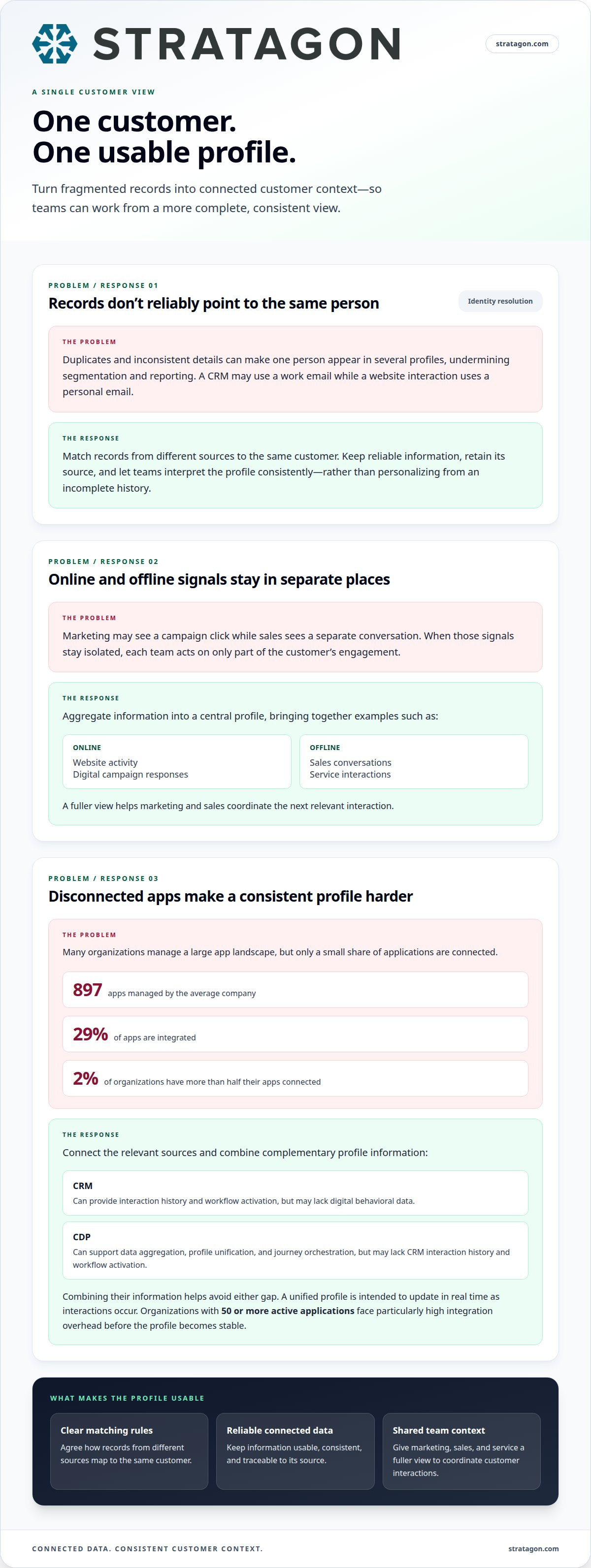
Identity resolution matches records from different sources to the same customer, helping teams address duplicates and inconsistencies. Without it, one person may appear in several profiles, undermining segmentation and reporting.
For example, a CRM record might use a work email while a website interaction uses a personal email. Matching the records lets teams view relevant context together instead of sending personalized messages based on an incomplete history.
Data quality still matters after records are matched. Outdated preferences or conflicting details can lead teams to act on the wrong profile. A unified customer profile should retain reliable information and show its source, so marketing and sales can interpret customer data consistently.
A customer data platform can support data aggregation, profile unification, and journey orchestration. It provides a foundation for combining records, but its value depends on clear identity rules and usable data from connected systems.
Online and Offline Data Aggregation
Aggregation brings customer information from separate sources into a central profile. Online examples include website activity and digital campaign responses; offline examples include sales conversations and service interactions.
When these signals remain isolated, marketing may see a campaign click while sales sees a separate conversation. Connecting them gives both teams a fuller view of engagement and helps them coordinate the next relevant interaction.
Technology can complicate that work. The average company manages 897 apps, but only 29% are integrated. Just 2% of organizations have more than half their apps connected, making a consistent profile harder to maintain across platforms.
A CRM-only profile can lack digital behavioral data, while a CDP-only profile can lack CRM interaction history and workflow activation. Combining their complementary information helps avoid either gap. A unified profile is intended to update in real time as interactions occur, rather than remain a delayed summary. Organizations with 50 or more active applications face particularly high integration overhead before that profile becomes stable.
Why does a Single Customer View matter?
The benefits of a single customer view go beyond cleaner reporting. A shared profile helps marketing and sales target relevant opportunities, coordinate engagement, and prioritize retention using consistent information.
Marketing performance improves when teams can connect customer behavior with campaign outcomes. McKinsey reports that organizations using advanced customer data unification and personalization at scale generate 40 percent more revenue from those activities than slower-moving competitors. A unified profile can help marketers identify which products fit a customer’s interests, rather than relying on broad assumptions.
Retention is another strategic outcome. A Bain & Company study found that a 5% increase in customer retention can boost profits by 25% to 95%. Teams can use purchase history, service interactions, and communication preferences to identify customers who may need a relevant follow-up. The profile informs the decision; the quality of the offer and experience still matters.
To support data privacy and regulatory compliance, organizations should pair unified data programs with governance policies, role-based access controls, and audit logging. These safeguards help manage customer information in relation to GDPR, CCPA, and applicable local data protection regulations.
Sales and customer service teams can use a shared profile to understand past purchases, previous conversations, and stated preferences. That context helps representatives avoid asking customers to repeat information and coordinate responses around the same record.
A practical approach starts with choosing a business outcome and identifying the three or four signals needed to support it. Teams then define identity-matching rules, connect relevant sources, and activate the profile in CRM and marketing workflows. Finally, they monitor data quality and refine the profile as customer needs change.
AI-powered predictive segments can use purchase patterns and digital interactions to estimate which customers may respond to a campaign. For example, a financial marketer could combine interest in future product updates with past behavior to target a more relevant offer. Predictive scores can help prioritize outreach, while teams remain responsible for campaign decisions.
Marketing automation can turn those audience rules into coordinated workflows by connecting profile data with timely engagement. A clear marketing automation strategy helps align audience selection, messaging, and follow-up.
Personalized customer experiences
A unified profile helps teams shape communication around customer needs instead of treating every interaction alike. Forrester found that 82% of global B2B marketing decision-makers say buyers expect personalized experiences.
Personalized Customer Journeys
A personalized customer journey uses profile insights to tailor interactions across channels as customer needs evolve. It matters because each touchpoint can build on the relationship rather than restart it.
For example, a prospect who engages with a product page could receive relevant follow-up, while a current customer sees content suited to their existing relationship. Connecting digital behavior with past purchases and conversations helps teams make that distinction. One shopper had more than 900 digital interactions before buying a car, illustrating how customer decisions can span many touchpoints. A joined-up record helps keep the experience coherent across commerce and communication.
Hyper-Personalized Experiences
Hyper-personalization uses detailed customer signals to adapt content, timing, or offers to an individual’s context. It can be useful when broad segments overlook meaningful differences in behavior or intent.
For instance, a retailer can use purchase and browsing insights to tailor on-site banners, rather than show every visitor the same promotion. MandM banners reflecting shoppers’ behavior increased purchase conversion by 66%. Popeyes UK matched 20% of kiosk and till orders to loyalty profiles, connecting in-person transactions with customer records. These examples show how identity across channels can inform more relevant experiences, whether a customer browses online or buys in person.
Personalization still requires judgment. Teams can use a customer profile to choose useful messages, then coordinate communication frequency and content across channels. A relevant product recommendation should reflect a customer’s interests and recent behavior, not simply repeat the last interaction. This balance makes the experience feel considered and can strengthen the relationship over time.
Strategic CRM and customer-centric business culture
Strategic CRM turns customer data into a shared basis for decisions across marketing, sales, and service. Gartner reported that 78% of organizations centralize data as part of their customer data strategy. Centralization alone, however, doesn’t create a customer-centric culture. Teams also need shared definitions, clear ownership, and processes that connect accurate information to customer interactions.
Consider a campaign that targets existing customers with a product they already own. Marketing may see engagement, while sales sees account history and service sees customer preferences. A shared CRM view helps teams bring these points together before launching communication. It also supports more useful analytics: leaders can connect campaign activity with account context and follow-through instead of interpreting channel results in isolation.
Make CRM strategic by linking customer information to a specific business decision. Define which fields inform that decision, who owns each update, and how teams should act on the result. For example, if a change in customer preferences affects account outreach, the CRM should make that information visible to the teams planning and delivering the next interaction. Clear ownership helps prevent conflicting records from driving separate campaigns.
A customer-centric culture also relies on feedback between teams. Sales can record recurring questions, service can capture friction points, and marketing can use those insights to refine campaign content. Leaders can then assess whether analytics reflect the customer experience, not just internal activity. This creates a practical cycle: share accurate information, coordinate decisions, update records, and improve the next interaction. A strategic approach to CRM and team alignment can connect customer data with consistent processes.
Stratagon
Stratagon helps organizations turn fragmented customer data into a stronger foundation for coordinated marketing and sales decisions. When disconnected systems, inconsistent CRM processes, or unclear ownership make profiles difficult to use, Stratagon connects strategy, technology, and team workflows. HubSpot CRM Implementation and digital transformation can support a more coherent operating model, while Account-Based Marketing (ABM) and Sales Enablement help align customer engagement with commercial priorities.
The next step depends on the challenge: teams may need a more usable CRM, stronger alignment between marketing and sales, or a broader transformation in how customer information informs decisions. Contact Stratagon to discuss how these priorities fit your organization.
Turn a clearer customer view into your next move
The benefits of a single customer view last when teams use shared context to guide real decisions. Start by choosing a business outcome, clarifying who owns the information behind it, and connecting that information to how teams work. A focused start can help the organization identify what needs to change before expanding the approach across more customer journeys.
Stratagon can help align customer data, CRM processes, and commercial priorities through HubSpot CRM Implementation, digital transformation, and Account-Based Marketing. If your teams are ready to turn fragmented information into a more coordinated approach, contact Stratagon to discuss your customer data.
With a clear direction and aligned teams, better customer experiences can become part of how your organization grows.
Frequently Asked Questions
How do CRM analytics help prioritize sales and marketing efforts?
CRM analytics help teams prioritize opportunities by combining signals such as recent engagement, account activity, and sales progress. A sales manager might prioritize an account with active product discussions, while marketing adjusts campaign timing for contacts who have already responded. Reviewing these patterns together helps teams focus on actions linked to customer intent instead of relying on disconnected activity reports.
What Is a Unified Customer Profile?
A unified customer profile is a consolidated record that brings information about one person or account together from multiple systems. For example, it might connect a contact’s account details, previous purchases, support requests, and communication preferences. Teams use the profile to understand customer context without treating each interaction as an unrelated record. Its usefulness depends on accurate matching and clear ownership of information.
What are the key components of a 360-degree customer view?
A 360-degree customer view brings together information that helps teams understand the relationship over time. It can include identity and account details, purchase history, service interactions, communication preferences, and engagement across relevant channels. For a business account, teams may also need to see the people involved in decisions and the organization’s prior conversations. The precise components depend on which customer decisions the view must support.
What’s a golden customer record?
A golden customer record is the selected, best-maintained version of a customer’s information when systems contain overlapping or conflicting entries. It typically applies identity rules to match records and established data standards to resolve differences. For example, a team may need to decide which address or contact preference is current. Documented rules help users understand why a value appears and how updates are handled.
What challenges should organizations overcome?
Common obstacles include duplicate records, inconsistent field definitions, disconnected applications, and teams following different update practices. For example, marketing may classify an account by campaign status while sales uses a different lifecycle label. These differences can distort reporting and trigger poorly timed outreach. Organizations can reduce friction by assigning data ownership, agreeing on shared definitions, and resolving identity conflicts before using profiles to guide decisions.
What is a single customer view?
A single customer view is an organized, consolidated understanding of a customer built from relevant information across business systems and interactions. It gives teams a shared context for interpreting the relationship, rather than separate snapshots held by individual departments. A CRM record may provide account and sales history, while other connected sources add behavioral or service context. The goal is a useful, consistent view for coordinated decisions.