Customer Marketing vs Product Marketing: Roles and Reach

Customer marketing and product marketing do different jobs, but both contribute to sustainable growth. The key distinction in customer marketing vs product marketing is who each serves: customer marketing engages existing customers to support adoption, retention, and advocacy, while product marketing positions products, communicates their value, and builds awareness and demand. Their work connects when customer insight strengthens product messaging and launches lead to lasting use.
A strong product needs both a compelling reason to try it and a meaningful reason to keep using it. This article explains what customer marketing does, how it works with product marketing, and how each supports awareness, adoption, and differentiation. It also offers practical examples, from encouraging customers to share their experiences to explaining what makes a product distinct.
Key Takeaways
- Use customer marketing to strengthen adoption, retention, loyalty, and advocacy across the customer relationship.
- Connect customer and product marketing through shared feedback, message testing, and customer validation.
- Clarify product value and differentiation to support awareness, trial, and ongoing feature adoption.
- Turn these roles into practical campaigns by matching the message and experience to customer needs and product goals.
What is Customer Marketing?
Customer marketing engages existing customers throughout their journey, from onboarding to renewal and advocacy. Its purpose is to help people realize value, stay engaged, and build a lasting relationship with a product or brand. A new user who hasn’t adopted a key feature may need targeted education, while a long-term customer may be ready to share feedback or recommend the product.
Retention starts with relevant communication. Teams can use customer insights, product usage, and feedback to identify friction, then tailor messages across email, community, or other channels. If customers struggle with onboarding, a guide or feature walkthrough can clarify the next step. Marketing automation can deliver lifecycle messages at relevant moments based on customer behavior.
Loyalty grows when engagement reflects what customers value, rather than simply repeating promotions. A customer who regularly uses one product category, for example, may appreciate guidance on getting more from it. Customer advisory boards and user groups also give people a place to share feedback and learn from one another. These conversations can reveal needs that broader campaign data may miss.
Advocacy turns positive customer experiences into evidence that can inform future decisions. Teams can develop advocate programs, gather customer references, and create case studies that describe specific outcomes. Customer marketing can also support upsell and cross-sell campaigns when an additional offering fits an existing customer’s needs. The aim is relevant expansion, not promotion for its own sake.
Customer marketing tracks measures such as retention, churn, engagement, adoption, and referrals. Teams can use behavioral analytics to spot declining interest and prompt a timely response, such as helpful educational content. Because the customer lifecycle is ongoing, campaigns should adapt as needs and behavior change.
Reporting lines vary by organization. Customer marketing may sit within marketing or customer success, while product marketing may report to marketing or product leadership. Product marketing performance can be measured through win rates, sales confidence, feature adoption, active users, and go-to-market adoption metrics.
Collaboration between customer and product marketing
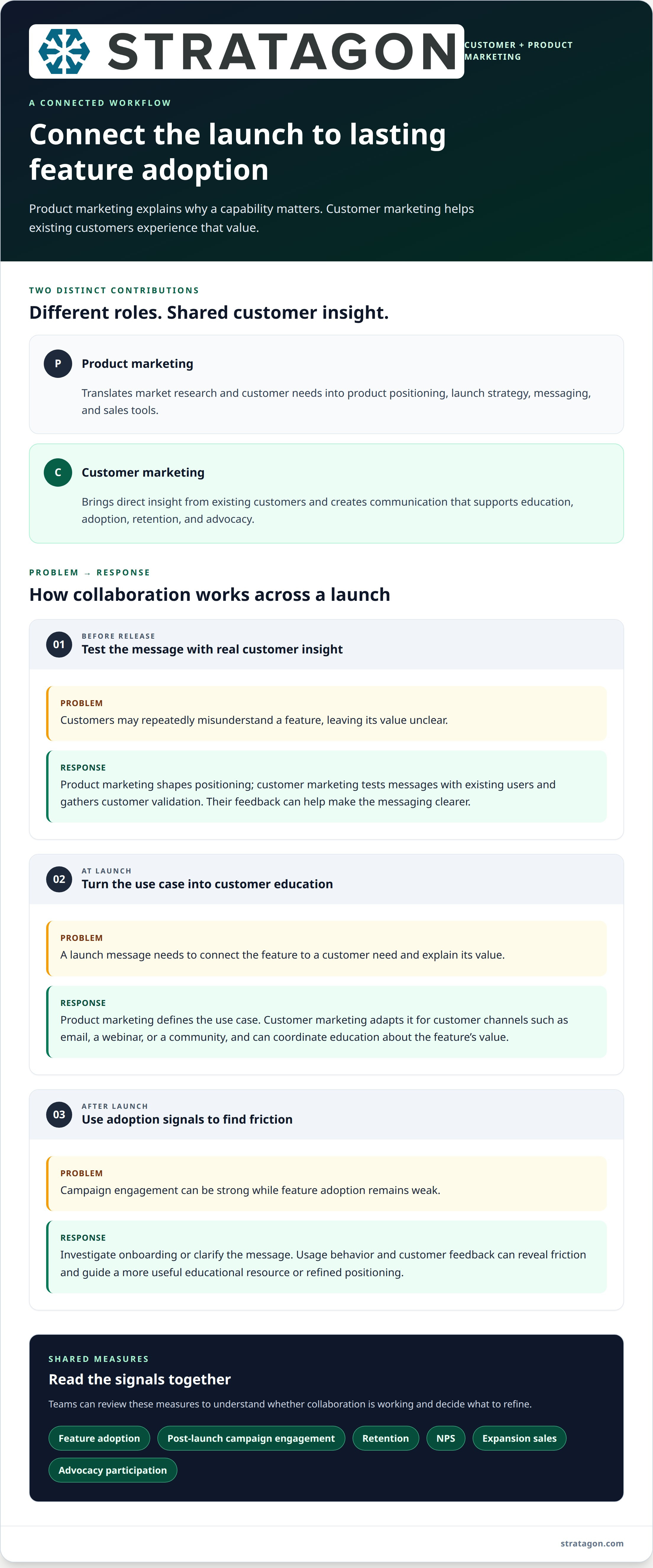
Understanding customer marketing vs product marketing starts with how each team contributes distinct insight. Product marketing translates market research and customer needs into positioning, launch strategy, and sales tools. Customer marketing brings direct insight from people already using the product. If customers repeatedly misunderstand a feature, their feedback can inform clearer messaging and help product teams address friction. Together, the teams connect market priorities with the lived product experience.
The connection matters both before and after a launch. Before release, customer marketing can help product marketing test messages with existing users and gather customer validation. After launch, the teams can coordinate education that explains a feature’s value and supports adoption. A product marketer might define the use case, while customer marketing adapts it for email, a webinar, or a customer community. A shared customer marketing vs product marketing workflow makes this work continuous, rather than limited to launch day.
Cross-functional training helps teams apply shared insights consistently. Product marketing can brief customer marketing on target personas, key use cases, and positioning. Customer marketing can share recurring questions from support conversations, customer events, and feedback channels. A joint session might review a new feature, then practice explaining its value to a new user, an experienced account, and a potential advocate. Sales and customer success can contribute their perspectives, too, so campaign language reflects real customer needs.
Shared measures show whether collaboration is working. Teams can review feature adoption, engagement with post-launch campaigns, retention, NPS, expansion sales, and advocacy participation. If a launch generates strong campaign engagement but weak feature adoption, the teams can investigate onboarding or clarify the message. These signals guide the next step, from refining positioning to creating a more useful educational resource.
For teams coordinating lifecycle campaigns, marketing automation can support timely communications informed by customer behavior. The goal is alignment: product marketing defines why a capability matters, while customer marketing helps customers experience that value.
Product marketing’s role in awareness, adoption, and differentiation
Product marketing turns a product’s distinctive value into clear positioning, messaging, and campaigns. Before launch, research, win/loss analysis, and competitive intelligence help define the target audience and strongest points of difference. A software company, for example, might position a new analytics feature around faster decision-making and build its launch messaging around that use case. The goal is to explain why the product matters and who benefits.
Awareness alone doesn’t create adoption. Product marketers shape go-to-market plans that help potential buyers understand a product, evaluate its value, and take the next step. As market acceptance grows, distribution can broaden and messaging can respond to stronger competition. Understanding customer marketing vs product marketing helps teams connect initial awareness with trial, sales enablement, and a clear path to core value.
Adoption also depends on how people learn after purchase. Product marketing can work with customer-facing teams to develop onboarding materials, feature guides, and post-launch education campaigns. If a new feature solves a particular workflow problem, a walkthrough can explain the relevant steps and outcome. Usage behavior and customer feedback then show whether the messaging and education address real points of friction.
Everett Rogers’ Innovation Diffusion Model describes adoption across innovators, early adopters, the early majority, the late majority, and laggards. Innovators and early adopters may try a product despite uncertainty, while the early and late majority often look for social proof and lower perceived risk. Laggards tend to adopt once a product is established or alternatives narrow. These segments help product marketers adapt proof, education, and channel choices instead of relying on one campaign for every audience.
Product marketing continues beyond launch by monitoring feature adoption, active users, and go-to-market performance. If awareness rises but activation remains weak, teams can refine onboarding or clarify the first-use experience. If competitors make similar claims, customer feedback and usage patterns can sharpen differentiation. A customer marketing vs product marketing strategy uses these signals to keep positioning connected to real product relationships, not just the initial launch message.
Customer and product marketing examples
Customer campaigns can make recognition personal. Coca-Cola’s “Share a Coke” campaign replaced its logo on packaging with popular names, inviting buyers to find and share bottles that felt personal. The example shows how a familiar product can encourage participation through a customer-centered idea. The message isn’t only about the product; it gives customers a reason to engage and share the experience.
GoPro used another advocacy approach by encouraging customers to share adventure videos captured with its cameras. Customer marketers can build on this idea by inviting customers to contribute stories and developing selected submissions into useful social proof. Customers demonstrate how they use a product, while potential buyers see real-world applications.
Personalized lifecycle campaigns can also respond to customer behavior. A retailer might tailor a category email to show a loyalty customer products available with their points balance, while presenting a reactivation offer to a lapsed customer. The messages differ because the relationships do. Customer marketing uses customer context to make communication more relevant, rather than sending every segment the same promotion.
Product marketing examples focus on the product’s value and market introduction. Apple unveiled the iPhone in 2007, while Tesla launched the Model 3 in 2016. For a product launch, product marketers clarify the intended audience, explain the value proposition, and equip sales teams with messaging that distinguishes the offering. Each campaign should make the product’s purpose clear before asking audiences to act.
The strongest programs connect both approaches. Product marketing frames a new capability and its points of difference; customer marketing can tailor education for users who need help adopting it and encourage satisfied customers to become advocates. A launch campaign might introduce a feature, followed by behavior-based guidance for customers who haven’t tried it. Teams can review feature adoption, campaign engagement, and advocacy participation to decide what to refine. The practical takeaway is to anchor product campaigns in a clear value proposition, then use customer insights to make follow-through relevant.
Stratagon
Stratagon helps organizations connect customer insights, product positioning, and commercial execution. When customer and product marketing operate in separate systems, campaigns can lose alignment between the value promised and the experience delivered. A coordinated strategy can clarify audience priorities, improve information sharing, and connect customer engagement with broader growth objectives.
Depending on the challenge, HubSpot CRM Implementation, Account-Based Marketing (ABM), Sales Enablement, and digital transformation can help align marketing and sales. CRM implementation can organize customer information, while sales enablement helps teams use consistent messaging in customer conversations. The right combination depends on your goals, operating model, and existing processes.
If you’re working to align customer engagement with product positioning and growth, contact Stratagon to discuss your priorities.
Put the Partnership Into Practice
Make shared ownership visible in your operating rhythm. Give product and customer marketing a common view of customer needs, launch priorities, and the signals guiding future decisions. This alignment can help teams recognize when to lead with a new capability and when customer preferences call for a different approach.
Use the distinction between customer marketing and product marketing to clarify responsibilities, not create silos. Define how teams exchange customer feedback, coordinate campaign timing, and apply learning across the customer journey. Revisit those connections as market conditions and customer behavior evolve. A deliberate approach can turn separate efforts into a connected growth system grounded in product value and customer experience.
If you’re ready to align your marketing strategy around those priorities, contact Stratagon to discuss your marketing strategy. A focused conversation can help you identify a practical direction and build momentum for the next stage of growth.
Frequently Asked Questions
What is Product Marketing?
Product marketing connects a product’s capabilities to the needs and decisions of its intended market. It shapes how the product is positioned, introduced, and supported in sales conversations. When launching a reporting tool, for example, a product marketer may define which users benefit most, what problem it solves, and how sales teams can explain its value clearly.
What are the main differences between customer marketing and product marketing?
Customer marketing focuses on the experience and growth of existing customer relationships; product marketing focuses on how a product meets market needs. One starts with customer insights and behavior, while the other often starts with product value, research, and launch objectives. If a feature needs a clearer explanation, product marketing can shape the message, and customer marketing can adapt it for current users.
What are the typical responsibilities of a customer marketer?
A customer marketer plans communication for existing customers and connects it to their needs at different lifecycle stages. Responsibilities may include coordinating customer education, gathering feedback, supporting reference programs, and developing campaigns for relevant expansion opportunities. For example, a customer marketer might work with customer success to identify a recurring setup challenge and create a targeted resource to help users address it.
What are the typical responsibilities of a product marketer?
A product marketer researches the market, defines product positioning, and equips teams to communicate the product’s value. They may analyze win/loss feedback, develop launch plans, segment audiences, and prepare sales materials. If prospects repeatedly misunderstand a product’s use case, for instance, the product marketer can revise the messaging and give sales teams clearer explanations for customer conversations.
How do customer marketing and product marketing work together?
The teams coordinate product messaging with the realities of customer use. Product marketing can share a feature’s intended use case; customer marketing can surface user questions and help shape follow-up education. After a feature update, for example, the teams can compare customer questions with the launch message, then refine guidance or sales materials to address misunderstandings and support consistent communication.
What metrics measure customer marketing success?
Useful measures connect campaign activity to customer behavior and business outcomes. Teams can assess cohort retention, repeat engagement with customer education, participation in reference programs, and expansion activity tied to relevant campaigns. A practical review compares these signals across customer groups or lifecycle stages. That view helps distinguish a campaign that attracts attention from one that strengthens customer relationships over time.