Data Strategy for Revenue Operations: A Practical Guide

What if your revenue teams needed fewer dashboards and better decisions? When marketing, sales, and customer data don’t connect, activity reports can obscure what’s actually driving growth. A data strategy for revenue operations organizes information around the decisions teams need to make and the handoffs that move customers forward, rather than the volume of data collected.
If your teams use different definitions, question the numbers, or struggle to connect activity to business impact, another report won’t solve the problem. Shared standards and clear ownership help people trust the information and act on it consistently.
This guide explains how to build a practical approach: align revenue teams on core definitions, prioritize data work around important decisions, and establish governance and review practices that last. It also shows how CRM implementation and marketing automation can support dependable reporting, smoother handoffs, and measurable outcomes. The goal is a data foundation that helps teams move from describing performance to improving it.
Key Takeaways
- Anchor revenue data to customer lifecycle stages and team handoffs to see where information supports or slows progress.
- Use a data strategy for revenue operations to focus effort on decisions with the greatest business value, not simply on collecting more data.
- Compare use cases such as pipeline visibility, lead routing, campaign influence, and retention analysis by impact, feasibility, data readiness, and ownership.
- Establish clear decision rights for data definitions, access, quality issues, and system changes so governance becomes part of everyday operations.
- Translate priority use cases into coordinated CRM, automation, enablement, and marketing workflows with accountable follow-through.
Why Revenue Operations Needs a Data Strategy, Not Another Dashboard
A dashboard can show that pipeline changed, but it can’t resolve whether marketing and sales mean the same thing by a “qualified lead,” or who should correct a record when they don’t. Revenue operations needs more than a place to view metrics. It needs agreed decisions about which information matters, how teams define it, who is accountable for it, and how people use it.
A data strategy for revenue operations connects those decisions to the customer and revenue lifecycle. It identifies the business questions teams need to answer, the systems that can provide the information, the standards that make data consistent, the owners responsible for maintaining it, and the governance that guides access and change. It also defines how teams use information in processes, workflows, and reporting.
Tools support this work, but they don’t set its priorities. A CRM stores and organizes records; marketing automation can act on defined signals; analytics tools can surface patterns. None can decide which handoff needs attention or what counts as a sales-ready lead. Those decisions belong to the organization and should be made by the people who rely on the data.
What does a data strategy for revenue operations include?
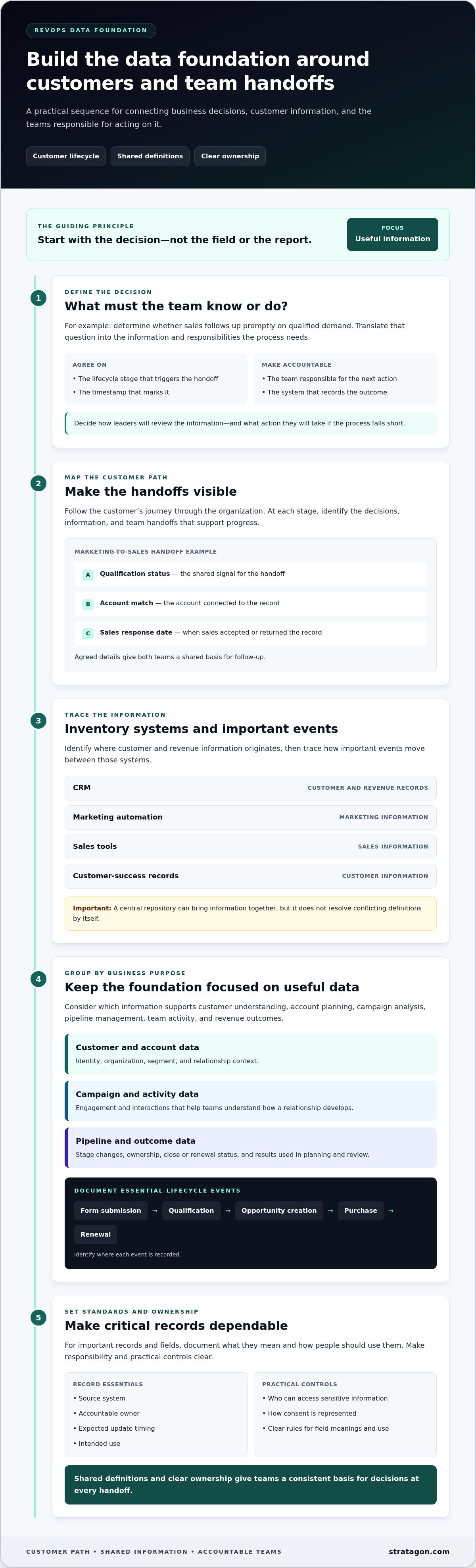
Start with a decision, not a field or report. For example, if the question is whether sales follows up promptly on qualified demand, define the lifecycle stage that triggers the handoff, the timestamp that marks it, the team accountable for the next action, and the system that records the outcome. Then decide how leaders will review the information and what action they’ll take when the process falls short.
This sequence keeps data work connected to operating needs. A useful strategy clarifies:
- Business questions: What must teams know to prioritize, forecast, or support customers?
- Sources and standards: Which systems provide the information, and how will key fields and stages be defined?
- Ownership and governance: Who approves definitions, manages quality issues, and decides how data can be accessed or changed?
- Activation: Where will teams use the information, such as routing, follow-up workflows, performance reviews, or customer planning?
This is different from collecting every available field or building a more elaborate dashboard. The strategy sets the purpose and rules; tools make the agreed approach usable.
What problems does an unclear RevOps data strategy create?
Consider three teams using “customer” differently. Marketing may mean a person who submitted a form, sales may mean an account with an open opportunity, and customer success may mean an organization that has completed onboarding. Each definition can make sense locally. Together, they can blur lifecycle reporting and make ownership at team handoffs uncertain.
The same problem affects lead and opportunity definitions. If marketing counts a lead at one threshold while sales expects another, routing and follow-up reports won’t describe the same process. If opportunity stages or close dates are applied inconsistently, forecasts and performance reviews can become debates about records instead of discussions about decisions.
Dependable data, shared definitions, and clear ownership give revenue teams a consistent basis for decisions at every handoff. Aligning those elements turns reporting from competing interpretations into a practical guide for coordinated action.
Build the RevOps Data Foundation Around Customers and Team Handoffs
A useful data foundation follows the customer’s path through your organization. Start with the decisions teams need to make at each stage, then map the handoffs and information that support them. For example, a marketing-to-sales handoff may depend on a qualification status, an account match, and the date sales accepted or returned the record. Agreeing on those details makes the process visible and gives both teams a shared basis for follow-up.
Next, inventory the systems where customer and revenue information originates. Include CRM, marketing automation, sales tools, and customer-success records, then trace how important events move between them. While platforms like Syntes AI help unify complex data into a structured format across systems, a central repository cannot resolve conflicting definitions by itself. The foundation also needs clear rules about what each field means and how people should use it.
Which data belongs in a revenue operations foundation?
Group information by its business purpose rather than treating every field as equally important. Consider which records support customer understanding, account planning, campaign analysis, pipeline management, team activity, and revenue outcomes. Then identify essential lifecycle events, such as a form submission, qualification, opportunity creation, purchase, or renewal, and document where each event is recorded.
- Customer and account data: identity, organization, segment, and relationship context.
- Campaign and activity data: engagement and interactions that help teams understand how a relationship develops.
- Pipeline and outcome data: stage changes, ownership, close or renewal status, and results used in planning and review.
For critical records, document the source system, accountable owner, expected update timing, and intended use. Include practical controls: who can access sensitive information, how consent is represented, how long records should be retained under company policy, and how teams flag incomplete or conflicting data. These details help make the foundation usable as well as organized.
How should teams define revenue data consistently?
Bring the teams that create and rely on the data into the same working session. Agree on lifecycle stages and qualification criteria, then document each field’s meaning, permitted values, owner, and update expectations. For instance, define what qualifies as an accepted handoff and specify which team changes the status, when it should happen, and what follows if the record is returned.
Shared definitions make cross-team reporting comparable, so teams can act on the same view of the customer journey. When functions disagree, assign a cross-functional decision owner to resolve the definition, record the rationale, and communicate the change. This prevents local workarounds from becoming competing versions of the process.
Once teams agree on the foundation, technology can support those standards through CRM fields, automation, and reporting. Stratagon provides CRM implementation and marketing automation to put shared revenue processes into practice.
Prioritize RevOps Data Use Cases by Decision Value
A revenue data initiative deserves priority when it helps a team make a consequential decision, not simply because the information is available. A data strategy for revenue operations should compare use cases against the company’s current goals, operating model, data readiness, and capacity to act on findings. A team focused on improving pipeline coverage may prioritize visibility into opportunity progression; a business emphasizing customer growth may put retention signals first.
Begin by naming the decision each use case will support. Marketing may need to understand which investments contribute to qualified pipeline progression, using agreed attribution rules rather than treating every touch as equal. Sales may need account context, opportunity status, and documented forecast assumptions. Customer teams may need adoption, renewal, or expansion signals to identify where to focus support. Define both early indicators and final outcomes: engagement or stage movement can signal what may happen, while closed revenue, renewal, or expansion records show what did happen. Neither replaces the other.
How can teams compare data use cases fairly?
Use a shared scorecard and state the assumptions behind each rating. The examples below are illustrative, not universal rankings. Ratings will vary with business priorities, available information, workflow complexity, and whether a team can act on the result.
| Use case | Decision supported | Impact | Feasibility | Data readiness | Accountable owner |
|---|---|---|---|---|---|
| Pipeline visibility | Where should leaders focus deal support? | High | Medium | Medium | Sales operations |
| Lead routing | Which team should follow up, and when? | High | High | Medium | Marketing and sales operations |
| Campaign influence | How does marketing activity relate to pipeline progression? | Medium | Medium | Low | Marketing operations |
| Retention analysis | Which customers may need attention or expansion support? | High | Medium | Low | Customer success operations |
Assess impact by the importance of the decision, feasibility by the effort to deliver and use the insight, and data readiness by whether required fields are accessible, complete, and consistently defined. Confirm an accountable owner who can interpret results and coordinate action. A high-impact idea without an owner or usable data may be a longer-term investment rather than the first pilot.
Choose a focused use case that tests the definitions, data flow, and follow-through together. For example, a lead-routing pilot can reveal whether qualification criteria, assignment rules, and response tracking work as intended. Record limitations and assumptions, then review whether the information changed a decision. This gives the team a basis for choosing the next investment without assuming a predetermined return.
Operationalize the Strategy With Governance, Ownership, and Review
A revenue data strategy becomes operational when people know what to do, who can decide, and how the organization will respond when information is unreliable. Treat governance as a working practice, not a document separate from daily processes. A clear sequence helps teams build standards around business needs, test them in real workflows, and refine them as the business changes.
Use this roadmap to move from intent to sustained practice:
- Align on outcomes: Identify the business decisions and customer journeys the strategy must support, and agree how teams will recognize progress.
- Audit data and processes: Trace key information through systems and handoffs. Note gaps, conflicting definitions, access concerns, and manual workarounds.
- Set standards and decision rights: Document definitions, quality expectations, access rules, and who approves changes.
- Pilot a priority use case: Apply the standards in a contained workflow, train affected users, and capture issues as they arise.
- Review and refine: Assess data quality, adoption, and business outcomes, then update the roadmap based on what the pilot reveals.
Who should own revenue operations data?
Accountability is shared, but decision rights should be specific. RevOps can coordinate the operating model; marketing, sales, customer teams, finance, and technology contribute the definitions and controls their work depends on. Name a steward for critical data definitions and a sponsor who connects priorities to business goals. Set an escalation path: teams raise a conflict with the steward, and unresolved trade-offs go to the designated cross-functional decision owner.
Make ownership visible in a simple responsibility record. For each critical definition or data process, capture who proposes changes, who approves them, who maintains the system, and who needs to be informed. For example, marketing and sales may jointly shape a qualification definition, while a named decision owner resolves disagreement and technology implements the approved change. This prevents important decisions from being left to informal consensus or individual workarounds.
How can teams sustain governance and adoption?
Build standards into the places where work happens. CRM fields can guide consistent entry, automation can support agreed processes, and training can explain why a definition matters to the next team in the handoff. Keep the guidance practical: show users what to enter, when to update it, and how the information will support their decisions.
Use recurring cross-functional reviews to examine data quality and adoption alongside business outcomes. Discuss specific exceptions, identify the cause, and leave with a named action owner and a follow-up point. If records repeatedly miss a required value, determine whether the workflow, field design, training, or definition needs attention. Revisit the roadmap when priorities, processes, or customer journeys shift; governance should keep pace with the work it supports.
Stratagon connects governance to CRM implementation, marketing automation, and team adoption through strategic planning and practical execution. Explore strategic marketing and technology services to learn how these capabilities support coordinated revenue operations.
Turn the RevOps Data Strategy Into Coordinated Growth Execution
A strategy creates value when its priorities change how teams work. Translate each selected use case into an operating sequence: define the decision, specify the data and workflow needed, assign the people responsible, and determine how results will be reviewed. That connects planning to execution without treating a new report or system configuration as the outcome.
For example, a team prioritizing faster, more consistent lead follow-up might first agree on the qualification signal and what counts as a completed handoff. CRM implementation can make the agreed stages and ownership visible. Marketing automation can route records or prompt next steps, while sales enablement helps representatives understand the context and expected action. Reporting then shows whether the process is being followed and where it needs adjustment.
How do strategy, CRM, and execution work together?
The CRM is the operational environment for the definitions, records, and processes teams have agreed to use. It isn’t the strategy itself. Implementation should reflect business priorities in fields, permissions, workflows, and reporting, while automation supports repeatable actions across marketing, sales, and customer teams. Clear ownership matters too: a workflow needs an accountable person who can respond when records are incomplete or a handoff stalls.
Coordinate technology with the people and processes around it. Marketing execution creates and tracks engagement; sales enablement equips teams to act on useful account and opportunity context; customer-facing teams contribute information that can inform retention or expansion decisions. Stratagon brings these disciplines together through digital transformation and marketing services focused on prioritized workflows and outcomes.
What should leaders do next?
Choose one business decision that needs more dependable information. Keep the starting point specific, such as deciding which opportunities need leadership attention or identifying which customer accounts require a review. Then bring the teams involved in that decision into a working session. Align on the intended outcome, the definitions and data required, the system or process changes needed, and who will own follow-through.
Before implementation, document the assumptions the pilot will test. Agree on what evidence will indicate that the workflow is usable, what quality issues could affect interpretation, and when the team will review its findings. This creates a practical learning cycle: build around a real decision, observe how people use the process, and refine it based on what happens. Avoid expanding the effort until teams understand what the first use case reveals.
A data strategy for revenue operations works best when strategy, technology, and execution stay connected as priorities evolve. Stratagon’s digital transformation and marketing services can help align revenue data with the decisions your teams need to make.
Make Your Next Revenue Decision the Starting Point
The strongest data strategy for revenue operations doesn’t begin with a platform project. It begins with a decision your leadership team wants to make with greater confidence, then brings the right people together to define what information that decision requires and how teams will act on it.
Choose one priority and use it to create momentum. Align marketing, sales, and technology around a practical first step, then build from what the team learns. Stratagon connects strategic marketing, sales, and technology capabilities to help organizations turn that direction into coordinated execution.
Ready to shape an approach around your revenue goals? Discuss a data strategy built around your revenue goals with Stratagon.
Frequently Asked Questions
What is a data strategy for revenue operations?
A data strategy for revenue operations gives teams a coordinated way to turn revenue information into decisions and action. It clarifies what information is useful, how teams interpret it, and how they apply it across the customer journey. For example, leaders assessing a new market segment might agree on the account attributes and opportunity outcomes needed before comparing performance. The strategy connects that analysis to a defined business question rather than collecting data without a purpose.
How is a RevOps data strategy different from a CRM strategy?
A CRM strategy focuses on how the customer relationship management system supports users, records, and processes. A RevOps data strategy addresses a wider set of decisions and information across teams and systems. For example, marketing may use automation data while sales relies on CRM opportunity records. The broader strategy establishes how those sources relate to a shared revenue question; the CRM strategy determines how the CRM supports the agreed process.
Who should own data governance in revenue operations?
Governance needs an executive sponsor and named owners who understand how different teams create and use revenue data. RevOps can coordinate the shared operating approach, while marketing, sales, finance, and technology bring expertise about their work. Assign a specific steward to maintain important definitions and a decision owner to resolve conflicts. If teams disagree about a measure, document the decision and its rationale so future reviews use the same interpretation.
How can a small B2B team create a data strategy without a data department?
A small team can start with one decision that affects its work, such as choosing which accounts to prioritize for sales follow-up. Identify the minimum information needed, agree on where it comes from, and assign responsibility among existing team leads. Test the approach in a manageable workflow, then check whether users can find and apply the information. Expand only when the initial process is workable and the next decision is clear.
How does a data strategy improve revenue forecasting?
A data strategy can improve forecasting inputs by making stage movement, close-date changes, and forecast categories easier to interpret consistently. For example, leaders can review whether a change in expected close date reflects a documented customer event or an internal estimate. The strategy doesn’t guarantee an accurate forecast; market shifts and judgment still matter. It helps teams distinguish evidence from assumptions and investigate gaps before relying on a forecast for planning.
What role should AI play in a revenue operations data strategy?
AI can assist with analysis or workflow automation when the intended use, data quality, and human oversight are clear. Start by defining the decision or task it should support, then consider whether the data is appropriate and who reviews the output. For example, AI-generated account summaries may help prepare a sales conversation, but a team should check key details before acting on them. Keep accountability with people, not the tool.