How to Calculate a Customer Health Score: A Practical Guide

A customer health score can be easy to calculate yet still point your team toward the wrong accounts. Learning how to calculate customer health score starts with a practical question: which signals show whether customers are making progress, and what should your team do when those signals change? One number can help prioritize attention, but it can also hide important differences between accounts if its inputs and weights aren’t clear.
A useful score reflects your business model, combines reliable customer signals, and supports human judgment rather than replacing it. This guide explains how to choose relevant inputs, put them on a shared scale, assign weights transparently, and interpret results without treating every account the same. You’ll also learn how shared definitions and CRM data can help customer-facing teams coordinate their response, then refine the model as customer outcomes provide new evidence.
Key Takeaways
- Start with the decision your score should support, such as prioritizing accounts or assessing renewal readiness.
- Choose signals tied to customer outcomes, and document each signal’s source so teams can distinguish evidence from interpretation.
- Learn how to calculate customer health score with a transparent process for defining inputs, setting rubrics, assigning weights, and combining results.
- Set thresholds using your organization’s data and define an owner and response for each meaningful score change.
- Use shared CRM definitions and workflows to help customer-facing teams interpret account signals consistently and coordinate next steps.
What Is a Customer Health Score, and What Decision Should It Support?
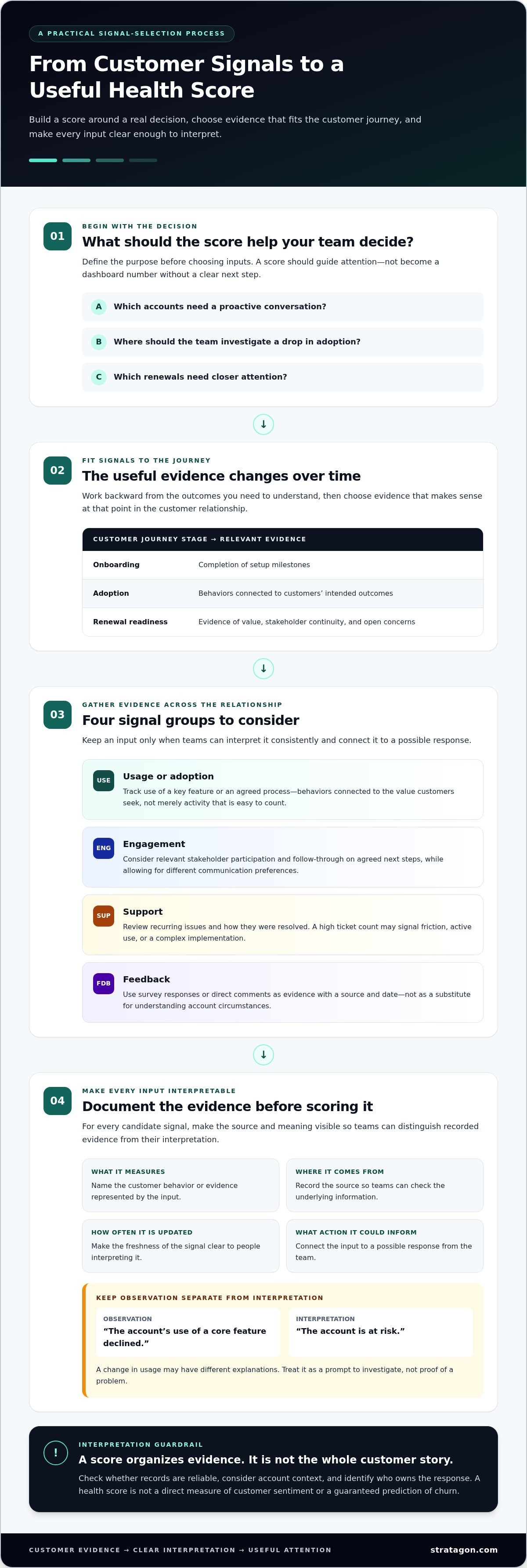
What should your team decide after reviewing a customer health score? It might decide which accounts need a proactive conversation, where to investigate a drop in adoption, or which renewals need closer attention. Define that decision first. Without a clear purpose, a score can become a dashboard metric that looks precise but doesn’t guide anyone’s next step.
A customer health score is a structured summary of selected signals about an account’s relationship with your organization and progress toward desired outcomes. It can organize evidence for a decision, but it can’t tell you everything about the customer or guarantee what will happen next.
A customer health score is a decision aid that summarizes account signals to guide attention; it is not a direct measure of customer sentiment or a guaranteed prediction of churn.
What Does a Customer Health Score Actually Measure?
The score combines selected signals into an account-level assessment. Depending on your business model and the decision at hand, those signals might include product adoption, support history, customer feedback, or renewal information. The purpose isn’t to create a number for its own sake. Each input should connect to an outcome your organization wants to understand, such as whether customers are adopting a service or appear prepared for renewal.
Keep the underlying observation separate from its interpretation. “The account’s use of a core feature declined” describes observed behavior. “The account is at risk” is an interpretation that may warrant investigation. A change in usage could reflect a problem, a seasonal pattern, a change in responsibilities, or successful completion of a task. Recording the source and meaning of each input helps teams see what the score is based on and where judgment enters the process.
Why Use a Health Score Instead of Relying on Anecdotes?
Customer-facing teams often hold different pieces of an account’s story. Sales may know about a renewal conversation, support may see recurring issues, and an account manager may hear positive feedback directly. A shared framework brings those signals into a consistent view, helping teams compare priorities and spot accounts that deserve follow-up. It makes patterns easier to see across a portfolio without assuming every account has the same needs.
That shared view should support conversations, not replace them. A low score can prompt the team to ask what changed; it shouldn’t dictate how to approach the customer. Likewise, a healthy score doesn’t prove the relationship is strong if the data is incomplete or outdated. Before acting, consider the signal’s context, check whether the underlying records are reliable, and identify who owns the response.
This distinction matters when deciding how to calculate customer health score. The calculation can summarize evidence consistently, while people validate what that evidence means for a specific account. Treating the result as a prompt for inquiry, rather than a verdict, makes it more useful to internal teams and customers.
Which Customer Signals Belong in Your Health Score?
Choose inputs by working backward from the outcomes your organization needs to understand. Are customers adopting what they bought? Is the relationship resilient across key stakeholders? Does the account appear ready for renewal? Each question calls for different evidence, so a useful score reflects the decision rather than collecting every available data point.
A useful input connects observable customer evidence to a defined business decision. For each candidate signal, record what it measures, where the data comes from, how often it’s updated, and what action it could inform. “No meeting logged” is an observation; “the relationship is weak” is an interpretation. Make that distinction explicit so a missing CRM entry doesn’t quietly become a negative score.
Combine Usage, Engagement, Support, and Sentiment Carefully
Consider evidence across the customer relationship, not only product activity. Adoption data may show whether customers use a key feature or follow an agreed process. Meeting participation, stakeholder involvement, and follow-through can add relationship context. Support patterns and customer feedback can surface friction or satisfaction, but neither should be treated as automatic proof of account health.
- Usage or adoption: Track behaviors connected to the value customers seek, rather than activity that’s easy to count but hard to interpret.
- Engagement: Note whether relevant stakeholders attend conversations and complete agreed next steps, while accounting for different communication preferences.
- Support: Review recurring issues and their resolution. A high ticket count could signal friction, but it may also reflect active use or a complex implementation.
- Feedback: Use survey responses or direct comments as evidence with a source and date, not as a substitute for understanding the account’s circumstances.
Keep a signal only if teams can interpret it consistently and connect it to a possible response. If people disagree about what a metric means, define the rubric before giving it influence in the score.
Choose Signals That Fit Your Customer Journey
The meaning of customer evidence changes over time. During onboarding, completion of setup milestones may matter more than long-term usage. During adoption, look for behaviors tied to customers’ intended outcomes. Later, renewal readiness may depend on evidence of value, stakeholder continuity, and open concerns. Map each potential input to the stage where it can inform a useful decision.
Segment thoughtfully. A high-touch account may have regular meetings to assess, while a self-directed customer may show progress through product or service activity. Don’t penalize an account for lacking a signal its engagement model doesn’t generate. Mark unavailable or inconsistent data as unknown rather than treating its absence as evidence of risk.
This selection discipline makes how to calculate customer health score a question of relevance and governance, not just arithmetic. A CRM can help organize signal sources and ownership. CRM implementation and digital transformation can also support a more usable foundation for shared customer data.
How to Calculate a Customer Health Score with a Transparent Model
A transparent model makes its logic visible: the outcome it is designed to inform, the evidence it uses, and how that evidence affects the result. Use this sequence to build a calculation your teams can explain and review.
- Define the outcome. Decide whether the score should help assess adoption, renewal readiness, or another specific customer outcome. Keep the intended decision in view as you design the calculation.
- Select relevant inputs. Choose evidence that relates to the outcome and that teams can interpret consistently. Record each input’s source and what it represents.
- Set scoring rubrics. Convert each input to a common scale. Define what low, middle, and high evidence look like so different teams apply the same criteria.
- Assign weights. Give greater influence to signals that matter more to the chosen outcome. Document why each weight was selected and which assumptions need review.
- Aggregate and explain. Combine the weighted inputs into an account-level result, while keeping the component scores visible so the total doesn’t obscure what’s driving it.
Conceptually, a weighted score can be written as total score = the sum of each input score multiplied by its weight, divided by the sum of the included weights. An input score represents the evidence for one signal on the shared scale; its weight represents that signal’s relative influence. Weights are documented business judgments, not proof that a signal causes an outcome. A high weight means, “we believe this evidence deserves more influence,” not “this factor guarantees renewal or churn.”
Normalize Inputs Before Combining Them
Inputs often arrive in different forms: a count of support issues, a usage trend, or a qualitative engagement assessment. Set a rubric that translates each into comparable levels. For example, define what low, middle, and high evidence mean for a particular signal using its source data and customer context. Specify how stale, conflicting, or unavailable information is handled. Don’t silently assign a poor score to missing evidence.
Set Weights and Segments Without Hiding Assumptions
Weight a signal more heavily when it has a stronger connection to the outcome you’re assessing, and record your reasoning. If onboarding expectations differ from renewal-stage expectations, or customer segments follow materially different engagement models, separate scoring rules may be more informative than forcing one model across all accounts. Document those distinctions so teams know which model applies.
A scorecard can show both the aggregate and its components. Color bands may help teams scan accounts, but define their meaning using your data and decision needs, not a universal cutoff. If an input is missing, you might calculate from available weighted inputs only when coverage is adequate, while clearly flagging reduced confidence. Otherwise, show the score as incomplete. This prevents a polished total from implying more certainty than the evidence supports.
That clarity is central to how to calculate customer health score: make the assumptions inspectable, preserve the evidence behind the total, and revise the model when validation shows that a signal or weight no longer supports the intended decision.
How to Validate Scores, Set Thresholds, and Trigger Useful Action
A score becomes operational when the team knows who reviews it, what changes deserve attention, and how to respond. That process is separate from proving the score predicts an outcome. An alert can help a team act promptly, but it doesn’t establish that the model accurately identifies renewal risk or customer progress.
A score should guide investigation, not automatically label a customer. Treat a low or declining result as a reason to examine the underlying evidence and account context, not as a conclusion about customer intent.
Set thresholds using your own customer data and decision needs. Review how scores relate to observed progress and outcomes, such as adoption milestones or renewal results. Look for useful patterns, while remembering that correlation doesn’t prove causation. A score may change alongside an outcome without causing it, and an apparent relationship may reflect another factor, such as customer stage or data coverage.
Turn Score Changes into Proportionate Team Responses
Assign an owner to review meaningful changes and coordinate follow-up across customer-facing teams. Match the response to the evidence: a drop in adoption may call for a check-in about the customer’s goals, while a cluster of unresolved support issues may require coordination with the team handling those requests. Alerts should prompt investigation and conversation, not assumptions or impersonal outreach.
Define what happens after review. The owner might verify the data, check for recent account context, then decide whether a customer conversation or internal action is appropriate. This keeps automation focused on surfacing signals while people remain accountable for the response.
Review Model Quality and Recalibrate
Revisit the model with the people who use it. Ask whether score categories distinguish accounts that need different kinds of attention, whether the inputs remain reliable, and whether thresholds lead to useful decisions. Compare score patterns with customer progress and outcomes over time, noting exceptions and segments where the relationship is less clear.
- Check the data: Identify missing, stale, or inconsistently recorded inputs that could distort the result.
- Assess the categories: See whether accounts grouped together actually need similar responses.
- Review the assumptions: Confirm that weights, thresholds, and segment rules still fit the customer journey.
- Revise with a reason: Adjust or retire signals that no longer inform decisions, and document what changed.
Use what you learn to refine the model, then observe whether the revised score supports clearer prioritization. As you determine how to calculate customer health score for your organization, treat validation as an ongoing management practice, not a one-time approval. Stratagon’s CRM implementation and digital transformation services can help align customer data and workflows around clear ownership and action.
How CRM and Cross-Functional Alignment Make Health Scores Useful
A customer health score depends on more than a calculation. Teams need shared definitions, dependable records, and a clear process for deciding what a score change means. A CRM can bring relevant account information into a usable view, but technology won’t resolve disagreement about what counts as a risk signal or who should respond. Governance comes first; the system supports it.
Align Marketing, Sales, and Customer-Facing Teams
Agree on what each signal means and who maintains its source. For example, teams should share a definition of an active stakeholder, know which role records meeting outcomes, and understand who reviews a shift in renewal readiness. Marketing, sales, service, and account teams may contribute different evidence, but they need consistent terms to interpret it together.
Make responsibilities explicit. Identify who contributes data, who reviews score changes, who coordinates escalation, and who owns customer communication. This prevents an account from being overlooked because each team assumes another will act. It also helps avoid several teams contacting a customer independently with disconnected messages.
Use the score to inform dialogue, not script it. A change can help a team prepare relevant questions, while the customer’s goals and circumstances shape the conversation. The score is an internal signal, not a substitute for listening or a label to present as fact.
Build the Workflow Around the Model, Not the Other Way Around
Once people agree on definitions and ownership, map the selected inputs to CRM fields and workflows. Use records that teams can maintain consistently, and make the source and update context visible. If an input is unreliable or unavailable for a customer segment, don’t force it into an automated calculation simply because the system can store it.
Keep the model explainable in the CRM. A team member should be able to see which signals contributed to an account’s result, what information is missing, and what action is expected. A workflow might route a meaningful change to an accountable owner for review; it shouldn’t turn a score into an automatic judgment about customer intent. This creates a practical bridge between data, process, and human response.
That foundation matters to how to calculate customer health score in a way that teams can use. Stratagon’s CRM implementation and digital transformation services connect technology decisions with the processes and ownership that make customer data actionable. Its CRM implementation work includes HubSpot CRM optimization for Force Management, an example of CRM work rather than a claim about customer-health scoring outcomes.
If your teams are aligning customer data, definitions, and workflows, explore Stratagon’s services for CRM implementation and digital transformation support.
Make Your Customer Data Work Harder
Your next step is to make the health score part of a broader operating rhythm: review what the evidence says, decide who acts, and learn from what happens next. That discipline keeps how to calculate customer health score focused on better decisions rather than a number that simply fills a dashboard.
Stratagon brings marketing, sales, and technology together through services that include HubSpot Partner Solutions and Salesforce Design & Development. Its experience includes Force Management’s HubSpot CRM optimization. These examples reflect technology and implementation work, not promised results from health scoring.
Aligning customer data, systems, and team workflows can help turn a carefully designed model into a practical part of your customer strategy. Explore Stratagon’s CRM and technology solutions to take the next step toward clearer, more coordinated decisions. A useful score doesn’t need to be perfect on day one; it needs to help your team learn and improve.
Frequently Asked Questions
Is a customer health score the same as an NPS score?
No. Net Promoter Score (NPS) captures how likely a respondent says they are to recommend a company, usually through a survey question. A health score can combine that feedback with other account evidence over time. For example, a customer might give a positive NPS response while product adoption is slowing. The two signals offer different perspectives, so use NPS as one input rather than treating it as a complete account assessment.
How do you calculate a customer health score for a new customer?
For a new customer, use evidence available from the start of the relationship, such as onboarding participation, completion of agreed setup milestones, or early stakeholder engagement. Don’t treat the absence of a renewal history or long-term usage pattern as a negative signal. Mark those inputs as unavailable until there’s enough relevant evidence, and interpret the initial score cautiously as the account develops.
Can you calculate a customer health score without product usage data?
Yes. Product usage isn’t essential if it doesn’t fit your business model or isn’t accessible. To determine how to calculate customer health score without it, consider evidence such as progress against service milestones, support themes, stakeholder continuity, customer feedback, or renewal discussions. Select measures that reflect how customers receive value in your context. Avoid using meeting volume as a stand-in for progress unless it genuinely signals something meaningful.
Can a customer health score predict churn with certainty?
No. A score can help identify accounts for closer review, but it can’t establish with certainty that a customer will leave. Customers may renew despite warning signs, or disengage for reasons the available data doesn’t capture. Treat the score as a risk indicator, not a promise about what will happen. For planning, describe accounts as needing attention rather than communicating a definitive churn outcome.
Should every contact at an account have the same customer health score?
Not necessarily. An account-level score summarizes the broader relationship, while individual contacts can have different roles, concerns, and levels of engagement. A champion may be active as another stakeholder becomes less involved. Keep account health distinct from contact-level engagement so one person’s behavior doesn’t stand in for the entire organization. This distinction can help teams identify gaps in stakeholder coverage without misrepresenting the account’s overall status.
What should you do when customer health data is incomplete or conflicting?
First, identify which input is missing or inconsistent and check its source, owner, and last update. If support records suggest friction but a recent customer conversation indicates progress, retain both pieces of evidence and investigate the difference rather than averaging them into a misleading result. Flag the score as lower confidence when key inputs are unavailable, and avoid escalating solely on the basis of uncertain data.