How to Ensure Marketing Data Integrity: A Practical Framework for 2026

What if the biggest obstacle to better marketing decisions isn’t a lack of data, but a lack of confidence in the numbers? When campaign reports and CRM records disagree, teams can’t clearly see which channels are working or where to focus investment. Learning how to ensure marketing data integrity starts with recognizing that reliable reporting depends on more than dashboards. It requires shared definitions, dependable tracking, and clear ownership.
Marketing, sales, and operations teams need a common view of customers and the metrics that guide growth. Yet inconsistent formats, missing fields, duplicate records, and gaps between systems can undermine that view before a report reaches decision-makers. A practical framework helps teams catch these issues early and resolve them before they affect campaign or revenue decisions.
This guide explains how to define key marketing data, capture it consistently, validate it across systems, and govern it over time. You’ll learn how to establish accountability and build repeatable checks that support trustworthy reporting. With the right alignment between processes, technology, and people, your data can become a more dependable foundation for action.
Key Takeaways
- Reliable marketing data must be accurate, complete, consistent, valid, and fit for its intended use, not simply present in a report.
- Trace the path from campaign interactions through analytics and CRM to reporting to pinpoint where tracking gaps, inconsistent UTMs, or duplicate records erode trust.
- Match each data problem to the right control, whether that means clearer governance, stronger tracking, improved CRM configuration, or ongoing monitoring.
- To learn how to ensure marketing data integrity, start with critical data sources and journeys, set shared standards, assign owners, then audit and monitor.
- Make data integrity a recurring cross-functional practice, with documentation and reviews shaped by the risk and change frequency of each data flow.
What Does Marketing Data Integrity Mean, and Why Does It Matter?
Marketing teams rely on data that moves across ads, websites, analytics, CRM systems, and reports. A record can look polished in a dashboard yet misrepresent what happened if a campaign value was captured incorrectly or a lifecycle stage means something different to sales and marketing. Data integrity is a foundational concept for any system that stores and processes information. In marketing, it must hold across the full path from collection to decision.
Marketing data integrity is the degree to which data remains accurate, complete, consistent, valid, timely, and unique enough to serve its intended use. This definition doesn’t imply perfect data. It sets a practical standard: teams can understand the limits of their records and judge whether those records are fit to guide a particular decision.
Which dimensions make marketing data trustworthy?
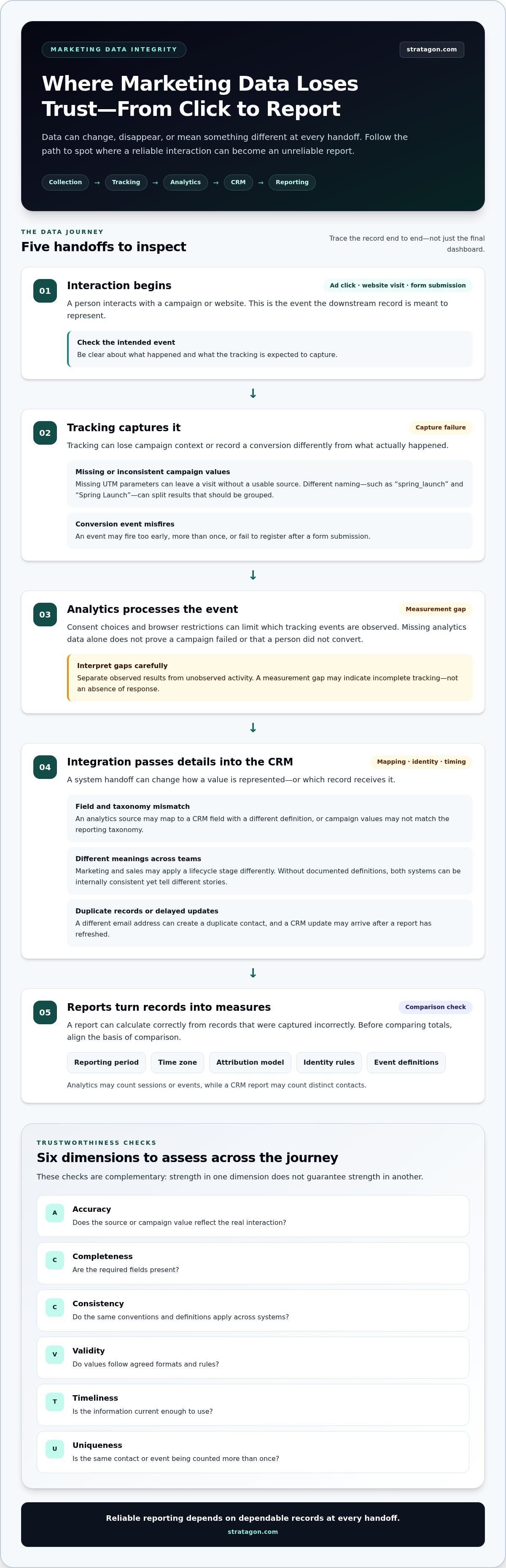
Each dimension helps catch a different failure. Accuracy asks whether a source or campaign value reflects the real interaction. Completeness checks whether required fields are present. Consistency means the same conventions and definitions apply across systems. Validity confirms values follow agreed formats and rules. Timeliness concerns whether information is current enough to use. Uniqueness helps prevent the same contact or event from being counted more than once.
These dimensions overlap, but they aren’t interchangeable. A contact record may contain every required field and still be inaccurate if a form or integration assigns the wrong campaign source. Completeness alone can’t establish trustworthy attribution.
Data integrity also differs from related concepts. Data quality is the broader assessment and improvement of data’s fitness for use, while integrity focuses on maintaining dependable records through their lifecycle. Data privacy concerns how personal information is collected and handled. Reporting accuracy describes whether a report represents its underlying data and calculations correctly. A report can calculate perfectly from records that were captured incorrectly.
Where does marketing data integrity affect business decisions?
Dependable campaign records help teams compare channels on a consistent basis and allocate resources with a clearer view of performance. If source values vary or key interactions go unrecorded, channel analysis may reflect tracking conventions rather than customer behavior. Integrity improves the evidence behind a decision, but it can’t guarantee campaign performance or replace strategic judgment.
Shared definitions matter just as much. When marketing and sales agree on lifecycle stages and apply them consistently in the CRM, they can interpret handoffs and progression using the same meaning. That alignment supports more useful planning and reporting. Understanding how to ensure marketing data integrity therefore starts with the records themselves and the shared rules that make them actionable across teams.
How Marketing Data Breaks Across Collection, CRM, and Reporting
A campaign record travels through several handoffs: someone clicks an ad or visits a website, tracking captures the interaction, analytics processes the event, an integration passes selected details into the CRM, and reports turn those records into performance measures. At each handoff, information can change, disappear, or be interpreted differently. A reliable source can become unreliable downstream when systems transform, synchronize, or interpret records using inconsistent rules.
Which collection and tracking failures create unreliable records?
At collection, missing UTM parameters can leave a visit without a usable campaign source. Inconsistent naming, such as “spring_launch” in one system and “Spring Launch” in another, can split results that should be grouped together. A conversion event may also be configured to fire too early, fire more than once, or fail to register after a form submission. These are capture problems: the interaction wasn’t recorded as intended.
Consent choices and browser restrictions can also limit which tracking events are observed. A gap in analytics therefore doesn’t, by itself, prove that a campaign failed or that a person didn’t convert. It may indicate incomplete measurement. Distinguish observed results from unobserved activity, and don’t treat missing tracking data as proof of no response.
How do CRM and analytics systems introduce inconsistency?
Some problems emerge after collection. An integration might map an analytics source into a CRM field with a different definition, or convert a campaign value into a format that doesn’t match the reporting taxonomy. Marketing may classify a contact as a qualified lead while sales uses that lifecycle stage only after a specific handoff. Without documented meanings, both systems can be internally consistent and still tell different stories.
Identity and synchronization add further complexity. A person may submit a form with a different email address and create a duplicate contact, or an update may reach the CRM after a report has refreshed. Before comparing totals, align the period, time zone, attribution model, identity rules, and event definitions. Analytics may count sessions or events, while a CRM report may count distinct contacts or lifecycle changes. Those figures won’t necessarily match, and the difference isn’t automatically an error.
To locate the break, trace one campaign record from its original interaction through analytics, CRM fields, and the final report. Note what each system captures, transforms, and counts. This cross-system view is central to how to ensure marketing data integrity, because it identifies whether a discrepancy starts in tracking, mapping, synchronization, identity resolution, or interpretation. Teams aligning CRM design and marketing operations can explore marketing and CRM services as part of that work.
Marketing Data Integrity Controls vs. Tools: What Solves Which Problem?
A new platform can help identify or prevent certain data issues, but it can’t decide what “qualified” means, assign responsibility for campaign fields, or resolve conflicting team practices on its own. Before adding technology, identify the failure you need to fix. The right response may be a shared definition, a process change, a configuration update, or a monitoring capability already available in your systems.
When are governance and process changes the right first move?
Start with governance when teams classify sources, conversions, or lifecycle stages differently. Agree on definitions and document how to apply them across campaigns, CRM records, and reports. Name an owner for shared fields, and require review before changing campaign taxonomies so a local adjustment doesn’t create downstream confusion. Establish a routine for logging recurring issues, assigning resolutions, and escalating problems that affect business-critical reporting.
These controls address ambiguity and inconsistent behavior. They won’t repair a broken event or synchronize a field between systems, but they give technical changes a stable standard to follow.
When can tracking, CRM, or integration changes help?
Choose a technical fix when you’ve identified a specific failure in collection or system behavior. Match the control to the issue, and account for its limits:
- Tracking controls: Address missing tags, inconsistent campaign parameters, or misconfigured events. They can improve what gets recorded, but they don’t define CRM stages or reporting rules.
- CRM configuration: Supports consistent field mapping, lifecycle management, and duplicate handling. It won’t correct an inaccurate value captured at the source unless the process or integration is also fixed.
- Integrations: Move and transform records between systems. Mapping rules and synchronization schedules can reduce mismatches, but they can also propagate errors if definitions conflict.
- Data-quality monitoring: Flags patterns such as missing values, unexpected formats, or duplicate records. It helps teams detect issues, but people still need to investigate causes and resolve them.
Use this comparison to locate the gap before selecting a tool. For example, if the same lifecycle stage has different meanings across teams, settle the definition first. If the definition is shared but the CRM receives a different value, examine the field mapping and synchronization. That diagnosis is central to how to ensure marketing data integrity without layering new technology over an unresolved process problem.
When an issue crosses CRM configuration, marketing operations, and technology, coordinated marketing and technology services can help align implementation with agreed data standards.
How to Ensure Marketing Data Integrity: A Step-by-Step Operating Plan
A sustainable integrity program doesn’t begin with a full historical cleanup or a new platform. It begins with the customer journeys and fields that influence important decisions, then establishes a repeatable method to find, fix, and prevent errors. Focus effort where unreliable data could most affect campaign evaluation, customer handoffs, or resource allocation.
Inventory, standardize, assign ownership, audit, remediate, and monitor: this repeatable cycle turns data integrity from a cleanup project into an operating practice.
How should teams audit and prioritize marketing data issues?
Start by mapping the data path for a priority journey, such as a paid campaign leading to a website conversion, a CRM record, and a performance report. List the collection points, integrations, key fields, reports, and teams involved. Then trace sample records from the initial interaction to the report used for a decision. This reveals where values are lost, changed, duplicated, or interpreted differently.
Prioritize issues by their effect on decisions, how often they recur, how much data they affect, and the effort required to address them. A broken conversion event used in budget reviews may deserve attention before an outdated field in an inactive campaign. Avoid treating every historical inconsistency as equally urgent.
How can teams validate and maintain data after cleanup?
Use the audit to set standards and assign a named owner to each critical field or flow. Define allowed source and campaign values, required fields, accepted formats, and rules for identifying duplicate records. Document how and when systems should synchronize, including who investigates a failed transfer or unexpected value.
- Inventory: Map critical sources, systems, fields, reports, and accountable teams.
- Standardize: Agree on definitions, naming conventions, required values, and validation rules.
- Assign ownership: Name decision-makers for shared fields and changes to tracking or taxonomy.
- Audit and remediate: Trace sample records, rank issues by business impact, and correct priority failures at their source where practical.
- Monitor: Track exceptions, duplicate records, and synchronization failures; record an owner and resolution status for each.
Begin with the high-impact journey, validate the correction from capture through reporting, then extend checks to other priority flows. This practical sequence is a core part of how to ensure marketing data integrity without letting a broad cleanup effort stall progress. Reviewing how marketing and sales processes connect can also help surface ownership gaps and inconsistent handoffs.
How to Sustain Marketing Data Integrity Across Teams and Technology
Data integrity lasts when teams treat it as part of daily marketing operations, not a one-time cleanup. Systems change, campaigns evolve, and new reporting needs emerge. Named owners, clear documentation, and recurring reviews help keep shared data standards useful as those changes happen.
Who should own marketing data integrity?
Separate business decisions from technical execution while keeping both connected. Marketing and sales leaders should agree on the meaning of campaign sources, conversion events, and lifecycle stages. Operations or system owners can maintain field configuration, integrations, and validation checks. Each critical data flow needs a clear path for reporting exceptions and resolving issues.
Document who approves changes to CRM fields, tracking events, campaign taxonomies, and reporting rules. A change log can capture what changed, who approved it, and which systems or reports may be affected. This prevents a local update from quietly changing how other teams interpret a record.
How can teams set a useful review cadence?
Set review frequency according to risk, change, and business importance rather than using one schedule for every field. Check critical flows after changes to forms, integrations, CRM configuration, or campaign tracking. Review recurring exceptions on a regular schedule, and give fields tied to important decisions more attention than low-use data. Marketing, sales, and operations should review trends together, agree on remediation owners, and escalate unresolved issues that affect shared reporting.
That shared routine creates accountability without making data governance a separate project. It also helps teams distinguish a one-off error from a recurring process or system problem, then adjust standards or controls accordingly.
How can an agency support a sustainable integrity program?
Building a durable approach to how to ensure marketing data integrity means aligning operating requirements with the systems that capture and use the data. Stratagon brings together marketing strategy, HubSpot CRM implementation, marketing automation, and cross-functional alignment to connect business definitions with technology configuration. Priorities should reflect the organization’s data flows, reporting needs, and ownership model.
A practical next step is to review where a high-priority customer journey moves between marketing, CRM, and sales, then identify the standards and owners needed to keep its records usable. Explore Stratagon’s marketing and technology services to see how strategy and implementation can support a more consistent operating approach.
Make Trusted Data Part of Every Decision
Marketing data integrity isn’t a one-time cleanup. It’s an operating discipline built on shared definitions, accountable owners, dependable data flows, and recurring validation. Start with the customer journeys and fields that shape important decisions, then strengthen the standards and checks that keep those records useful across marketing, sales, and operations.
Knowing how to ensure marketing data integrity helps teams distinguish a genuine performance signal from a collection, CRM, or reporting issue. The result is a stronger foundation for planning and resource allocation, even though trustworthy data can’t guarantee campaign outcomes.
Stratagon brings marketing strategy and technology capabilities together, including HubSpot CRM implementation and marketing automation. If your systems and teams need a more consistent approach to capturing and using data, explore Stratagon services.
Frequently Asked Questions
What is marketing data integrity?
Marketing data integrity means records remain accurate, complete, consistent, valid, timely, and unique enough for their intended use. For example, a campaign record should capture the correct source, follow agreed naming rules, and connect reliably to the relevant CRM record and report. Integrity doesn’t mean every record is perfect. It means teams can understand the data’s limitations and assess whether it’s dependable for a particular decision.
How do you ensure data integrity in marketing?
To understand how to ensure marketing data integrity, start by mapping important customer journeys, systems, and fields. Agree on shared definitions and naming conventions, assign owners, and set validation rules for required values, formats, duplicates, and integrations. Trace sample records from collection through CRM and reporting to find discrepancies. Fix the highest-impact problems first, then monitor exceptions and review standards whenever systems, campaigns, or business processes change.
Why is marketing data integrity important?
Marketing data integrity gives teams a more dependable basis for evaluating channels, planning campaigns, and allocating resources. If campaign sources are inconsistent or conversions are missing, a report may misrepresent performance and lead to poor decisions. Shared definitions also help marketing and sales interpret lifecycle stages and handoffs consistently. Integrity strengthens decision-making, but it can’t guarantee campaign results or replace sound strategy and judgment.
What causes poor marketing data quality?
Common causes include missing tracking parameters, inconsistent campaign names, misconfigured conversion events, incomplete fields, outdated values, duplicate contacts, and integration or synchronization failures. Teams can also create inconsistencies when they use the same field or lifecycle stage to mean different things. These problems may begin during collection or appear as data moves into the CRM and reporting systems. Tracing records across that journey helps reveal where and why errors enter.
Can a CRM improve marketing data integrity?
Yes. A well-configured CRM can support consistent field definitions, required values, lifecycle stages, duplicate handling, and connections between marketing and sales records. It provides structure for capturing and using customer data across teams. But a CRM can’t correct every problem on its own. If tracking captures inaccurate campaign information or teams use conflicting definitions, those issues need to be addressed in the processes and systems that create or transform the data.
How often should marketing data be audited?
Set the audit cadence according to the risk, change frequency, and business importance of each data flow. Review critical journeys after changes to forms, tracking, integrations, or CRM configuration, and examine recurring exceptions on a regular schedule. Business-critical fields that inform performance or sales handoffs may need closer attention than rarely used records. The aim is to detect emerging issues early and give each exception a clear owner and resolution path.
What is the difference between data integrity and data quality?
Data quality is the broader assessment of whether data is fit for a use, including its accuracy, completeness, and relevance. Data integrity focuses on maintaining reliable, consistent records as they’re collected, stored, transformed, and used. The concepts overlap, but they aren’t identical. For example, a quality review may flag an inaccurate campaign source, while integrity controls help prevent, detect, and correct that kind of issue across connected systems.