How to Manage a Marketing Tech Budget: A Practical 2026 Guide

Gartner reports that marketing budgets averaged 7.8% of company revenue in 2026, only slightly above 7.7% in 2025. With resources under pressure, every technology investment needs a clear purpose. Overlapping tools, implementation and training needs, and recurring renewals can make it difficult to see what the stack really costs. Learning how to manage a marketing tech budget means looking beyond license fees to whether teams use the tools and whether they support business outcomes.
If renewals are difficult to justify or marketing, sales, finance, and technology teams disagree about priorities, you’re not alone. A defensible budget connects total cost of ownership with adoption, strategic fit, and measurable value, so decisions are based on more than the next invoice.
This guide explains how to build that view, assess overlapping capabilities, and prioritize investments across CRM, automation, and other marketing technology. You’ll also learn how to establish a repeatable review process that aligns stakeholders, tracks outcomes, and keeps spending focused as business needs change.
Key Takeaways
- Build a complete cost picture that includes the resources needed to implement, integrate, operate, and support each tool.
- Compare investments by strategic fit, expected business value, adoption readiness, risk, and total ownership cost before deciding what to fund.
- Manage a marketing tech budget through a repeatable planning and review cycle with clear decision rights across teams.
- Assess the full impact of tool changes, including migration, workflow disruption, and data continuity, rather than treating every removal as a saving.
- Turn approved spending into a sequenced roadmap with accountable owners, dependencies, and outcome measures.
Why managing a marketing tech budget starts with visibility
A folder of renewal notices isn’t a technology strategy. It shows what vendors will charge, but not what the organization spends to implement, connect, maintain, and use its marketing tools. Without that wider view, teams may renew overlapping capabilities by default, cut a tool that supports a critical workflow, or approve a platform without understanding its full operational impact.
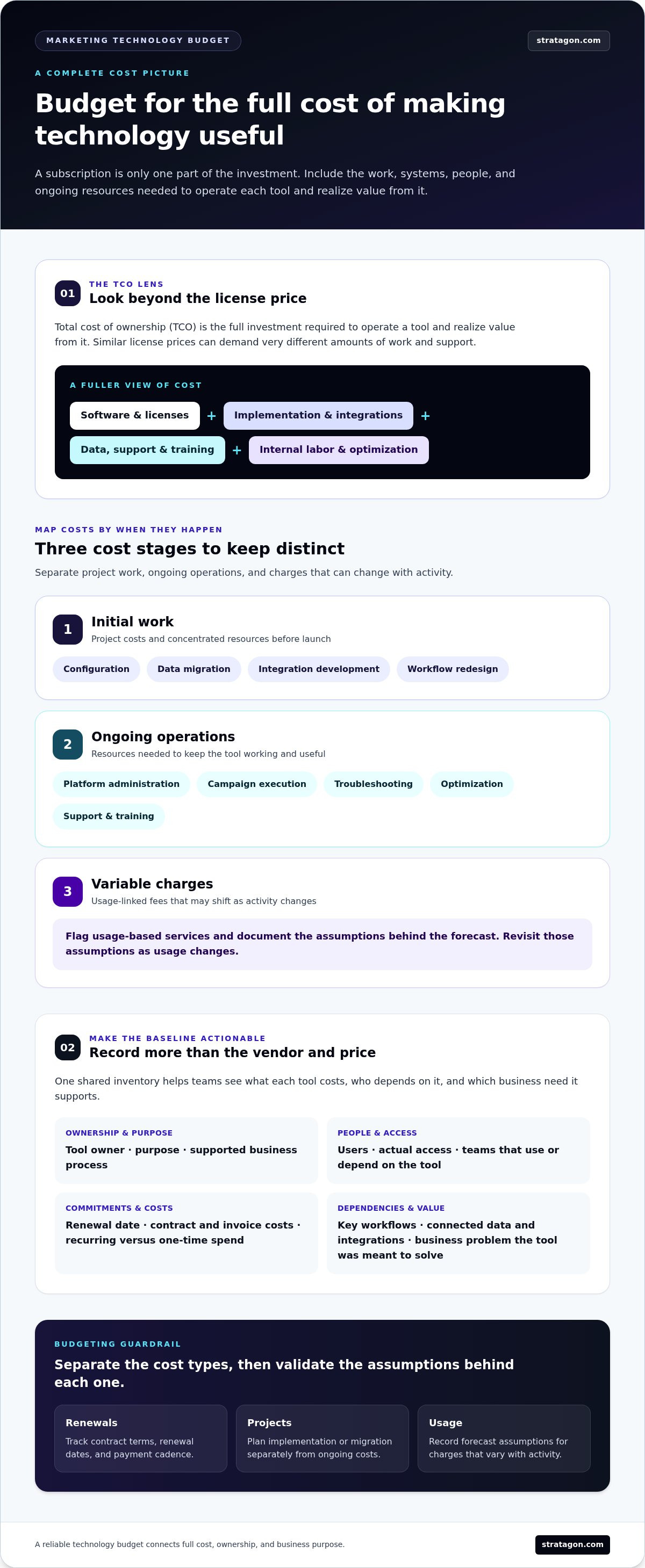
A marketing technology budget should capture the costs and resources required to make the stack work: software and licenses, implementation, integrations, data management, support, internal administration, and user adoption. Separate recurring commitments from one-time projects and variable usage charges. A license renewal has a different planning horizon from a system migration, while a usage-based charge can change as activity increases or decreases.
A tool inventory tells you what exists; an actionable budget baseline shows what each tool costs, who depends on it, and which business need it supports. Build that baseline before reviewing renewals, consolidating systems, or proposing purchases. It gives marketing, sales, finance, and technology a shared starting point instead of leaving each team to make decisions from partial information.
The scope can extend beyond campaign platforms. Digital marketing spans channels and activities that rely on technology, from campaign execution to automation and measurement. A shared CRM, for example, may support marketing segmentation, sales follow-up, and reporting. One department may pay for it while several benefit from it and depend on its data. Make those connections visible before assigning ownership or judging value.
What belongs in a marketing technology budget?
Capture platforms, licenses, implementation work, integrations, support, and the staff time spent administering systems. Record recurring subscriptions separately from one-time setup or migration projects, and flag variable charges such as usage-based services. For shared tools, note which departments fund, use, and depend on them. This prevents a department-level view from obscuring costs or business processes that span the organization.
How to establish a reliable baseline
Create one inventory that records each tool’s owner, purpose, renewal date, users, and supported business process. Compare contracts and invoices with actual access and usage. A paid seat count may not reflect active users, while a lightly used platform may still underpin a key workflow. Document the business problem the tool was meant to solve so future reviews assess its role, not just its name.
For example, if a marketing automation platform supports lead routing, campaign follow-up, and sales notifications, record each dependency and its business owner. If only marketing appears in the contract records, the baseline is incomplete. Confirm the workflow with the teams that use it, and identify the data and integrations that would need attention if the platform changed. With that visibility, managing a marketing tech budget becomes a practical exercise in mapping cost, ownership, and purpose before making commitments.
Build a marketing tech budget around total cost of ownership
Total cost of ownership (TCO) is the full investment required to operate a technology tool and realize value from it. The subscription is only one part. A useful estimate also accounts for implementation, integrations, data, support, training, internal labor, and ongoing optimization. Two tools with similar license prices can place very different demands on the business once these costs are included.
License price alone understates a technology investment because it excludes the work, systems, and skills required to make the tool useful. A CRM, for example, may need configuration and data migration before launch, followed by integration maintenance, user training, and process improvements. Budget these components separately so leaders can see what drives the total and which assumptions need validation.
Separate recurring commitments from implementation costs
Map when and how each cost occurs. Record contract terms, renewal dates, payment cadence, and usage-based charges. Then list project work, such as configuration, migration, integration development, and process redesign, separately. This makes it easier to forecast renewals without treating one-time setup as a permanent expense or overlooking future project needs because the initial license is already funded.
Recurring costs are often easier to forecast, but renewal timing and payment schedules still affect when funds are needed. Usage-based charges can fluctuate with activity, so document the assumptions behind the forecast and revisit them as usage changes. Project costs follow a different pattern: implementation or migration may require concentrated resources before launch, while optimization and maintenance continue afterward.
Keep these stages distinct:
- Initial work: configuration, migration, integration development, and workflow redesign.
- Ongoing operations: platform administration, campaign execution, troubleshooting, and optimization.
- Variable charges: usage-linked fees that may shift as data volumes or activity change.
Account for the people and data behind the tools
Tools need capable owners and reliable information. Estimate internal time for administration, training, governance, campaign operations, and reporting. Include the work required to maintain data quality and troubleshoot integrations. If these responsibilities are shared across marketing, sales, and technology, identify who contributes and how much effort the budget assumes. That makes capacity constraints visible instead of treating staff time as cost-free.
Document estimates and their basis, such as a project scope, internal workload assessment, or known contract terms. If details are uncertain, label the assumption and plan to refine it rather than relying on a generic benchmark that may not fit the organization. A CRM or automation investment, for example, may require different data preparation and training depending on current processes and team readiness.
For organizations aligning strategy with implementation, marketing and technology services can help connect platform decisions to operational needs. Applying a TCO approach is central to managing a marketing tech budget: compare the complete investment across the technology portfolio, not just the visible subscription.
Prioritize marketing technology investments without mistaking cuts for savings
Reducing the number of tools can look like an obvious way to control spend. But cancelling a platform may trigger migration work, interrupt workflows, or break data connections that other teams rely on. A lower renewal bill isn’t necessarily a lower total cost if the business must rebuild processes or replace capabilities elsewhere.
Compare each decision as a set of scenarios: retain, optimize, consolidate, or replace. A tool that overlaps with another may still serve a distinct audience, support a separate workflow, or hold data the other platform cannot use. Map those dependencies first, then compare future-state costs alongside transition effort and risks to adoption, reporting, and business continuity.
Compare scenarios on consistent criteria
Use the same scorecard for renewals, improvement work, consolidation, and new purchases. Consider strategic fit, expected outcome, adoption readiness, risk, and total ownership cost. Define what a strong or weak rating means for your organization, and record the evidence behind each assessment. Consistent criteria make trade-offs easier to explain without assuming every proposal has the same purpose or risk profile.
- Strategic fit: Does the investment support a defined business priority?
- Expected outcome: What operational or commercial change should it enable, and how will you measure that change?
- Adoption readiness: Do users, processes, and implementation capacity support effective use?
- Risk and dependencies: What could disrupt workflows, data, reporting, or continuity?
- Total ownership cost: What does each scenario require to operate and sustain?
For example, consolidating two campaign tools may reduce overlapping functionality, but only if the remaining platform supports the audiences, permissions, and reporting both teams need. Include data mapping, workflow redesign, testing, and training in the comparison. Then weigh those transition costs and risks against the ongoing expense and limitations of retaining both tools.
Rank proposals by strategic value and evidence
Every proposal should name a business objective and an accountable executive owner. Assess team readiness, implementation capacity, data dependencies, and the time needed to learn whether the investment is working. These factors affect feasibility and when the organization can reasonably evaluate progress.
Label each benefit as proven value, supported by existing results; plausible opportunity, supported by a reasoned case but not yet demonstrated; or an unvalidated assumption, which still needs testing. If adoption or benefits are uncertain, model conservative, expected, and upside scenarios. Show what changes in each case, such as usage levels or implementation timing, rather than presenting one forecast as guaranteed.
There’s no universal ROI threshold that fits every organization. Set decision criteria according to strategic priorities, risk tolerance, and the quality of available evidence. A transparent, repeatable scorecard helps leaders compare different choices on a shared basis while leaving room for informed judgment.
Manage the marketing tech budget with a repeatable planning cycle
A budget review works best as an ongoing management process, not an exercise triggered only by renewal notices. A shared cycle gives marketing, finance, sales, IT, and procurement a consistent way to forecast commitments, weigh requests, and respond when conditions change. It also clarifies who recommends, who validates, and who approves each decision.
Use this sequence as a practical planning rhythm. Set review dates that fit your organization’s planning calendar, and bring forward urgent decisions when a trigger arises.
- Set business priorities. Identify the outcomes the organization needs to support, then connect proposed technology spending to those priorities.
- Build and update the forecast. Bring together planned commitments, renewal timing, project needs, and usage assumptions.
- Assess proposals and risks. Review the evidence, ownership, dependencies, adoption readiness, and capacity required to deliver each investment.
- Approve and assign. Record the decision, budget approver, business owner, operational owner, and any conditions for purchase, renewal, or expansion.
- Review and adjust. Compare actual commitments, usage, adoption, and outcomes with the plan, then revise assumptions as needed.
Set owners, assumptions, and decision gates
Give each major investment three clear roles: a business owner accountable for the outcome, an operational owner responsible for day-to-day use, and a budget approver responsible for funding. Marketing can define campaign and adoption needs; sales can validate revenue workflow impacts; IT can assess integration and security dependencies; finance can test forecast assumptions; procurement can manage contract steps. Establish decision rights before a request reaches a renewal deadline.
Define the evidence and approvals required at each gate. A purchase may need a business case and implementation plan; a renewal may need usage, operational health, and outcome evidence; an expansion may require a capacity and cost review. Keep assumptions, dependencies, unresolved risks, and decision rationale in one planning record. That makes the reasoning traceable when owners change or forecasts shift.
Review performance and revise forecasts
Set review intervals and compare actual commitments and usage with planned assumptions. Look beyond financial variance: track whether users have adopted the tool, whether integrations and workflows are operating as intended, and whether the investment is contributing to its defined outcome. Assign follow-up actions to named owners so each review leads to decisions, not just reporting.
Also establish triggers for an out-of-cycle review. These may include an approaching renewal, a material change in usage, a shift in business strategy, or delivery risks such as delayed implementation or an integration issue. If a key assumption changes, update the forecast and document the impact rather than waiting for the next planning round. This turns the budget into a living portfolio instead of a static spreadsheet.
For organizations aligning planning with hands-on execution, strategic marketing and technology services can connect investment decisions with the workflows and outcomes they’re intended to support.
Turn budget decisions into an aligned marketing technology roadmap
An approved investment creates value only when it becomes part of a coordinated operating plan. A roadmap translates funding decisions into sequenced work with owners, dependencies, timing, and outcome measures. It helps teams see not only which tool comes next, but what must happen before people can use it effectively and how the organization will assess progress.
Sequence work around business priorities and operational dependencies. For example, a change to CRM workflows may depend on agreed sales and marketing handoffs, reliable data, and connected automation. Starting implementation before those elements are clear can create rework or weaken adoption. Map the steps first, then set realistic milestones and identify who owns each deliverable.
Connect technology decisions to people and processes
Map the critical customer and employee workflows affected by a proposed change. Identify where information enters, who acts on it, and what the next team needs to continue the process. Plan communication, training, and change ownership alongside technical configuration. Assign responsibility for data governance and reporting so teams know who maintains definitions, resolves quality issues, and interprets results.
Use the roadmap to make dependencies visible across departments. Marketing may own campaign execution, sales may rely on timely and useful context, and technology teams may manage integrations or access. These responsibilities intersect. A shared view helps teams coordinate changes without letting a platform’s default settings dictate how people must work.
Make the next step a focused planning conversation
Bring a concise planning record to the roadmap discussion: the current-state inventory, priority gaps, upcoming decisions, and the workflows each proposed investment affects. Include marketing, sales, finance, and technology stakeholders, along with the owners who will deliver and use the work. This keeps the discussion grounded in business needs, resources, and operational realities.
For each roadmap initiative, define an accountable owner, key dependencies, a measurable outcome, and a review point. Choose measures that fit the goal. A workflow improvement might be assessed through adoption and process consistency, while a demand generation investment may be evaluated against the business outcomes it was designed to support. Set a baseline where possible, and distinguish early indicators from longer-term results.
Stratagon brings marketing strategy, technology implementation, and creative execution together to align initiatives with business goals. This combination can connect CRM, automation, and demand generation decisions to the workflows and outcomes they’re meant to support, without treating software as a strategy in itself.
If your team is ready to turn budget priorities into coordinated action, explore Stratagon’s strategic services. A focused roadmap discussion can help clarify what to sequence, who needs to be involved, and how to keep technology investment aligned with growth priorities.
Make your next technology decision a growth decision
A marketing technology budget can do more than control spend. With clear ownership and business priorities, it can help teams decide where to build capability, where to simplify, and what needs to change next. Make each investment part of a deliberate growth plan rather than an isolated purchase.
That shift starts with connecting strategic intent to execution. Stratagon brings strategic marketing, technology, and creative expertise to that work. Founded in 2005, the agency is a HubSpot partner with CRM implementation and optimization experience, and supports long-term partnerships that can extend from strategy into ongoing execution.
Ready to align technology investment with your growth priorities? Discuss a marketing technology roadmap with Stratagon. A focused conversation can help turn your next decision into a confident step forward.
Frequently Asked Questions
What is included in a marketing technology budget?
A marketing technology budget should include the full costs of acquiring and using tools, not just subscription charges. Check pricing tiers, seat minimums, usage limits, overage terms, and charges for optional modules. Also account for transition costs, such as exporting data or replacing a connector. These details help distinguish the amount committed under a contract from the resources and conditions that affect the tool’s practical cost.
How often should a company review its marketing technology budget?
Review the budget on a regular schedule that matches the organization’s financial planning cadence, and revisit individual investments before renewal decisions. A quarterly check-in can help teams catch changes in usage or delivery early, while a deeper annual review can inform the next year’s plans. Don’t wait for a scheduled meeting if a strategic priority changes or a project slips. The right cadence is frequent enough to act on new information without creating unnecessary reporting work.
Should marketing technology spending sit under marketing or IT?
Assign budget ownership according to who is accountable for the investment, but define shared responsibilities for tools used across departments. Marketing may own campaign outcomes, while IT oversees technical architecture and security, and finance manages controls and forecasting. For a shared CRM, departments can agree on a funding split or central budget owner while documenting each team’s role. The essential point is to have one accountable approver make the final funding decision with input from affected teams.
How should a team budget for AI marketing tools?
Budget for the use case, not the AI label. Start with a contained application, such as drafting campaign variants or summarizing research, then estimate licensing, usage, training, review, and data governance needs. Define how the team will assess quality and time saved before expanding access. Include limits or approval controls for variable usage, and plan for human review where outputs affect customer communications. Expand investment only when the workflow, team capability, and evidence support broader use.
What should a small marketing team prioritize in its technology budget?
A small team should prioritize tools that remove a clear operational bottleneck and can be adopted with available capacity. Choose a dependable core for customer data, campaign execution, and measurement before adding specialized tools that require separate administration. When managing a marketing tech budget with limited resources, weigh time saved and process fit alongside subscription cost. A platform that teams use consistently may be more valuable than a broader stack with features no one has time to operationalize.
How can finance and marketing agree on technology investment priorities?
Use a shared investment brief that connects proposed spending to a business objective, expected timing, and a way to evaluate progress. Marketing should explain the workflow or audience need; finance can test the assumptions, timing, and downside case. Agree in advance on what evidence would support continuation, expansion, or a change in approach. This replaces competing departmental estimates with a common decision record and makes trade-offs easier to discuss when several initiatives seek funding.
Should unused software licenses be removed immediately?
Not before checking why the licenses appear unused and whether they support a less frequent but important workflow. Confirm access records with the team, identify dependencies such as automated reports or integrations, and review contract terms before reducing seats. If appropriate, reclaim access in stages and monitor for disruption before making a broader change. Removing inactive seats can make sense, but preserving necessary access and continuity matters more than making a quick adjustment based on a dashboard alone.