How to tailor sales sequences and track their performance

A well-built sales sequence is measured by relevance, not volume. A typical B2B sequence uses 8-12 touchpoints over 2-4 weeks, with the cadence and message shaped around the audience and purpose. The best practices for HubSpot sales sequences start with that balance: consistent follow-up, coordinated channels, and room for meaningful personalization.
It’s easy to focus on the number of emails or steps, but a sequence works only when each touch gives the contact a reason to engage. This guide explains how to segment audiences, set cadences for outbound outreach, inbound leads, event follow-up, and reactivation, and coordinate emails with timely sales tasks. You’ll also learn which performance signals to track and how to use them to refine messaging and timing. The goal is outreach grounded in buyer context and measurable engagement, not activity for its own sake.
Key Takeaways
- Use contact properties to organize prospects and connect sequence activity to meaningful performance measures.
- Adjust follow-up timing and messaging to fit whether a contact is inbound, outbound, or event-based.
- Segment by buyer context and coordinate email with timely sales tasks to keep outreach relevant.
- Review engagement and meeting outcomes to identify which parts of a sequence need refinement.
Contact properties and performance tracking
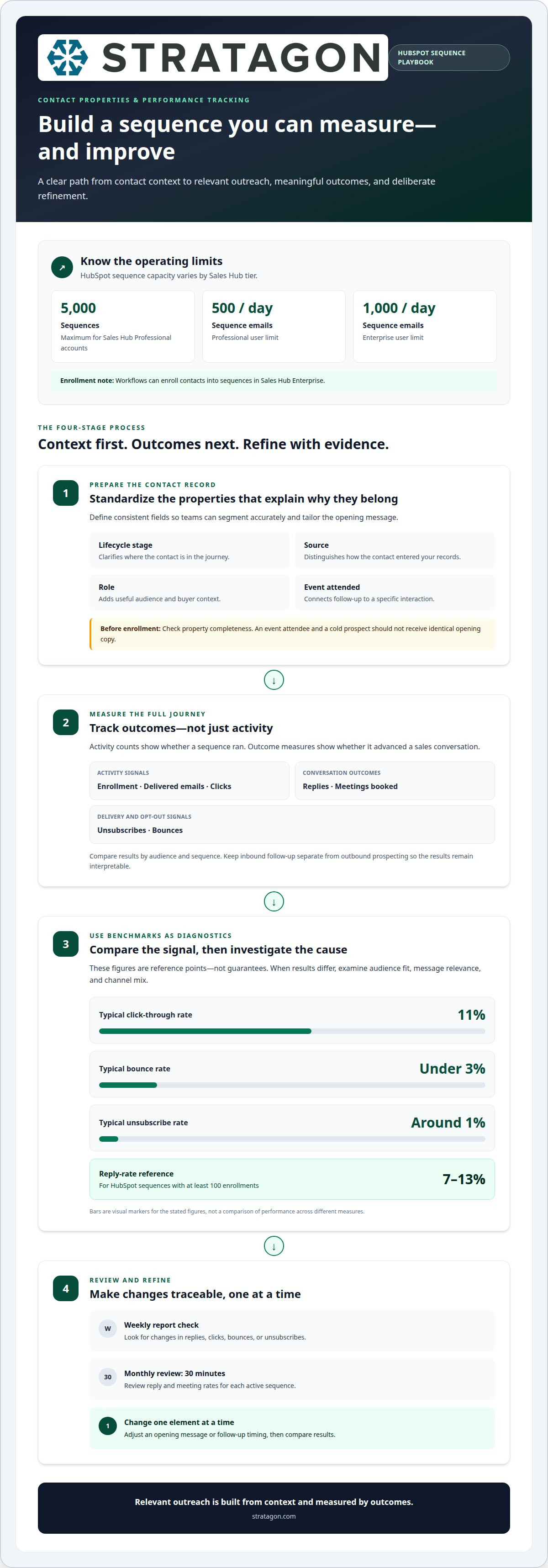
HubSpot sequences automate planned sales outreach, while workflows can enroll contacts into sequences in Sales Hub Enterprise. Sales Hub Professional accounts can have up to 5,000 sequences; Professional users can send up to 500 sequence emails per day, and Enterprise users up to 1,000. Common mistakes include stale contact properties, generic messaging, and measuring sends without tracking replies or meetings. These issues can weaken relevance and make sequence results harder to interpret.
- Standardize the contact properties. Define the fields that explain why a contact belongs in a sequence, such as lifecycle stage, source, role, or event attended. Use consistent values across records so teams can segment accurately and tailor messages. For example, an event attendee and a cold prospect should not receive identical opening copy. Review property completeness before enrollment; missing context can lead to mistimed or irrelevant outreach.
- Track outcomes beyond activity. Record enrollment, delivered emails, clicks, replies, meetings booked, unsubscribes, and bounces. Activity counts show whether a sequence ran; outcome measures show whether it advanced a sales conversation. Compare results by audience and sequence, rather than blending inbound follow-up with outbound prospecting. This gives sales leaders a clearer view of which message or timing needs adjustment.
- Use benchmarks as diagnostic signals. A typical sequence click-through rate is 11%, bounce rate is under 3%, and unsubscribe rate is around 1%. For HubSpot sequences with at least 100 enrollments, a reply rate of 7 to 13% is a reference point. Treat these figures as comparison points, then examine audience fit, message relevance, and channel mix when results differ.
- Build a consistent review rhythm. Check sequence reports weekly to spot changes in replies, clicks, bounces, or unsubscribes. Then hold a 30-minute monthly review of each active sequence’s reply and meeting rates. Change one element at a time, such as the opening message or follow-up timing, and compare results. This makes performance decisions traceable instead of relying on impressions.
Inbound, outbound, and event-based sequences
Match each sequence to the contact’s context, desired next action, and response signals.
-
Set Reply and Meeting Unenrollment
Set sequences to stop when a prospect replies or books a meeting. A response changes the best next action: the salesperson should address the conversation rather than continue scheduled outreach. Confirm that replies and meeting bookings trigger the intended exit, including when a contact engages through another channel. Otherwise, they may receive a follow-up that ignores an active discussion.
For event follow-up, a booked meeting should move the contact from nurture to direct sales coordination. A reply without a meeting may still call for a personal response. Define both outcomes before enrollment, then test the path with a sample contact. Aligning sequence enrollment and follow-up with your CRM processes helps keep the handoff clear.
-
Understand How Sequences Work
Use HubSpot sequences for structured, one-to-one sales outreach. They combine scheduled emails with reminders for sales tasks, keeping follow-up organized while leaving room for personal action. Cold outreach sequences typically use 10-12 steps; warm-lead or event follow-up can use six to eight. Choose the shorter path when a prior interaction already supplies relevant context.
For inbound leads, prioritize a timely response and a clear meeting invitation. A framework using a 7-business-day cadence sets a meeting-booked target of 15 to 20 percent. For cold outbound, a 14-business-day cadence sets a reply-rate target of 8 to 12 percent. Treat these as framework targets, not a reason to send the same message to every contact.
After an event, refer to the session or conversation that prompted your follow-up. Add a task reminder when a sales representative needs to provide context before the next touch. Separate attendees who requested a meeting from those who only engaged with event content. This distinction keeps follow-up relevant and prevents the team from treating every attendee as sales-ready.
Use sequences to follow up after events or re-engage inactive contacts. For reactivation, explain why you’re reaching out again and make the message relevant to the contact’s history. For event follow-up, refer to the event or conversation rather than sending a generic touch. In both cases, connect each message to the contact’s previous engagement.
Audience segmentation and multichannel outreach
Segment by buyer context, then choose the channel that best supports the next useful action. Applying hubspot sales sequences best practices means using consistent logic across contact records and sales activity.
- Group contacts by meaningful signals. Use properties such as role, lifecycle stage, account fit, or recent activity to distinguish audiences. For example, a decision-maker who attended a product webinar needs different follow-up from a cold contact in the same industry. Keep each segment tied to a clear message and next step. HubSpot lead-scoring models support up to 100 filter groups, allowing teams to define detailed criteria.
- Choose sequence enrollment with intent in mind. Separate high-value prospects from broader outreach groups before enrollment. A prospect with a specific question may need a tailored one-to-one email, not a templated sequence. HubSpot recommends spending at least 60 seconds researching each prospect to make outreach more relevant. Use that time to identify a concrete business detail, then connect it to the message’s purpose.
- Coordinate channels through deliberate tasks. Use sequence emails for planned written follow-up, then add task reminders for personal outreach where it makes sense. A task can prompt a salesperson to call a priority contact or send a LinkedIn message that builds on relevant context. Keep the channels connected: a LinkedIn touch should develop the email conversation, not simply repeat it. This creates a coherent interaction instead of disconnected activity.
- Measure each channel against its role. Compare engagement within the same audience and outreach context. A 3% LinkedIn message click-through rate is a reference benchmark, while a 12% reply rate is described as strong for cold LinkedIn outreach. These hubspot sales sequences best practices can help identify where a channel supports progress, but clicks alone don’t show buying intent. Review replies and resulting conversations alongside channel activity before adjusting the sequence.
For high-value prospects and client inquiries that need a tailored response, use one-to-one emails rather than assuming every contact belongs in the same sequence. Make the message specific to the prospect or inquiry, and choose a next step that fits the response needed. This keeps personalized outreach distinct from broader sequence-based follow-up.
Outbound, inbound follow-up, and reactivation cadences
Set the cadence according to intent, response urgency, and the next useful action. Keep the schedule consistent, but leave room for relevant, personal follow-up.
-
Set Cadence and Step Spacing
Plan 8-12 touchpoints across 2-4 weeks for a typical B2B sales sequence. A standard outbound cadence may space touches every 2-3 days over two weeks. Use that structure as a starting point, then adjust for engagement and prospect context. Avoid compressing every touch into consecutive days; each message needs a distinct reason to reach out.
Give every step a purpose, such as introducing a problem, sharing a useful resource, or asking for a conversation. Review the full timeline before launch to prevent emails and task reminders from colliding. For a high-priority prospect, replace a generic step with researched, personal follow-up.
-
Write Sequence Emails
Write each email around one clear point and one next action. HubSpot recommends keeping an executive outreach opening email under 75 words. Lead with a relevant business observation, then explain why it matters to that recipient. Avoid lengthy product descriptions, repeated claims, and several competing calls to action.
Make the early request easy to assess. HubSpot recommends that an early sequence call to action may invite prospects to consider a 15-minute conversation. Keep later messages meaningfully different, such as adding a useful insight instead of repeating the opening. Check names, company details, and links before enrollment to prevent avoidable errors.
-
Plan Follow-Up and Reactivation Cadences
Match timing and success measures to the contact’s starting point. An inbound framework uses a 7-business-day cadence, with a meeting-booked target of 15 to 20 percent. A reactivation framework uses 10 business days and a reply-rate target of 4 to 6 percent. For outbound, set a defined timeframe and evaluate replies against its intended audience.
For reactivation, acknowledge the previous relationship and give the contact a relevant reason to reconnect. Stop or change direction when they reply, book a meeting, or show renewed interest. These signals call for a personal next step, not another automated reminder. Plan your CRM processes to coordinate cadence, messaging, and sales follow-up.
Stratagon: HubSpot CRM Implementation
Stratagon helps align HubSpot CRM configuration with the sales processes behind effective sequences. HubSpot CRM Implementation can connect contact properties, enrollment criteria, and reporting so your team works from consistent data. Sales Enablement can help align messaging and follow-up practices across the sales team.
Turn to Stratagon when sequence performance is difficult to interpret, contact data is inconsistent, or outreach steps don’t reflect how your sales team works. A coordinated approach can clarify handoffs between automated emails and personal follow-up, while grounding sequence design in buyer context and measurable activity.
Contact Stratagon to discuss HubSpot CRM Implementation for your sales process.
Turn sequence insights into a stronger revenue process
Connect outreach decisions with the broader ways your teams qualify, engage, and support buyers. HubSpot sales sequence best practices deliver more value when CRM structure, sales execution, and account strategy reinforce one another. This alignment helps teams act on buyer context rather than treat each sequence as an isolated campaign.
Stratagon brings this perspective through HubSpot CRM Implementation, Digital transformation, and Account-Based Marketing (ABM). These services can support organizations refining CRM processes, aligning sales activity with marketing priorities, or coordinating their approach to target accounts. Start with the operational gap that most limits consistent, relevant outreach.
Contact Stratagon to plan your outreach and explore how a more connected revenue process can support your team’s goals. Thoughtful execution turns sequence learning into stronger decisions and sustained progress.
Frequently Asked Questions
How do HubSpot sequences differ from workflows?
Sequences organize planned one-to-one outreach through scheduled emails and sales-task reminders. For Sales Hub Enterprise accounts, workflows can automatically enroll contacts in sequences.
How do you create and enroll contacts in a HubSpot sales sequence?
Define the sequence’s audience using consistent contact properties, then plan relevant emails and follow-up task reminders. Enroll the contacts; Sales Hub Enterprise accounts can also use workflows for enrollment, and bulk enrollment can select up to 50 contacts at a time.