HubSpot Lead Scoring Model Best Practices: A Practical 2026 Guide

A lead score that sales doesn’t trust isn’t a prioritization tool; it’s another dashboard number. The strongest hubspot lead scoring model best practices start with a practical question: which combination of customer fit and buying behavior signals that a prospect is worth a sales conversation?
If your team is unsure whether to reward a job title, a pricing-page visit, or repeated product engagement, you’re not alone. Sales and marketing need a shared definition of qualification, and the score must reflect it. HubSpot’s modern scoring framework separates Fit from Engagement, replacing the legacy single HubSpot Score, which stopped updating at the end of August 2025. That shift creates a clearer foundation, but only when the criteria and next steps make sense to the people using them.
This guide explains how to choose meaningful demographic, firmographic, and behavioral signals, set practical thresholds, and connect scores to timely sales actions. You’ll also learn how to review conversion outcomes, gather sales feedback, and refine the model as your business and buying patterns change.
Key Takeaways
- Use a lead score to guide prioritization, not to guarantee purchase intent or replace lifecycle and qualification definitions.
- Apply hubspot lead scoring model best practices by evaluating fit, engagement, and disqualification signals before assigning points.
- Set thresholds around sales actions, then weigh the trade-offs between false positives and false negatives.
- Start with a simple model, align sales and marketing on shared definitions, and test it with a pilot before launch.
- Assess performance by segment and signal category using accepted-lead rate, progression, conversion, disqualification reasons, and response time.
What a HubSpot lead scoring model should tell your revenue team
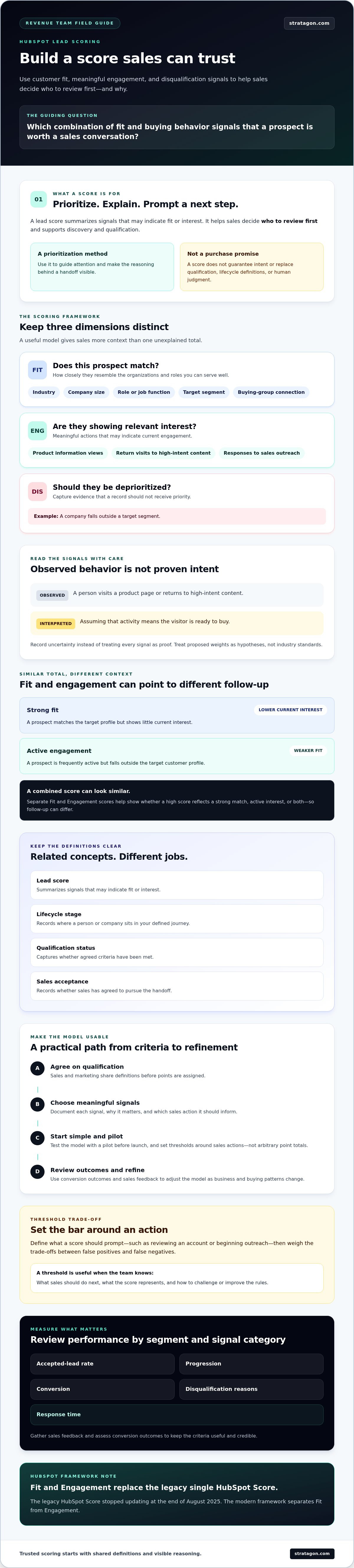
A lead score should help sales decide who to review first and explain why that prospect deserves attention. It’s a prioritization method, not a promise that someone will buy. A useful model turns selected contact or company signals into a structured summary, then links that summary to a clear next step, such as reviewing the account or beginning outreach.
A lead score summarizes signals that may indicate fit or interest; a lifecycle stage records where a person or company sits in your defined journey. These concepts work together, but they aren’t interchangeable. A lifecycle stage describes progression, while qualification status captures whether agreed criteria have been met. Sales acceptance records whether the sales team has agreed to pursue the handoff. None of these labels replaces the others.
Fit and engagement answer different questions. Fit asks, “Does this prospect resemble the organizations and roles we can serve well?” Signals might include industry, company size, or job function. Engagement asks, “Is this prospect showing relevant interest now?” That might include visiting a high-intent page or responding to sales outreach. HubSpot’s modern scoring framework separates Fit and Engagement scores, helping teams see whether a high score reflects a strong match, active interest, or both. The foundational Lead scoring methodology also distinguishes explicit information from implicit behavioral signals.
What does a lead score mean in HubSpot?
The number is useful only when sales understands what contributes to it and what action it should prompt. For example, a prospect may show frequent activity but fall outside the target customer profile; another may fit the profile but show little current interest. Those cases call for different follow-up, even if a combined score looks similar. Scoring supports discovery and qualification; it doesn’t replace either, or the judgment of the people speaking with the prospect.
Why scoring models lose sales trust
Trust erodes when repeated, low-value actions inflate scores, broad criteria reward poor-fit prospects, or incomplete records distort fit. Definitions can also diverge: marketing may count a content download as meaningful intent while sales sees it as casual research. If the team can’t inspect the rules behind a score, it can’t explain, challenge, or improve the prioritization. Document each signal, its rationale, and the action it should inform. That shared logic is central to hubspot lead scoring model best practices.
Build a HubSpot scoring framework around fit, intent, and disqualification
Before assigning points, define three separate dimensions: fit (whether the prospect matches your target profile), engagement (which relevant actions they’ve taken), and disqualification (evidence they shouldn’t be prioritized). This gives sales more context than a single total and makes the lead scoring model a shared agreement between sales and marketing, rather than a set of unexplained numbers.
Which fit and engagement signals should count?
Choose signals that connect to your actual customers and sales process. Fit may include role, company profile, target segment, and whether the person appears connected to the buying group. Engagement can include meaningful interactions, such as viewing product information or returning to high-intent content. Separate observed behavior from inferred intent: a page visit is observable, while assuming it means the visitor is ready to buy is an interpretation. Record that uncertainty instead of treating every signal as proof.
Use a working table to challenge each proposed criterion before it enters the model:
| Signal category | Example | Rationale | Validation question |
|---|---|---|---|
| Fit | Role matches a target buying-group function | May indicate relevance to the purchase | Do sales-accepted opportunities include this role? |
| Engagement | Repeated visits to product information | Suggests active research | Does this behavior precede meaningful sales conversations? |
| Disqualification | Company falls outside a target segment | Reduces attention on poor-fit records | Does sales consistently exclude this segment? |
Treat weights as hypotheses, not industry standards. Compare historical conversion patterns with sales feedback, then adjust only when evidence supports a change. The right weighting depends on your market, buying group, and sales cycle, so universal point values can create false confidence. These hubspot lead scoring model best practices keep criteria grounded in your own revenue process.
How should negative scoring and exclusions work?
Decide how to handle poor-fit segments, invalid records, and explicit opt-outs. Keep exclusions distinct from low engagement: inactivity may reduce an engagement score over time, but it shouldn’t erase persistent fit information. Ask sales to review exclusion rules, especially for buying-group members whose titles or activity may look atypical but still matter to a deal.
Record each signal’s definition, rationale, and evidence for retaining it. If aligning criteria with sales workflows requires broader CRM configuration, Stratagon’s HubSpot CRM implementation services may be relevant.
Choose scoring thresholds that reflect sales readiness: not arbitrary point totals
A threshold matters only when it prompts a useful action. Choose it based on what your team can follow up on and what past opportunities suggest, not because a round number looks tidy. In HubSpot, teams can use separate Fit and Engagement scores or combine them. Neither approach suits every sales process; the model should make readiness easier to interpret and act on.
Should fit and engagement use separate scores?
Separate scores make the logic visible. Sales can distinguish a strong-fit prospect with little recent activity from an active researcher who may not match the target profile. That clarity helps teams troubleshoot weak handoffs. A combined score can be simpler when an established process already treats fit and activity together, but it can hide why a prospect crossed the threshold. Compare interpretability, workflow complexity, and how easily the team can diagnose missed or misrouted leads before choosing.
Thresholds also involve trade-offs. A low cutoff may send more prospects to sales, including false positives that consume capacity without progressing. A high cutoff may create false negatives, holding back prospects who could have qualified through a conversation. Scoring thresholds earn their place only when teams validate them against downstream sales outcomes.
How do you establish a useful qualification threshold?
Review historical records across different outcomes: leads that progressed, converted, stalled, or were rejected. Compare their fit and engagement patterns, then test candidate cutoffs against both accepted-lead quality and the volume sales can reasonably handle. Avoid optimizing for handoff volume alone; a threshold should help sales focus effort where it can move opportunities forward.
For each threshold, document the rationale, owner, and next step. For example, a prospect who meets the fit requirement and shows strong engagement might enter a sales review queue, assigned to a named owner with an agreed response expectation. A high engagement score paired with weak fit might instead prompt further review rather than automatic outreach. The action should reflect the signal combination, not just the total.
- Threshold reached: Name the person or team responsible for reviewing the lead, and define the expected response.
- Near threshold: Specify whether marketing continues relevant follow-up or sales reviews the record selectively.
- Below threshold: Clarify what should happen next, including whether inactivity or new activity changes the lead’s priority.
Record why each cutoff exists, then revisit it as sales capacity, funnel performance, or buying behavior changes. These hubspot lead scoring model best practices turn a score into an operational decision and keep the model accountable to results rather than convention.
Implement and test your HubSpot lead scoring model step by step
Translate the scoring framework into CRM rules only after teams agree on what each signal means and what should happen when a lead reaches a threshold. A disciplined rollout helps prevent inconsistent data or unclear ownership from undermining the model. Keep the first version focused: start with criteria sales and marketing can explain, then expand when performance data supports doing so.
Prepare the CRM data and scoring definitions
Begin with a data audit. Check whether key contact and company properties are populated consistently, identify duplicates, and review lifecycle stages and field values for conflicting formats. A job title entered several different ways, for example, can make a fit criterion unreliable. Then align sales and marketing on the ideal-customer profile, qualification language, lead ownership, and exclusions.
Document every approved criterion before configuration. Record its property or source, rationale, responsible team, and intended impact on prioritization. This creates a working reference when someone questions a score or proposes a change.
Configure, pilot, and activate the scoring workflow
Use an ordered rollout to connect the definitions to HubSpot and the team’s process:
- Confirm the scoring approach. Decide whether to use separate Fit and Engagement scores or a combined approach based on how sales needs to interpret priority.
- Map criteria to CRM data. Connect each approved signal to an available HubSpot property and scoring capability. Before setup, verify current feature names, configuration steps, and subscription access against HubSpot’s documentation and your account. Availability can depend on the HubSpot subscription.
- Test representative records. Include strong-fit and low-fit examples, incomplete records, duplicate scenarios, inactive contacts, and records near or above a threshold. Confirm scores change as intended and that routing or notification actions match the agreed process.
- Pilot with sales users. Ask users to review actual scored records and report whether the priority and rationale make sense. Capture feedback, correct data or logic issues, and avoid adding criteria without evidence.
- Launch with controls. Document ownership, monitoring, change approval, and rollback steps so the team knows how to respond if scoring or routing behaves unexpectedly.
These hubspot lead scoring model best practices connect CRM configuration to real sales work, rather than treating setup as a technical task alone. If your team needs support aligning HubSpot configuration with its scoring and handoff process, explore Stratagon’s HubSpot CRM implementation services.
Optimize HubSpot lead scoring with sales feedback and measurable outcomes
A scoring model earns trust through what happens after a lead reaches a threshold. Review whether sales accepts the handoff, whether the prospect progresses, and whether the score helped the team prioritize effectively. Marketing and sales should own this review together, using the same outcome definitions and a shared record of proposed changes.
Which metrics show whether the model is working?
Compare high-scoring and low-scoring cohorts on downstream progression and conversion. Then interpret those results alongside accepted-lead rate, sales rejection reasons, and response time. A high score with low acceptance may point to weak criteria or a mismatch in qualification definitions. Strong engagement without later progression may mean the model rewards activity that isn’t a reliable indicator of buying readiness.
Don’t rely on one overall average. Break results down by customer segment, Fit and Engagement score, and individual signal category. This can reveal, for example, that a signal performs well for one segment but generates false positives in another. Review disqualification reasons as well: consistent rejection for poor fit suggests the model may need clearer exclusions, while qualified leads below threshold may indicate that an important signal is missing.
Check whether the model favors activity that’s easy to capture over behavior that meaningfully reflects buyer interest. A cluster of low-value interactions can look impressive in aggregate while offering little evidence of sales readiness. Ask sales users to explain why they accepted or rejected leads, and compare that feedback with the recorded signals.
When should you recalibrate the scoring model?
Set a recurring review involving sales and marketing, and keep a change log that records the proposed adjustment, evidence, decision, and owner. Reassess when your ideal customer profile, product, sales process, or observed buying behavior changes. Also investigate patterns such as repeated false positives, ignored alerts, and qualified prospects who remain below the handoff threshold.
Before changing a rule broadly, test the adjustment against relevant segments and review sample records with sales. Compare the results with the current model, including acceptance, progression, conversion, and response time. This helps distinguish a real improvement from a change that simply shifts lead volume between teams.
These hubspot lead scoring model best practices make optimization a shared operating discipline, not a score adjustment made in isolation. Document what the team learns, retain the reasoning behind each change, and use the next review to check whether the revised criteria improved the outcomes they were designed to influence.
Turn lead scoring into a stronger revenue process
A useful scoring model does more than rank prospects. It gives sales and marketing a shared way to interpret fit and engagement, take timely action, and learn from what happens next. The most effective hubspot lead scoring model best practices keep criteria transparent, connect thresholds to clear ownership, and measure performance through accepted leads, progression, conversion, and sales feedback.
Keep the model focused as it evolves. Review results by segment and signal, investigate missed opportunities and poor-fit handoffs, and adjust rules when evidence shows they need to change. That discipline helps your team keep scores relevant to real buyer behavior instead of treating them as a system that needs no ongoing attention.
Stratagon provides marketing, sales, and technology services, including HubSpot CRM implementation, marketing automation, and sales enablement. Explore strategic CRM and marketing automation support to see how configuration and team processes can work together. A clear, collaborative scoring approach gives your revenue team a stronger foundation for prioritizing the prospects who deserve attention.
Frequently Asked Questions
What is a lead scoring model in HubSpot?
A HubSpot lead scoring model assigns value to selected prospect signals to help teams prioritize follow-up. HubSpot’s modern scoring framework separates Fit, based on demographic and firmographic information, from Engagement, based on behavioral signals. Teams can use those dimensions separately or combine them. A score indicates priority according to your chosen rules, not a guarantee of purchase intent, and it doesn’t replace lifecycle stages or sales qualification.
How do you create a lead scoring model in HubSpot?
Start by agreeing with sales on qualification criteria, then audit the CRM data those criteria depend on. Configure Fit and Engagement scoring using the capabilities available in your HubSpot subscription, and connect relevant thresholds to clear sales actions. Test sample records, edge cases, and routing before piloting with sales users. These hubspot lead scoring model best practices help keep the model explainable and grounded in your team’s process. Verify current setup options and subscription requirements in HubSpot’s documentation.
What is a good lead score threshold?
A good threshold identifies prospects worth a defined sales action, based on your own funnel evidence. Review leads that progressed, converted, stalled, or were rejected, then compare candidate cutoffs with sales acceptance and team capacity. A threshold set too low can create false positives and excess follow-up; one set too high can leave qualified prospects waiting. Assign an owner and next step to every threshold.
Should fit and engagement have separate lead scores?
Separate Fit and Engagement scores make it easier to see whether priority comes from a strong customer match or active behavior. This can help sales decide how to follow up when a prospect fits the ideal profile but shows little recent activity, or engages frequently without matching that profile. A combined score may suit a simpler, established handoff. Choose the approach your team can interpret and maintain, then validate it against outcomes.
What information should count toward a HubSpot lead score?
Include information that has a clear connection to customer fit or meaningful buying behavior. Fit signals may include role, company profile, target segment, and buying-group relevance. Engagement signals might include repeated product research or interactions with high-intent content. You can also account for disqualifiers such as poor-fit segments or invalid records. Distinguish observed actions from inferred intent, and use historical conversion patterns and sales feedback to assess each criterion.
How often should you review a lead scoring model?
Review the model on a recurring schedule agreed by sales and marketing, and revisit it when your ideal customer profile, product, sales process, or buyer behavior changes. Look for repeated false positives, qualified prospects below threshold, ignored alerts, and shifts in sales acceptance or conversion. Review performance by segment and signal category, not just by overall score. Keep a change log so the team can connect adjustments to evidence and outcomes.
Can HubSpot lead scoring automatically assign leads to sales?
Yes, scoring can inform automated sales assignment when your HubSpot subscription supports the necessary scoring and workflow features and the CRM is configured accordingly. For example, a workflow could use a score threshold to assign an owner, create a task, or notify a sales team. Confirm current feature availability and subscription requirements in HubSpot’s documentation. Test routing rules before launch, including edge cases, and make sure ownership and response expectations are clear.