HubSpot Sales Territory Management: Implementation Guide

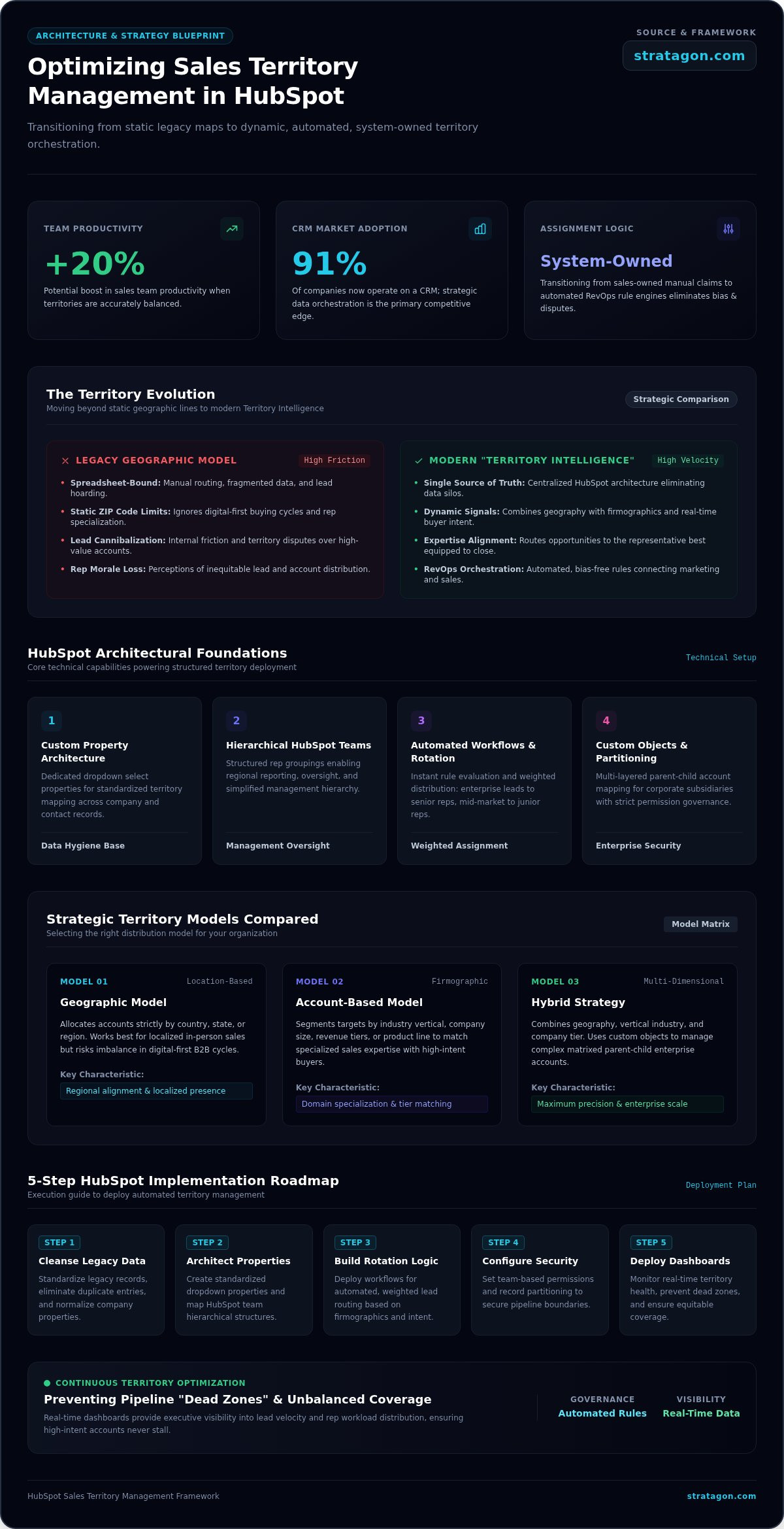
Recent industry data reveals that balanced sales territories can boost team productivity by up to 20 percent. Despite this, many B2B organizations remain tethered to manual spreadsheets and fragmented data that spark internal friction and missed opportunities. You've likely seen the fallout firsthand through inequitable lead distribution, data silos, and the persistent headache of territory disputes. Using hubspot for sales territory management offers a path away from these operational bottlenecks and toward a system defined by precision and accountability.
We understand that a CRM is only as effective as the architecture supporting it. This implementation guide provides the strategic framework you need to transition from manual routing to a high-performance, automated model. You'll learn to master the technical setup and sophisticated workflows required to align your sales expertise with buyer intent. By the end of this article, you'll have a clear roadmap for deploying real-time performance dashboards and automated rotation logic that eliminates lead hoarding. This ensures your revenue teams operate with total clarity, momentum, and the data-informed confidence required for modern organizational growth.
Key Takeaways
- Understand why shifting from static maps to dynamic, data-driven resource distribution is essential for maintaining sales velocity in 2026.
- Identify the foundational technical requirements for using hubspot for sales territory management, specifically focusing on custom property architecture and hierarchical team permissions.
- Compare geographic, firmographic, and hybrid modeling strategies to align your representatives' specific vertical expertise with high-intent accounts.
- Execute a structured five-step implementation plan designed to cleanse legacy data and deploy sophisticated lead rotation logic.
- Leverage real-time dashboards to monitor territory health, ensuring equitable distribution and preventing "dead zones" in your sales pipeline.
The Evolution of Sales Territory Management in the CRM Era
A Sales territory was once defined by static lines on a map. In the modern commercial environment, this definition has shifted toward a dynamic, strategic allocation of organizational resources. It is no longer just about where a customer is located; it is about matching the right expertise to the right opportunity at the exact moment of intent. Using hubspot for sales territory management allows organizations to move beyond the limitations of manual spreadsheets, which often lead to friction and missed revenue. With 91 percent of companies now utilizing a CRM, the competitive advantage lies in how effectively you orchestrate that data.
Modern territory management requires what we call "Territory Intelligence." This approach integrates geographic data with firmographics and real-time intent signals. When you centralize this logic within HubSpot, the CRM becomes your single source of truth for organizational health. It provides the clarity needed to ensure every lead is routed to the representative best equipped to close the deal, maintaining momentum across the entire growth cycle. By automating this process, you eliminate the data silos that traditionally prevent a clear view of performance.
Why Legacy Geographic Models are Stalling Growth
Digital-first buying cycles have rendered traditional ZIP code boundaries largely irrelevant. When territories are strictly geographic, you risk lead cannibalization and internal disputes. If two reps claim the same high-value account based on overlapping criteria, sales friction follows. This lack of clarity doesn't just hurt the bottom line; it damages rep morale. High-performing talent will leave if they perceive the distribution of opportunities as inequitable or chaotic. You need a system that prioritizes logical alignment over simple proximity.
The RevOps Approach to Territory Logic
Success requires transitioning from "Sales-owned" assignments to "System-owned" logic. This is where Revenue Operations (RevOps) plays a critical role. By automating the assignment process, you remove human bias and manual error. This creates a bridge between marketing's demand generation efforts and the sales team's execution. It ensures that both departments are aligned on territory definitions and performance expectations. For organizations looking to bridge this gap, Stratagon’s strategic alignment consulting provides the architectural expertise to turn complex data into a functional, high-performance model that drives predictable revenue.
Core HubSpot Features for Territory Configuration
Configuring a high-performance territory system requires mastering specific native features within the CRM. When using hubspot for sales territory management, your architectural foundation begins with custom properties. Creating a dedicated dropdown select property for "Territory" allows you to map clean, standardized data points to your company and contact records. From there, you organize your sales representatives into hierarchical HubSpot Teams. This organizational structure enables accurate regional reporting, simplifies management oversight, and enforces data hygiene across your entire commercial enterprise.
Workflow automation serves as the operational engine driving real-time record assignment and instant internal notifications. Instead of relying on manual oversight, automated workflows instantly evaluate incoming firmographic and intent data against your predefined territory criteria. Advanced lead rotation actions allow revenue leaders to implement sophisticated, weighted distribution models. You can easily configure the system to route a higher percentage of high-value enterprise accounts to senior executives while directing mid-market opportunities to junior representatives, maximizing the structural efficiency of your sales enablement initiatives.
Leveraging Custom Objects for Complex Hierarchies
Standard properties work well for linear territory models, but enterprise B2B organizations often require matrixed structures. When territories involve multi-layered account assignments, such as overlapping vertical and geographic boundaries, custom objects become necessary. You can map complex parent-child relationships to link multiple corporate subsidiaries to a single master territory record. Custom Objects are the key to unlocking multi-dimensional territory logic.
Permissions and Partitioning for Territory Security
Protecting pipeline integrity requires strict governance over who can view and modify account data. HubSpot allows you to restrict record access based on team alignment, ensuring representatives only interact with their assigned pipeline. This eliminates lead hoarding and cross-territory friction while leadership retains macro-level visibility through global dashboards. Implementing this team-based partitioning secures your data assets without slowing down sales velocity. If you need expert guidance structuring these advanced permission matrices, securing a partner for HubSpot CRM Implementation ensures your system is built securely from day one.
Strategic Territory Models: Geographic vs. Account-Based vs. Hybrid
Selecting the right strategic model is the bridge between CRM implementation and realized revenue. While many B2B organizations default to geographic boundaries, using hubspot for sales territory management allows for far more nuanced logic. Geographic modeling remains a staple for logistics-heavy field sales, yet it often fails to account for representative expertise. Firmographic or industry-based modeling solves this by aligning vertical specialists with specific sectors, such as Financial Services or Higher Ed. This ensures the buyer interacts with a professional who understands their unique operational challenges and regulatory environment.
Tier-based models prioritize accounts by revenue potential and strategic value, ensuring your top talent focuses on the highest-impact opportunities. For complex national organizations, a hybrid or matrixed approach often provides the best results. By combining geography with industry verticality, you create a sophisticated grid where expertise and proximity intersect. This prevents lead cannibalization while maximizing the coverage of your total addressable market, allowing your team to move with precision rather than just volume.
The Account-Based Marketing (ABM) Synergy
Territory management is the operational backbone of high-touch campaigns. By using HubSpot's target account features, you can automatically align high-value prospects with specialized sales experts. This synergy ensures that every touchpoint in an ABM motion is handled by a representative with the appropriate context and seniority. Stratagon's expertise in Account-Based Marketing helps organizations build these bridges, ensuring that technical CRM setups translate directly into personalized buyer experiences and accelerated deal cycles.
Calculating Territory Capacity and Load Balancing
A robust system must account for the human element within the technical framework. You shouldn't overwhelm one representative while others remain under-utilized. By analyzing HubSpot's real-time pipeline data, revenue leaders can adjust boundaries to balance the load based on representative capacity. Implementing "Round Robin" logic within automated workflows ensures a fair distribution of leads within a specific territory. This maintains team morale and prevents "lead hoarding," ensuring that no opportunity stalls due to representative burnout or a temporary lack of capacity.
How to Implement Territory Management in HubSpot: A 5-Step Guide
Transitioning from manual spreadsheets to an automated architecture requires a disciplined execution strategy. When using hubspot for sales territory management, revenue leaders must follow a structured, five-step deployment process to ensure system integrity and team adoption. This framework moves systematically from initial database preparation to final user enablement, eliminating the operational friction that typically derails complex CRM updates.
- Step 1: Data Audit and Cleansing: Enforce the rule of data hygiene to eliminate duplicate or incomplete records before applying automated logic.
- Step 2: Defining Logic and Mapping Properties: Translate your strategic business boundaries into concrete, standardized custom properties within the CRM.
- Step 3: Building the Automation Workflows: Construct the digital infrastructure that handles real-time lead segmentation and representative assignment.
- Step 4: Pilot Testing and Edge-Case Identification: Run controlled simulations to identify routing anomalies, handling off-hours coverage or unmapped industries.
- Step 5: Full Launch and Rep Training: Transition the live system to the wider team while delivering targeted enablement sessions to drive user adoption.
Step 1: The Essential Data Cleansing Checklist
Automated routing fails instantly when applied to dirty data. To prevent routing errors, your audit must standardize all geographic inputs, ensuring state and country fields utilize consistent formatting like ISO codes. Next, utilize data enrichment tools to fill critical firmographic gaps, specifically focusing on missing industry designations and annual revenue figures. Finally, identify and merge duplicate company records to prevent two separate representatives from working different variations of the same corporate account.
Step 3: Architecting the Routing Workflow
The technical core of your system relies on automated enrollment triggers and precise branching logic. Use structured if/then branches to evaluate incoming lead data, instantly segmenting records into their correct territory bucket based on your firmographic criteria. Incorporate delayed rotation steps to manage leads arriving during corporate holidays or outside standard business hours. To maintain sales velocity, integrate instant internal notifications that alert assigned representatives via email or connected communication tools like Slack the moment a new record lands in their queue.
Step 5: Driving User Adoption
Technical perfection means nothing without strong representative buy-in. Sales professionals must trust that the automated system distributes opportunities equitably, which requires absolute transparency in how assignments occur. Train your team on how to interact with their territory-specific dashboards, showing them how to track their active pipeline and monitor overall territory health. Providing clear visibility into the system's underlying logic eliminates the anxiety that drives lead hoarding. To see how structured system design transforms corporate performance, explore Stratagon's work for real-world examples of successful enterprise digital transformations.
Optimizing Territory Performance with Data-Driven Insights
Implementation is only the first stage of the growth cycle. To achieve lasting success, revenue leaders must shift from technical deployment to continuous optimization. A well-architected CRM provides the visibility needed to transform raw data into strategic action. Using hubspot for sales territory management allows you to build a comprehensive "Territory Health" dashboard, centralizing the metrics that define organizational success. This single source of truth enables you to identify "Dead Zones" where leads are stalling or territories are underserved, allowing for rapid, data-informed adjustments.
Leveraging HubSpot’s Fall '26 AI enhancements, such as the Breeze Assistant and Growth Context, adds a predictive layer to your operations. These tools analyze historical performance and buyer intent to forecast territory outcomes for the upcoming quarter. This proactive approach ensures your team isn't just reacting to past failures but is actively positioning itself for future growth. By integrating these AI-driven insights, you maintain a competitive edge in a market where speed and precision are paramount.
Key Metrics for Territory Success
Meaningful optimization requires tracking specific, outcome-oriented KPIs. You must look beyond surface-level activity to understand the underlying health of each segment. Focus on these core indicators:
- Lead-to-Opportunity Conversion Rate: Measures the quality of lead distribution and rep effectiveness within a specific vertical or region.
- Average Response Time (Speed to Lead): Monitors how quickly assigned reps engage with high-intent prospects, a critical factor in 2026 sales velocity.
- Territory Win Rates and Average Deal Size: Identifies which segments provide the highest ROI and where representative expertise is most effective.
Continuous Improvement: The Quarterly Territory Review
Static territories are a liability in a dynamic market. A structured, quarterly review process allows RevOps teams to use HubSpot reporting to justify boundary shifts or resource re-allocation. This cadence helps address "Lead Hoarding" by applying automated re-assignment rules to records that haven't seen activity within a defined window. It ensures the system remains equitable and performance-focused. Long-term success in Digital Transformation requires this high-level alignment between technical systems and human strategy. For organizations seeking to refine their architecture, Stratagon serves as a strategic partner, providing expert CRM Implementation Consulting to ensure your sales territory model evolves alongside your business.
Mastering the Future of Sales Territory Intelligence
Modern sales excellence requires a shift from static maps to dynamic, data-driven resource allocation. By centralizing your logic within a single source of truth, you eliminate the friction of territory disputes and ensure every high-value opportunity is met with the appropriate expertise. Using hubspot for sales territory management transforms your CRM from a passive database into an active driver of organizational growth and revenue health. You've now seen the roadmap for moving from manual spreadsheets to a sophisticated, automated architecture that scales with your ambition.
Successfully navigating this transition requires a strategic vision that aligns your internal teams with the complex buyer intent signals of 2026. Stratagon brings over 20 years of B2B strategic experience to every engagement, serving as a HubSpot Diamond Partner dedicated to sophisticated Sales Enablement and RevOps optimization. We don't just configure software; we build the resilient systems your representatives will actually use to hit their targets and sustain momentum. Your journey toward a high-performance territory model starts with a commitment to data integrity and strategic alignment.
Frequently Asked Questions
Can HubSpot handle geographic territories based on ZIP codes?
HubSpot handles geographic routing by utilizing the Postal Code property as a specific workflow trigger. You can create lists or if/then branches that group specific ZIP codes into larger territories for automated assignment. For high-volume needs, you might use data enrichment tools to automatically map these codes to specific regions. This ensures field sales teams receive leads within their physical coverage area without manual sorting, maintaining high sales velocity across your national operations.
How do I manage territory assignment for existing contacts, not just new leads?
Managing existing contacts requires a re-enrollment strategy within your workflows. You can trigger a territory audit by changing a foundational property or manually enrolling a filtered list of contacts into your assignment automation. This process ensures your legacy database aligns with your new territory architecture. It's a critical step during a HubSpot CRM Implementation to ensure no high-value accounts are left in unassigned dead zones. Maintaining this data hygiene preserves your long-term revenue health.
What happens if a lead fits into two different sales territories?
When a lead meets criteria for multiple territories, HubSpot follows the priority order defined in your workflow branching logic. The system processes if/then branches from top to bottom; the lead falls into the first bucket where it meets the requirements. To resolve complex overlaps, we recommend adding secondary firmographic filters. This creates a matrixed approach that prevents internal friction and ensures clear account ownership across your sales enablement structure, providing clarity for leadership and reps alike.
Do I need HubSpot Sales Hub Enterprise for territory management?
You don't strictly need the Enterprise tier for basic routing, but it's necessary for advanced features like deal splits and pipeline approvals. The Professional tier, priced at $90 per seat as of late 2026, includes the automated lead rotation and workflows required for standard models. Using hubspot for sales territory management at the Enterprise level unlocks sophisticated hierarchical structures and deeper reporting. This tier, currently $150 per seat, is the strategic choice for complex national organizations.
How can I prevent sales reps from manually changing their assigned territories?
You can restrict manual changes by utilizing HubSpot’s field-level permissions, which are available in the Enterprise tier. By setting the Territory property to View Only for specific user roles, you ensure only automated workflows or RevOps admins can modify these values. This governance prevents lead hoarding and maintains the integrity of your data-informed decision-making. Proper team partitioning further reinforces this security by limiting record edit access based on team alignment, protecting your organizational pipeline.
Can HubSpot automatically re-assign leads if a rep is on vacation?
HubSpot allows for dynamic re-assignment through lead rotation settings and user availability toggles. When a representative is marked as out of the office, the system can automatically skip them in a round-robin rotation or route their leads to a designated backup team. This ensures sales velocity isn't compromised by individual schedules. It's a key component of a resilient sales enablement strategy, maintaining a seamless buyer experience even during holiday periods or temporary absences without manual intervention.
How does territory management integrate with HubSpot's lead scoring?
Territory management and lead scoring work together to prioritize high-value opportunities for your vertical specialists. You can use a specific lead score threshold as an enrollment trigger for your assignment workflows. For instance, once a lead reaches a High Intent score, the system instantly routes it to a senior rep within the correct industry vertical. Using hubspot for sales territory management in this way ensures your most expensive resources are focused on the most promising deals.