Marketing Tech Vendor Selection: 2026 Buying Guide

Marketers actively used just 49% of their available marketing technology stack in 2025, according to Gartner’s Marketing Technology Survey. That gap points to a core buying challenge: selecting a tool is only the start. The vendor selection process for marketing technology must account for business priorities, existing systems, team workflows, and the people responsible for adoption. Otherwise, even an impressive demo can lead to a solution that’s difficult to integrate, use, or measure.
If requirements differ across marketing, sales, and technology teams, you’re not alone. Vendor presentations can make options look equally compelling, while integration and ownership risks may emerge only after a decision. A structured, cross-functional evaluation replaces competing opinions with shared criteria and a clear rationale.
This guide offers a practical framework to define requirements, compare vendors objectively, and select a partner aligned with your goals and operating environment. You’ll learn how to assess capabilities, integrations, data and privacy needs, implementation support, adoption, and measurement, then turn your evaluation into a shortlist and an actionable path toward measurable business outcomes.
Key Takeaways
- Start with a business case that connects the technology decision to shared marketing, sales, data, and customer experience priorities.
- Turn day-to-day workflows and user needs into documented requirements, separating essential capabilities from future aspirations.
- Use the same criteria and realistic scenarios to compare vendors beyond polished demos.
- Evaluate integration, data, governance, support, and change readiness to surface operational risks before making a decision.
- Make the vendor selection process for marketing technology the foundation for clear responsibilities and outcome measurement after selection.
Why the Marketing Technology Vendor Selection Process Starts with a Business Case
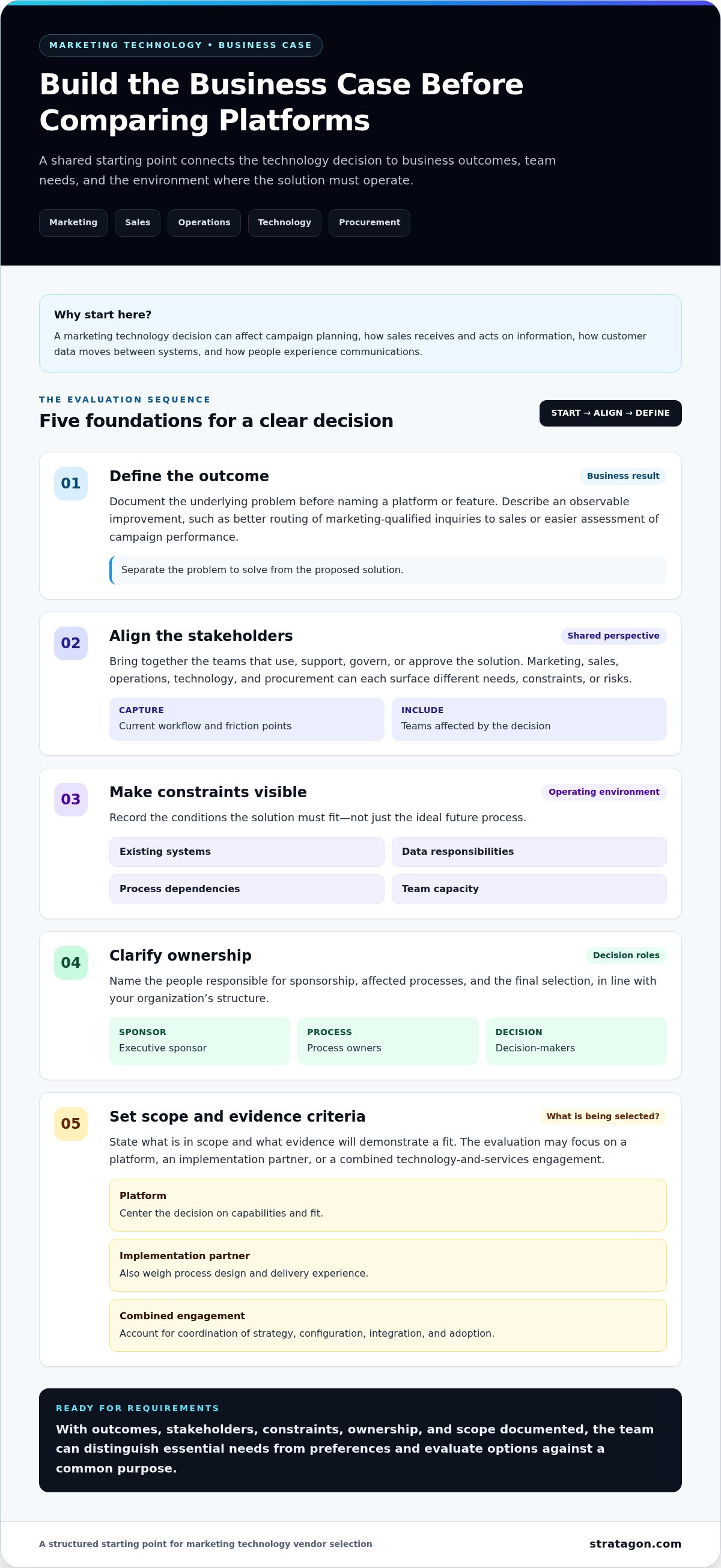
A marketing technology decision rarely stays within the marketing department. A new platform can change how campaigns are planned, how sales receives and acts on information, how customer data moves between systems, and how people experience communications. That makes the vendor selection process for marketing technology a business decision, not just a software comparison.
Starting with a preferred tool or feature can narrow the search too early. A team may seek automation to address slow campaign launches, for example, when the root issue is unclear approval ownership or disconnected customer data. The technology might help, but only if it addresses the agreed problem and fits the process around it. A business case gives stakeholders a shared basis for evaluating options instead of asking which demo looks most impressive.
Define the business outcomes before naming a platform
Translate organizational priorities into observable outcomes, such as improving how marketing-qualified inquiries reach sales or making campaign performance easier to assess. First document the underlying problem, then distinguish it from a proposed solution. If automation is under consideration, What is Marketing Automation? offers foundational context on the category and its functions.
Record the current workflow, points of friction, relevant data gaps, and teams affected. This baseline helps clarify what should change and gives vendor discussions a concrete business scenario to address.
Align stakeholders on scope, ownership, and decision criteria
Bring in the perspectives that shape the work. Marketing, sales, operations, technology, and procurement may each identify different needs, constraints, or risks. Name an executive sponsor, process owners, and decision-makers according to your organization’s structure. Capture existing systems, data responsibilities, and team capacity so the evaluation reflects the environment where the solution must operate.
Set the decision scope before comparing vendors. Are you selecting a platform only, an implementation partner, or a combined technology-and-services engagement? A platform decision centers on capabilities and fit. An implementation-partner decision also weighs process design and delivery experience. A combined engagement must account for how strategy, configuration, integration, and adoption will be coordinated. State which elements are in scope and who will own each decision.
Use a concise business-case checklist to establish a reliable starting point:
- Outcomes: What business or workflow result should improve, and how will the team observe progress?
- Stakeholders: Which teams use, support, govern, or approve the solution?
- Constraints: What existing systems, data responsibilities, process dependencies, or capacity limits shape the choice?
- Ownership: Who sponsors the decision, who owns the affected processes, and who makes the final selection?
- Scope and criteria: Is the evaluation for software, implementation support, or both, and what evidence will demonstrate a fit?
Once these points are documented, the team can move into requirements with a common purpose. That alignment helps distinguish essential needs from preferences and keeps the evaluation tied to business value.
How to Turn Marketing Technology Needs into Vendor Requirements
A useful requirements document translates the business case into needs vendors can address and your team can verify. It should reflect how work happens across marketing, sales, operations, and technology, not just the features stakeholders remember from a product demo. In the vendor selection process for marketing technology, clear requirements make comparisons more consistent and reveal where assumptions still need evidence.
Map workflows, users, data, and existing systems
Start with the path your audience and teams follow: how people are attracted, engaged, qualified, and measured. Map handoffs, identify the users involved at each stage, and note who owns the process and its data. Add current platforms and dependencies, including CRM and marketing automation systems where applicable. This view helps surface practical needs, such as transferring an inquiry with its campaign context to the right sales workflow.
Prioritize requirements with a practical scorecard
Not every request has equal weight. Separate must-have capabilities from valuable enhancements and future-state aspirations, then rank criteria by business importance. Use shared rating definitions so stakeholders judge vendors consistently, and record whether each requirement is demonstrated, documented, or unresolved. An unresolved item is a diligence question, not evidence of capability.
Build the requirements in a deliberate sequence:
- Map the workflow. Describe the current process from audience engagement through follow-up and measurement. Capture bottlenecks, handoffs, and exceptions rather than documenting only the ideal path.
- Identify user groups. Include people who configure campaigns, manage data, review performance, support the platform, and act on information. Note their needs and level of involvement.
- Write testable requirements. State what a user or process must be able to do. For example, specify that campaign engagement data should be available to the team responsible for follow-up, rather than asking for “better reporting.”
- Prioritize each need. Mark it as essential, beneficial, or future-state, and assign importance based on its connection to the business outcome and workflow.
- Define validation evidence. Specify how the requirement will be assessed, such as a realistic scenario, system documentation, or a structured discussion with the relevant owner.
Cover more than features. Include usability for different roles, integration with current systems, access to and use of data, governance responsibilities, support expectations, and the proposed implementation approach. Describe requirements in terms of tasks and outcomes so vendors can respond to the same operating scenario.
Put the results in a requirements matrix with columns for the need, affected workflow, owner, priority, validation method, and evidence status. For scoring, define a simple scale in advance, such as “meets,” “partially meets,” and “does not meet,” with a short explanation for each rating. Keep notes tied to evidence, and flag dependencies or unresolved items instead of hiding them in an average score. This makes trade-offs visible and gives decision-makers a traceable rationale for the shortlist.
When requirements span strategy, systems, and execution, marketing technology and implementation services can help connect those considerations to a workable plan.
How to Compare Marketing Technology Vendors Beyond the Demo
A polished demo can make different platforms appear equally capable. A disciplined comparison shifts attention from presentation quality to evidence: can each option support the workflows, integrations, and responsibilities your organization needs? Apply the same prioritized requirements and scenarios to every shortlisted vendor. That consistency makes trade-offs visible and keeps the evaluation grounded in operating fit, not the longest feature list.
Design demos around real workflows and decision criteria
Give each vendor the same practical scenarios, data context, and success conditions. For example, ask them to demonstrate how a campaign response is captured, routed to the appropriate team, and reflected in a performance report. Have evaluators observe usability, handoffs, reporting, and exceptions, including what happens when information is incomplete or a process changes. Score what the team sees against documented requirements, not the fluency of the presenter.
Keep the evidence organized as you compare. A simple matrix can separate a capability shown in a scenario from a statement made by the vendor and a question that remains open:
Platform fit: Demonstrated evidence: how the platform handles the agreed workflow. Vendor claim: capabilities described but not shown. Remaining question: whether the workflow supports relevant user roles and exceptions.
Implementation capability: Demonstrated evidence: a clear approach to planning, configuration, and execution. Vendor claim: experience or methods stated in discussion. Remaining question: how the proposed approach fits your team’s capacity and scope.
Integration approach: Demonstrated evidence: how information moves between the platform and existing systems in the scenario. Vendor claim: integrations described in materials. Remaining question: data ownership, dependencies, and work needed to support the connection.
Governance and support: Demonstrated evidence: how permissions, process ownership, and support needs are addressed. Vendor claim: stated practices or resources. Remaining question: who maintains decisions and resolves issues after implementation.
Use the same labels for every vendor: “demonstrated,” “claimed,” or “unresolved.” This distinction prevents an unverified statement from carrying the same weight as observed evidence, and gives the evaluation team a focused list of follow-up items.
Evaluate the technology partner as well as the platform
Software and delivery capability are separate dimensions. Consider whether the partner connects strategic planning to implementation and execution, and whether its experience aligns with your industry, workflows, and technology environment. Assess how responsibilities will be divided, how internal teams will collaborate, what knowledge will transfer, and who will own the solution’s ongoing operation.
Compare these factors independently rather than blending them into one impression. A strong platform fit doesn’t automatically resolve implementation or ownership questions, just as an experienced partner can’t make a poor technology fit suitable. The vendor selection process for marketing technology should end with a reasoned view of both: which option best supports the work, and whether the people and operating model around it can put that fit into practice.
How to Reduce Risk Before Selecting a Marketing Technology Vendor
A platform can meet documented requirements and still underperform if teams can’t adopt it or no one owns the processes around it. Risk diligence tests the conditions for success as well as technical fit. During the vendor selection process for marketing technology, surface capacity constraints, dependencies, and unanswered questions before approval, while there’s still room to adjust scope or plan mitigation.
Test implementation readiness and organizational capacity
Identify internal owners for data, workflows, integrations, training, and ongoing administration. Then assess whether those people can participate in design decisions, testing, and adoption alongside their existing responsibilities. A gap in ownership or capacity doesn’t automatically rule out a solution, but it should shape the implementation approach and responsibilities.
Document dependencies that could affect scope, such as required data cleanup, a decision about process ownership, or coordination with another system. Give each dependency an owner and record what decision or action is needed before work can proceed.
Validate data handling, integration, and governance
Trace the data relevant to the proposed use cases: where it originates, which teams need access, how it moves between systems, and who is accountable for its use. Review the integration approach in terms of responsibilities and dependencies, not just whether a connection is described as available. Keep privacy, security, access, and governance questions visible for review by the appropriate internal owners.
Use specific scenarios to expose gaps. For example, if campaign activity should inform a sales follow-up, clarify which information is shared, who can access it, and who resolves discrepancies between systems. Record open questions without assuming the vendor’s answer or applying a standard that hasn’t been established for your organization.
Before the decision, maintain a risk and readiness record. For each item, capture:
- Assumption: What the evaluation is taking as true, such as a team’s ability to support a new workflow.
- Dependency: What must be in place, including data decisions, integration work, or internal approvals.
- Responsibility: Who will resolve the issue, make the decision, or own the process.
- Open risk: What remains uncertain, its potential effect, and when it must be addressed.
- Mitigation: A practical response, such as clarifying scope, assigning an owner, or validating an assumption before implementation.
Close with a balanced decision record, not just a vendor score. Summarize expected benefits, trade-offs, evidence supporting the choice, unresolved questions, and mitigation plans. A solution may offer strong workflow fit while requiring more internal coordination. Documenting that trade-off helps leaders decide with a realistic view of the commitment. It also creates a useful handoff from evaluation into implementation planning, where responsibilities and adoption work can be made explicit.
For support connecting technology decisions with implementation planning, explore marketing technology and digital transformation services.
From Vendor Selection to a Marketing Technology Partnership
A vendor decision creates value only when the evaluation’s rationale carries into implementation and daily use. Convert the selection record into a shared operating plan: what’s in scope, who owns each workstream, how teams will make decisions, and which business outcomes they’ll review. This continuity keeps the chosen technology connected to marketing and sales priorities rather than treating implementation as a separate technical exercise.
Build a decision-to-implementation handoff
Give the implementation team the prioritized requirements, scenario findings, and documented assumptions from the evaluation. Translate them into workstreams, owners, dependencies, and decision rights. Set communication and escalation paths so teams can resolve questions without losing sight of scope. Agree on review points for adoption, workflow performance, and business outcomes, using measures tied to the original objectives.
The handoff should make next steps actionable. For example, if the selection depends on a defined data flow or a new marketing-to-sales handoff, name the owners responsible for documenting, configuring, testing, and accepting that work. Establish who approves changes and how unresolved decisions are escalated. This gives stakeholders a shared reference as implementation details become more specific.
Measurement also needs clear ownership. Choose indicators that show whether teams are adopting the solution and whether the affected processes are working as intended. Pair those operational signals with the business outcomes the organization set out to improve. Review them at agreed points, investigate gaps, and adjust the plan where evidence shows a workflow or adoption issue. The aim is a useful feedback loop, not a dashboard detached from decisions.
Choose a partner for strategic alignment and execution
A strong technology partnership connects strategy, platform decisions, creative work, and execution around shared goals. Look for alignment between the partner’s approach and your marketing and sales priorities, as well as clarity about collaboration, knowledge transfer, and ongoing ownership. Stratagon’s HubSpot Partner Solutions and Salesforce Design & Development capabilities connect technology decisions with implementation and business processes.
Relevant work can help decision-makers understand how those capabilities apply in practice, without implying that another organization’s results will be replicated. Stratagon’s client work and case studies include HubSpot CRM optimization for Force Management. A higher-education client also grew its prospective student base by 150% over three years. That result belongs to that client; it illustrates a documented outcome, not a promise for future engagements.
The vendor selection process for marketing technology is complete when the choice has a clear rationale and a workable path to adoption, ownership, and measurement. To connect technology planning with coordinated marketing, creative, and execution support, explore Stratagon’s services.
Make Your Next Technology Decision a Growth Enabler
The next step is to turn your selection rationale into a working agreement: define who will own the system, how teams will collaborate, and what evidence will show that the investment is supporting business priorities. That commitment keeps the vendor selection process for marketing technology connected to the way people work and the outcomes leadership needs to see.
Stratagon brings together HubSpot Partner Solutions and Salesforce Design & Development to connect marketing, sales, and technology decisions. Its experience includes a HubSpot CMS Enterprise implementation for a YMCA, alongside CRM optimization work for Force Management. These examples reflect distinct engagements, not a promise of identical results.
Choose a partner who can help carry the decision into coordinated execution, with clear ownership and progress measures. Explore how Stratagon connects marketing, sales, and technology and take a confident next step toward a more aligned, measurable growth engine.
Frequently Asked Questions
How long does a marketing technology vendor selection process take?
There’s no single timeline that fits every organization. Scope, stakeholder availability, data and integration complexity, and the number of options under consideration all affect the vendor selection process for marketing technology. Set milestones for requirements, evaluation, diligence, and approval, then plan implementation separately. For each milestone, identify the decision or evidence needed to proceed. A compressed schedule shouldn’t replace input from key decision-makers or validation of important claims.
Who should be involved in choosing marketing technology?
Include people accountable for business outcomes, users of the workflows, data owners, and teams that support the technology. For example, a campaign workflow may require input from marketing users, sales staff who act on responses, and the technology team responsible for systems. Assign a decision owner and distinguish who advises, evaluates, and approves. This keeps feedback useful and gives stakeholders a clear role if priorities conflict.
What should a marketing technology vendor scorecard include?
A scorecard should reflect your organization’s prioritized needs, not a generic list of features. Include workflow fit, usability, integration, data access, governance, implementation approach, support, and relevant experience. Give each criterion an owner, define the rating scale in advance, and note the evidence behind each score. For instance, distinguish a capability demonstrated in a scenario from one described in a presentation, then document trade-offs that affect the decision.
How do you compare marketing technology vendors fairly?
Give each shortlisted vendor the same use cases, evaluation conditions, and opportunity to address follow-up questions. Ask evaluators to score their observations independently before discussing differences as a group. This can reveal where a high score reflects different assumptions rather than stronger fit. Record gaps and supporting evidence consistently, and assess organizational fit alongside product capabilities. The result is a decision the team can explain and support.
What risks should buyers check before selecting a marketing technology vendor?
Review implementation dependencies, data flows, integration responsibilities, governance, security questions, internal capacity, and user adoption. A useful practical test is to trace one proposed use case from its data source through the teams and systems involved, noting who can access or change information. Assign an owner to each open issue and document how it will be addressed. The aim is to understand material risks and plan for them, not assume every uncertainty can be removed.
Should we choose a marketing technology platform or an implementation partner first?
Treat the platform and implementation partner as connected choices, guided by your business outcomes and requirements. If your team already has the capacity and expertise to configure workflows and manage change, platform fit may be the central evaluation. If the work depends on complex process or system changes, partner capability may weigh more heavily. In either case, assess how the selected combination will support execution and preserve clear ownership.
How can we measure whether the selected marketing technology is working?
Compare performance with the baseline established before selection, using indicators that reflect both adoption and business impact. For example, review whether teams follow the intended handoff process, whether records contain the information users need, and whether agreed marketing or sales outcomes change. Assign owners and set review intervals that fit the work. Interpret results alongside process changes and other contributing factors rather than crediting the software alone.