RevOps, Sales Ops, Marketing Ops: 2026 Alignment Guide

What if the friction stalling your revenue growth isn't a lack of talent, but the very structural silos you built to manage it? Most executive leaders recognize the frustration of reviewing three different departmental dashboards only to find three conflicting versions of the truth. It's a common struggle. Overlapping tech stacks drain budgets while lead handoffs remain clumsy and disconnected. You aren't alone in feeling that your operational engine is working against itself rather than fueling your momentum.
Understanding the differences between revops vs sales ops vs marketing ops is no longer just a choice of titles; it's a strategic decision about the architecture of your business. To compete in 2026, you must move beyond isolated efficiency and toward integrated revenue health that empowers your people. This guide promises to help you master the nuances between departmental operations and the holistic RevOps model so you can drive scalable, data-informed growth. We'll explore a clear framework for operational responsibility, show you how to improve decision-making through unified data, and provide a practical roadmap for total organizational alignment.
Key Takeaways
- Distinguish between top-of-funnel lead management and the closing process to ensure every stage of the customer journey has clear operational ownership.
- Evaluate the strategic scope of revops vs sales ops vs marketing ops to determine which model best supports your organization's specific growth targets.
- Eliminate technical debt and overlapping tools by establishing a unified framework for CRM and automation platform management.
- Identify the specific friction points, such as data silos and clumsy handoffs, that signal your organization's readiness for a RevOps transition.
- Build a 2026-ready revenue engine by aligning human performance with sophisticated digital transformation and unified data models.
Defining the Triad: Marketing Ops, Sales Ops, and RevOps
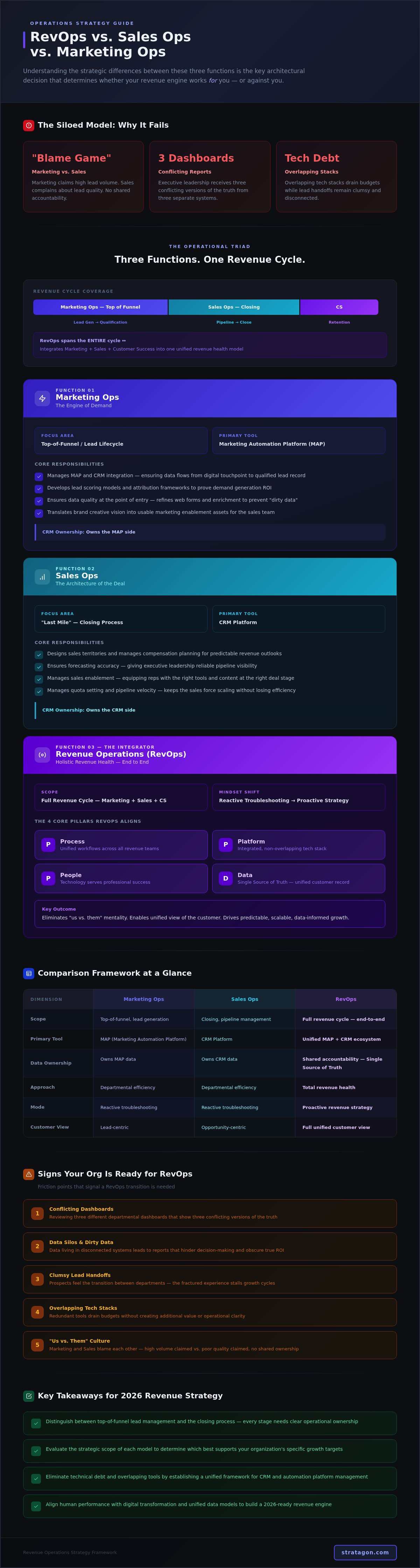
Growth demands more than volume. It requires structural integrity. To understand revops vs sales ops vs marketing ops, we must first look at how these functions anchor the revenue engine. Marketing Ops acts as the architect of the top-of-funnel, managing the technology and lead generation workflows that initiate the customer relationship. They ensure data flows from a digital touchpoint into a qualified lead record with precision.
In contrast, Sales Operations focuses on the "last mile" of the revenue cycle. This function optimizes the closing process through CRM management and sales enablement. While Marketing Ops builds the engine, Sales Ops ensures the vehicle stays on the road by managing territories, quotas, and pipeline velocity. Finally, Revenue Operations (RevOps) emerges as the holistic integration of marketing, sales, and customer success. It represents a shift from departmental efficiency to total revenue health.
The Traditional Siloed Model
Historically, Marketing and Sales Ops functioned as independent support units. This separation often leads to the "Blame Game." Marketing teams point to high lead volumes, while sales teams complain about lead quality. When data lives in disconnected systems, executive leadership receives conflicting reports. These silos create friction in the customer journey, causing prospects to feel the handoff between departments rather than a seamless transition. The result is a fractured experience that stalls growth cycles and obscures the true ROI of your tech stack.
The Rise of Revenue Operations
RevOps isn't just a new department; it's a strategic mindset. It serves as the connective tissue for the entire organization by aligning four core pillars: Process, Platform, People, and Data. By centralizing these elements, RevOps eliminates the "us vs. them" mentality that plagues siloed organizations. It prioritizes the human element within technical systems, ensuring that technology serves professional success rather than creating more work. This integrated approach allows for a unified view of the customer, enabling data-informed decision-making that drives predictable, scalable growth. In the context of revops vs sales ops vs marketing ops, the transition to RevOps marks the move from reactive troubleshooting to proactive revenue strategy.
Core Responsibilities: Where the Lines are Drawn
Distinguishing between tactical execution and strategic process optimization defines the operational maturity of a business. While the conversation around revops vs sales ops vs marketing ops often focuses on organizational charts, the practical reality is found in daily ownership. Each function manages a specific segment of the revenue cycle, yet they must synchronize to prevent data decay and process friction. This coordination ensures that technology remains a tool for human success rather than a source of administrative burden.
Marketing Ops: The Engine of Demand
Marketing Ops professionals act as the guardians of the lead lifecycle. Their primary responsibility involves managing the marketing automation platform (MAP) and its intricate integration with the CRM. They develop sophisticated lead scoring models and attribution frameworks to prove the efficacy of demand generation efforts. Beyond technical maintenance, they ensure data quality at the point of entry. By refining web forms and enrichment processes, they prevent "dirty data" from polluting the sales pipeline and damaging the integrity of the entire revenue record. For organizations looking to align their operations with targeted account-based marketing and modern demand capture, read more about specialized B2B marketing strategies.
Sales Ops: The Architecture of the Deal
Sales Ops focuses on the mechanics of conversion. This team designs sales territories, manages compensation planning, and ensures forecasting accuracy to provide executive leadership with predictable revenue outlooks. Their role in sales enablement is critical; they equip reps with the right tools and content at the precise moment they're needed in the deal cycle. While Marketing Ops builds interest, Sales Ops builds the infrastructure that allows a sales force to scale without losing efficiency or momentum.
Effective data governance requires a clear "Single Source of Truth." In a siloed model, Marketing Ops typically owns the MAP while Sales Ops owns the CRM. This divide often creates the very data silos that hinder growth. Successful digital transformation requires these teams to move past simple tool management and toward shared accountability for the entire customer record. Enablement serves as a vital bridge here. Marketing enablement ensures that the brand's creative vision translates into usable assets, while sales enablement focuses on the tactical application of those assets to close deals. Without a unified strategy, these efforts often overlap or conflict, leading to inefficient tech stack spend. Establishing a rigorous framework for tech ownership is the first step toward a high-performance revenue engine.
Comparison Framework: RevOps vs. Sales Ops vs. Marketing Ops
Understanding the hierarchy of influence is essential for any executive leadership team looking to scale. While departmental operations teams focus on localized efficiency, a unified revenue model expands the lens to the entire business lifecycle. This evolution moves the function from reactive troubleshooting-fixing broken workflows or cleaning data-to a proactive strategic partnership. When evaluating revops vs sales ops vs marketing ops, the primary difference lies in the scope of accountability and the complexity of the tech stack managed.
Key Performance Indicators (KPIs) Compared
Metrics serve as the ultimate indicator of operational focus. In a departmental model, success is often measured by volume and immediate conversion. Marketing Ops prioritizes Marketing Qualified Leads (MQLs), cost per acquisition (CPA), and campaign conversion rates. These are vital for measuring demand generation but often stop at the handoff. Sales Ops picks up the baton, focusing on win rates, sales cycle length, and average deal size to ensure the architecture of the deal remains sound.
A Revenue Operations model shifts the focus toward long-term revenue health and sustainability. Success is no longer defined by a single department's output but by the efficiency of the entire engine. Key metrics include:
- Net Revenue Retention (NRR): Measuring the ability to keep and grow existing customer revenue.
- Customer Lifetime Value (LTV): Understanding the total worth of a customer over the duration of the relationship.
- CAC Payback Period: Calculating the time it takes to earn back the cost of acquiring a new customer.
Organizational Impact and Authority
The reporting structure often dictates the strategic weight of an operations team. Marketing Ops traditionally reports to the CMO, while Sales Ops reports to a VP of Sales or the CRO. This departmental alignment naturally prioritizes the goals of that specific leader. In contrast, RevOps often reports directly to the CRO or even the COO, centralizing authority and budget ownership. This consolidation is a critical component of successful digital transformation, as it allows for a unified roadmap rather than competing departmental projects.
By controlling the technology spend across the organization, a RevOps leader can eliminate overlapping tools and ensure that the tech stack is integrated by design. This authority enables them to influence the long-term strategic direction of the company, ensuring that every process, platform, and person is aligned toward a single revenue goal. It transforms operations from a cost center into a high-impact growth driver that respects the human element of the business while leveraging the full power of data.
Transitioning to RevOps: Is Your Organization Ready?
The decision to evolve beyond the debate of revops vs sales ops vs marketing ops often happens when the cost of friction exceeds the cost of change. Growth-oriented organizations eventually reach a threshold where departmental speed actually hinders organizational scale. This transition isn't merely an administrative reshuffle; it's a fundamental commitment to a unified revenue architecture that supports long-term health. Moving toward an integrated model requires a visionary mindset that values interpersonal connection as much as technical prowess.
Signs You Need a RevOps Model
Identifying the need for consolidation starts with observing the daily operational experience of your leadership team. If executive meetings frequently stall because stakeholders are debating which department's spreadsheet is correct, you have a data governance crisis. Common friction points include:
- Inconsistent data reporting: Marketing reports high lead volumes while Sales sees low-quality opportunities, with no shared framework to reconcile the gap.
- A "Franken-stack" of tools: Your organization manages multiple overlapping software subscriptions that don't communicate, leading to manual data entry and human error.
- Clumsy handoffs: Prospects experience a jarring shift in tone or information as they move from a marketing nurture track into a sales conversation.
A Roadmap for Operational Alignment
Transitioning to a holistic model requires a structured approach that balances technical prowess with human-centric strategy. It begins with a comprehensive audit of your current processes, platforms, and people. You must identify where data leaks occur and where technology creates more work than it saves. This audit provides the clarity needed to rebuild your revenue engine on a foundation of reliability.
Establishing a unified revenue committee is the next logical step. This cross-functional group oversees the transition, ensuring that neither sales nor marketing interests override the collective goal of revenue health. Prioritizing the human element is vital. Without proper training and change management, even the most sophisticated CRM optimization will fail to produce results. The focus must remain on empowering your team to use technology as a tool for professional success.
Looking toward 2026, the urgency for a unified data model is driven by the rapid adoption of AI and advanced automation. These systems require a clean, integrated data source to provide actionable insights. If your data remains siloed in departmental buckets, your automation efforts will only accelerate existing inefficiencies. Managing this complexity requires a partner who understands the intersection of technology and strategy. Explore how our digital transformation services can guide your organization through a seamless RevOps transition.
Optimizing Your Revenue Engine with Stratagon
Stratagon acts as a high-level strategic partner to bridge the gap between executive vision and tactical execution. While the internal debate over revops vs sales ops vs marketing ops often centers on departmental boundaries, we focus on the ultimate objective: sustainable revenue health. Our methodology leverages a unique triad of strategy, technology, and creative expertise to ensure your operational architecture supports both your digital transformation and your human capital. We don't just provide services; we build the strategic framework that allows your business to scale with predictability and momentum.
HubSpot CRM as the Foundation for RevOps
HubSpot serves as the primary catalyst for mid-market and enterprise RevOps transitions. As a HubSpot Diamond Partner, we specialize in consolidating marketing, sales, and service functions into a single, unified hub. This process goes far beyond basic software setup. We focus on custom CRM implementation and optimization that accounts for the nuances of complex B2B sales cycles in industries like financial services and higher education. By centralizing your tech stack, we eliminate lead handoff friction and provide a clear framework for operational responsibility. Firms looking to scale their operations can explore our digital transformation solutions to build a unified revenue platform that respects the reader's time and delivers expert results.
Measuring What Matters: Data-Informed Growth
True revenue growth requires moving beyond vanity metrics like raw lead counts or email open rates. We help executive leadership teams identify the underlying reasoning behind their data, focusing on high-impact indicators like Net Revenue Retention and Lifetime Value. Our goal is to build auditable, transparent reporting that gives you quiet confidence in your decision-making. We transform data from a source of confusion into a tool for professional success. You can view our work to see how this structured approach translates into measurable outcomes for organizations navigating complex commercial challenges.
Choosing a strategic partner for your RevOps transformation means finding an entity that values interpersonal connection as much as technical prowess. We engage directly in the collaborative work of aligning your internal business functions, ensuring that the transition from isolated operations to a unified RevOps model is seamless. By prioritizing the human element within technical systems, we help you create a high-performance culture that is both refined and repeatable. In the evolving landscape of revops vs sales ops vs marketing ops, Stratagon provides the reliability and forward-thinking innovation needed to turn your operational engine into a primary driver of growth.
Architecting Your Future Revenue Health
The evolution of your organizational structure is the most critical lever for sustainable growth. Moving beyond the traditional debate of revops vs sales ops vs marketing ops allows your leadership team to focus on a unified revenue record. By aligning your technology and processes, you eliminate the data silos that cause friction and drain resources. This strategic shift ensures that every department works in unison toward shared revenue health rather than isolated departmental goals.
As a HubSpot Diamond Partner with over 20 years of digital transformation experience, Stratagon understands the complexities of B2B revenue cycles. We help you bridge the gap between visionary strategy and tactical execution, ensuring your team is equipped for the operational challenges of 2026. Your revenue engine should be your greatest competitive advantage, not a source of administrative burden.
Schedule a Strategic Consulting Session with Stratagon to begin your transition toward a high-performance, integrated model. The path to scalable, data-informed growth starts with a single step toward total organizational alignment.
Frequently Asked Questions
What is the main difference between RevOps and Sales Ops?
The main difference lies in scope and accountability. Sales Ops is a departmental function focused on optimizing the sales cycle, pipeline management, and rep enablement. In the debate of revops vs sales ops vs marketing ops, Revenue Operations acts as a holistic layer that integrates marketing, sales, and customer success. While Sales Ops aims for closing efficiency, RevOps prioritizes total revenue health across the entire customer lifecycle to ensure long-term scalability.
Does a small company need RevOps or should they start with Marketing Ops?
Small companies should prioritize a RevOps mindset even if they start with a single operational hire. Tactical execution often begins with Marketing Ops to manage lead generation, but ignoring the broader revenue architecture creates technical debt. By establishing a unified data model early, you avoid the friction of siloed reporting later. It's more efficient to build an integrated engine from the start than to dismantle a fractured "Franken-stack" once you reach a growth inflection point.
How does RevOps improve the customer experience?
RevOps improves the customer experience by eliminating the jarring handoffs between departments. When marketing, sales, and customer service operate on a shared data platform, the prospect's journey feels seamless. They don't have to repeat information to different reps, and the brand's messaging remains consistent from the first touchpoint to the final renewal. This alignment builds trust and reduces the friction that often leads to churn in disconnected organizations.
Can HubSpot be used to manage a full RevOps model?
HubSpot is an ideal foundation for a full RevOps model because it natively integrates marketing, sales, and service data. As a HubSpot Diamond Partner, we've seen how consolidating these functions into a single hub provides the "Single Source of Truth" required for sophisticated growth. The platform's Operations Hub specifically enables advanced data orchestration and automation, allowing firms to manage complex B2B revenue cycles without the need for multiple disconnected tools.
What are the first steps to transitioning from siloed ops to RevOps?
Transitioning starts with a comprehensive audit of your existing processes, platforms, and people. You must identify where data leaks occur and where departmental KPIs conflict. Once you've mapped the current state, establish a cross-functional revenue committee to oversee the shift. This group ensures that the move from siloed operations to an integrated model respects the human element while prioritizing technical efficiency. It's about building a strategic roadmap for total organizational alignment.
Who should the Head of RevOps report to in 2026?
In 2026, the Head of RevOps should report to the Chief Revenue Officer (CRO) or the Chief Operating Officer (COO). This reporting structure provides the necessary authority to influence processes across marketing, sales, and customer success. Reporting to a single departmental head, like a CMO, often limits the scope of the role and reinforces the very silos RevOps is designed to break. Centralizing leadership ensures that revenue strategy remains a primary business driver.
How does AI impact the roles of Sales and Marketing Ops?
AI transforms Sales and Marketing Ops by automating routine data hygiene and predictive modeling tasks. However, these tools only provide value when built on a unified data foundation. In the context of revops vs sales ops vs marketing ops, AI serves as a catalyst for consolidation. It allows ops professionals to shift from reactive troubleshooting to proactive strategic planning. Without an integrated model, AI only accelerates existing departmental inefficiencies and data discrepancies.
What is the typical ROI of implementing a RevOps function?
The ROI of a RevOps function is measured through increased sales productivity, reduced tech stack waste, and improved net revenue retention. By eliminating overlapping software subscriptions and manual data entry, organizations see immediate operational savings. More importantly, a unified revenue engine drives predictable growth by shortening sales cycles and identifying expansion opportunities within the existing customer base. It transforms operations from a necessary cost center into a high-impact strategic partner for the entire business.