Sales Enablement Tools: Building a Strategic Revenue Engine in 2026

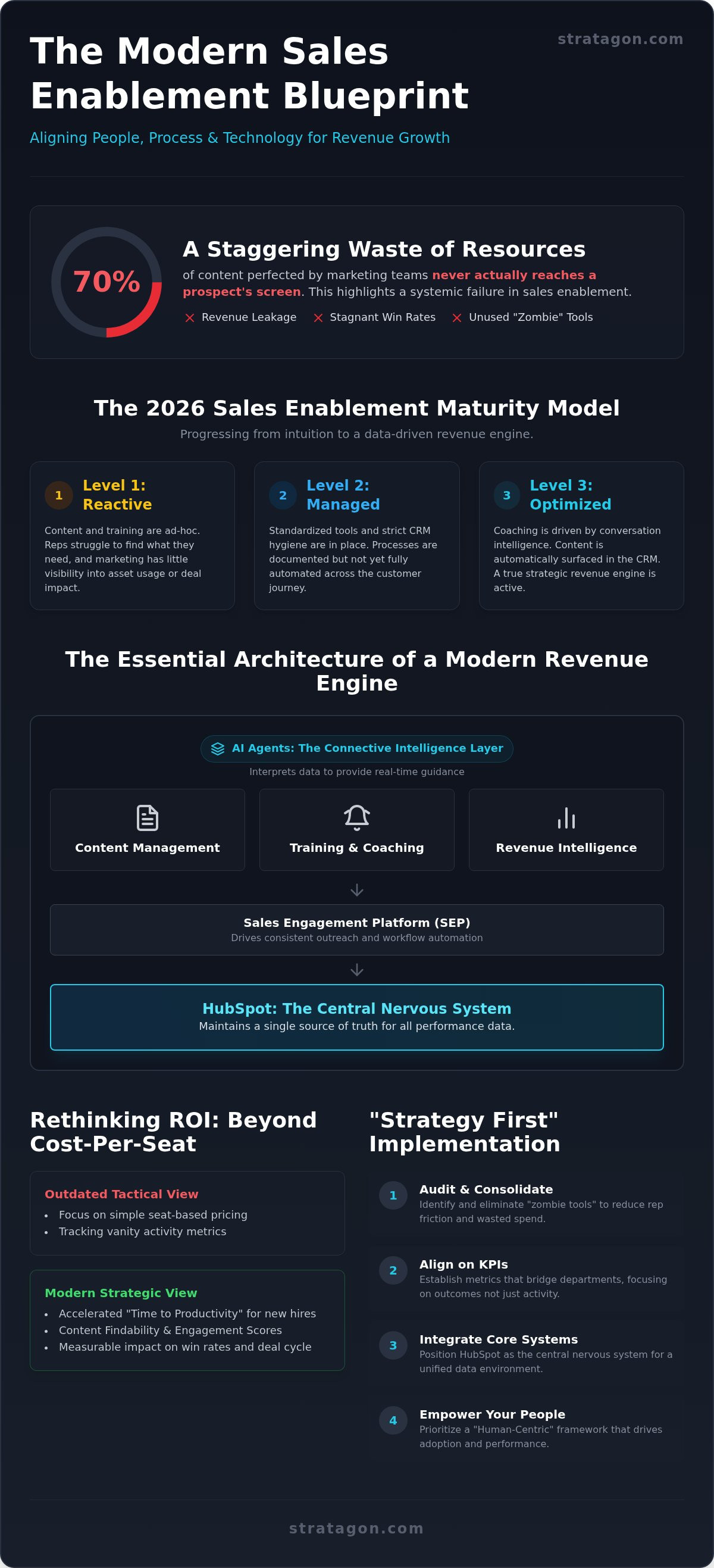
Did you know that 70% of the content marketing teams spend months perfecting never actually reaches a prospect's screen? This staggering waste of resources highlights a systemic failure in how organizations deploy sales enablement tools. While the market has consolidated into powerhouses like the merged Seismic and Highspot entities, many leadership teams still manage a graveyard of expensive, disconnected software that reps simply ignore. Fragmented data and a lack of alignment between marketing assets and sales conversations prevent even the most advanced teams from reaching their full potential.
You've likely experienced the friction of stagnant win rates despite a growing investment in complex technology. We believe that tools should empower your people, not overwhelm them. You'll learn how to master the architecture of modern revenue enablement and align your tech stack with a high-impact strategy. We explore the shift toward AI-native platforms, the importance of a single source of truth in HubSpot, and the tactical steps required to turn your sales infrastructure into a predictable revenue engine.
Key Takeaways
- Learn how to categorize sales enablement tools into high-impact pillars like content management and conversation intelligence to eliminate revenue leakage.
- Shift your ROI evaluation from simple seat-based pricing to strategic outcomes such as accelerated "Time to Productivity" for new sales hires.
- Discover the "Human-Centric" implementation framework that prioritizes organizational alignment and rep adoption over mere software deployment.
- Understand how to position HubSpot as the central nervous system of your revenue engine to maintain a single source of truth for all performance data.
- Explore the advantages of a managed enablement model that combines strategy, creative, and technology for continuous growth optimization.
Beyond the Tech Stack: Redefining Sales Enablement for 2026
The definition of sales enablement has moved far beyond providing reps with a few PDF case studies or static training decks. In 2026, we've entered the era of the "Agentic CRM," where AI agents proactively surface insights and execute repetitive tasks. Sales enablement is the strategic alignment of people, processes, and technology to maximize revenue performance across the customer lifecycle. While many organizations rush to acquire the latest sales enablement tools, the most successful firms recognize that technology is merely a vehicle for a well-defined go-to-market strategy. Without a clear framework, even the most advanced software becomes an expensive distraction.
High-growth companies no longer view enablement as a tactical support function. Instead, they build a "Revenue Engine" that bridges the gap between marketing activity and sales results. This shift is essential because tool proliferation often leads to revenue leakage. When data is siloed across disconnected platforms, reps spend more time navigating software than engaging with buyers. To understand where your organization stands, you must evaluate your position within the broader context of Sales Operations and Enablement. True efficiency comes from a unified stack that supports the human element of the sale.
The 2026 Sales Enablement Maturity Model
Progressing through the maturity model requires a shift from intuition to data-driven execution. Most organizations fall into one of three categories:
- Level 1: Reactive. Content and training are ad-hoc. Reps struggle to find what they need, and marketing has little visibility into asset usage or deal impact.
- Level 2: Managed. Organizations utilize standardized sales enablement tools and enforce strict CRM hygiene. Processes are documented, though not yet fully automated across the entire customer journey.
- Level 3: Optimized. This is the hallmark of a strategic revenue engine. Coaching is driven by real-time conversation intelligence, and content is automatically surfaced within the CRM based on deal stage, buyer persona, and intent signals.
Why Strategy Must Precede Software Acquisition
Automating a broken sales process only accelerates failure. Before purchasing new software, conduct a thorough technology audit to identify "zombie tools"—platforms that are paid for but rarely used by the field. This audit ensures your stack remains lean and focused on human performance rather than feature count. Identifying these redundancies requires looking at login frequency and feature overlap. If two tools provide similar intelligence, consolidate them to reduce rep friction.
Establishing KPIs that measure the bridge between departments is vital. Focus on metrics like "Time to Productivity" for new hires and content findability scores rather than just vanity activity metrics. By prioritizing strategy first, you ensure that your HubSpot implementation serves as the central nervous system of a high-impact revenue strategy, turning technical infrastructure into a competitive advantage.
The Essential Architecture of Modern Sales Enablement Tools
Building a strategic revenue engine requires more than a collection of apps; it demands a cohesive technical architecture. A modern stack consists of three primary pillars: Content Management, Training and Coaching, and Revenue Intelligence. This structured approach aligns with the Sales Enablement Definition and Strategy that emphasizes integrated support for the entire buyer journey. When these pillars sit atop a robust Sales Engagement Platform (SEP), they drive consistent outreach while maintaining HubSpot as the central nervous system of your operation. This ensures a single source of truth where every interaction is captured and analyzed for performance optimization.
AI agents are the latest evolution in this architecture, acting as the connective tissue between data and action. These agents don't just store information; they interpret it to provide real-time guidance during live sales calls. By integrating sales enablement tools directly into the rep's workflow, organizations eliminate the friction that typically leads to low software adoption. This intelligence layer allows leadership to move from reactive troubleshooting to proactive strategy, ensuring that every member of the team operates at the level of your top performers.
Content Enablement: Surfacing the Right Asset at the Right Time
In 2026, content enablement has moved beyond simple cloud storage. Intelligent surfacing tools now use predictive algorithms to suggest specific assets based on real-time CRM triggers, such as intent signals or specific deal stages. It's no longer enough to maintain a library; the system must know which case study or technical white paper moves a prospect from "considering" to "committed." This technical precision requires high-quality B2B copywriting to ensure the messaging resonates with sophisticated, data-driven buyers. By tracking asset engagement data, teams can finally measure content ROI, identifying exactly which resources contribute to closed-won revenue and which are simply noise in the funnel.
Training and Coaching: Building Skills That Scale
AI agents have revolutionized rep development by providing immersive, real-time role-play environments. Instead of waiting for a weekly manager 1:1, reps practice handling complex objections with an AI that mimics specific buyer personas and historical negotiation patterns. This shift from manual "shadowing" to data-driven conversation intelligence allows for continuous learning at scale. Using Stratagon’s educational solutions, organizations bridge critical skill gaps identified by these analytical tools. This human-centric approach ensures that technology serves to enhance professional prowess rather than replace it. If you're ready to audit your current stack, our team can help you design a high-performance enablement architecture tailored to your unique growth goals.
Evaluating ROI: Tactical Tools vs. Strategic Platforms
Measuring the success of sales enablement tools requires a shift from procurement-based metrics to performance-based outcomes. While many organizations focus on the "price per seat," this metric fails to capture the true impact of a technical stack on the bottom line. A tactical approach views software as a fixed cost, but a strategic perspective treats it as a revenue multiplier. To move beyond surface-level analysis, leadership must evaluate how these platforms influence deal velocity and overall win rates. High-performing teams prioritize integrated revenue platforms over fragmented point solutions to eliminate the data silos that typically stall complex B2B sales cycles.
One of the most critical indicators of enablement success is the "Time to Productivity" for new sales hires. In a strategic model, the goal is to compress the onboarding timeline, moving a rep from their first day to their first closed deal as rapidly as possible. When your stack is properly architected, you can track this progression through real-time CRM data. This allows for precise adjustments to training modules and content surfacing rules, ensuring that every rep has the resources needed to reach quota early in their tenure.
The C-Suite Perspective: Proving Revenue Health
Executive leadership rarely cares about tool adoption percentages; they care about revenue health and organizational alignment. Proving ROI at this level involves translating technical metrics into data that reflects digital transformation progress. Strategic sales enablement reduces the cost of customer acquisition (CAC) by increasing rep efficiency and ensuring every marketing dollar spent on lead generation is maximized through superior conversion tactics. By aligning enablement efforts with high-level growth cycles, you demonstrate that technology is a driver of commercial predictability rather than just a line item in the budget.
Total Cost of Ownership (TCO) in Enablement
A comprehensive TCO analysis must account for more than just license fees. It includes implementation, ongoing training, and the internal resources required for management. "Free" tools often carry a hidden cost in the form of lost opportunity and disconnected data, which can lead to significant revenue leakage over time. Working with a HubSpot Diamond Partner ensures that your technical investment is optimized from day one, preventing the technical debt associated with poorly integrated systems. This partnership approach allows you to focus on human performance while experts manage the complexities of the underlying architecture, maximizing the long-term value of your entire revenue engine.
Strategic Implementation: Integrating Tech with Human Performance
Successful implementation of sales enablement tools requires more than a technical handshake between software systems. It demands a human-centric approach that prioritizes the daily experience of the sales representative. Many deployments fail because they ignore the "What’s in it for me?" factor. If a tool adds five minutes of administrative work without providing a clear path to a larger commission check, adoption will inevitably plummet. To avoid this, we recommend establishing a cross-functional Enablement Council. This group, comprising leaders from Sales, Marketing, and Operations, ensures that every technical decision aligns with the practical needs of the field and the overarching revenue strategy.
The transition from basic CRM usage to full-scale revenue automation follows a logical, structured progression. It begins with stabilizing the core data layer and moves toward intelligent workflows that reduce rep friction. By focusing on the human element within these technical systems, you transform software from a management burden into a high-performance engine. This alignment prevents the "revenue leakage" mentioned earlier by ensuring that technology serves the process, rather than the process serving the technology.
CRM: The Foundation of Every Enablement Stack
A successful HubSpot CRM implementation serves as the bedrock for all subsequent enablement efforts. Without a clean, centralized data source, even the most sophisticated AI agents will generate flawed insights. We often see organizations struggle with "garbage in, garbage out" scenarios where fragmented data leads to missed opportunities and inaccurate forecasting. Cleaning your database is an essential prerequisite for any digital transformation. Once the foundation is solid, you can customize dashboards for specific revenue roles, ensuring that account executives and sales development reps see the exact data they need to execute their specific functions with precision.
Change Management: The Secret to High Adoption
Designing intuitive workflows is the only way to guarantee high adoption rates. Reps naturally gravitate toward tools that simplify their lives and accelerate their deal cycles. Continuous feedback loops are essential; leadership must remain open to adjusting the stack based on real-world usage patterns. Navigating the organizational friction that accompanies new technology often requires an objective, outside perspective. Leveraging Stratagon’s consulting expertise allows you to anticipate common pitfalls and build a culture that embraces technical innovation. If you're ready to modernize your commercial operations, contact our team to start your digital transformation journey today.
Driving Revenue Growth through Managed Sales Enablement
The era of "set it and forget it" technology has ended. In 2026, the rapid evolution of sales enablement tools and AI-native platforms means that a static implementation is a recipe for obsolescence. True revenue growth doesn't come from the initial purchase; it comes from continuous, data-driven optimization. This is where managed sales enablement becomes a decisive competitive advantage. By treating your sales infrastructure as a living system, you ensure that your strategy, creative assets, and technical configurations remain in perfect alignment with shifting market demands.
We've seen organizations transform disjointed, underperforming sales forces into high-performance engines by applying a holistic triad approach. One such transformation involved a firm struggling with low rep adoption and fragmented buyer data. By aligning their HubSpot CRM implementation with a specific strategy and custom creative messaging, they saw a measurable increase in win rates. This wasn't a result of a new tool alone. It was the result of a managed service model that prioritized the human element within the technical system, ensuring that the technology actually empowered the sales team rather than complicating their workflow.
The Managed Enablement Advantage
Choosing a managed model allows you to access a dedicated team of strategists, creative designers, and technical architects without the massive overhead of an internal enterprise department. This proactive management ensures you stay ahead of technological advancements, such as agentic AI and predictive intelligence, before your competitors do. As your revenue goals grow, your enablement efforts scale seamlessly, supported by experts who understand the underlying reasoning behind your performance data. This reliability allows executive leadership to focus on high-level growth while knowing their operational challenges are in expert hands.
Next Steps: From Tool Fatigue to Revenue Momentum
Starting your digital transformation journey requires a strategic roadmap, not just another software license. If you're currently experiencing tool fatigue, the solution isn't adding more features; it's refining your existing architecture to support your people. Focus on the core pillars of strategy, technology, and organizational alignment to build long-term commercial predictability. To see how these elements come together in practice, you can explore our work with complex B2B organizations. We help you move beyond the tactical to build a sustainable revenue engine.
The path from a fragmented stack to a strategic revenue engine begins with a single step toward alignment. Partner with Stratagon for a strategic approach to sales enablement and turn your technical infrastructure into a sustainable growth vehicle.
Future-Proofing Your Revenue Engine
Building a high-impact commercial operation in 2026 requires moving beyond the simple acquisition of sales enablement tools. You must shift toward a holistic architecture that prioritizes organizational alignment and the human element within your technical systems. By centering your strategy on a robust HubSpot implementation and fostering a culture of continuous optimization, you turn complex operational challenges into predictable growth cycles. This approach ensures that your technology serves as a bridge between departments rather than a source of friction.
True commercial success isn't defined by the volume of software in your stack; it's defined by the clarity and execution of your strategy. As a HubSpot Diamond Partner with over 20 years of strategic growth expertise, we specialize in the complex B2B digital transformation required to maintain a competitive advantage in a consolidating market. We help you bridge the gap between technical infrastructure and professional performance to ensure every investment yields a measurable return.
Elevate your revenue engine with Stratagon’s Sales Enablement solutions.
Your journey from tool fatigue to sustainable revenue momentum starts with a strategic roadmap. We're ready to partner with you to turn your vision for growth into a measurable reality.
Frequently Asked Questions
What are the most important sales enablement tools for B2B in 2026?
The most critical tools in 2026 include AI-native content management platforms, conversation intelligence software, and automated training systems. These technologies empower reps by surfacing real-time insights and deal-specific assets. Organizations should prioritize platforms that offer deep integration with their CRM. As markets consolidate, choosing a unified stack that supports the entire revenue lifecycle becomes essential for maintaining commercial predictability and operational efficiency.
How does sales enablement software integrate with HubSpot CRM?
Modern enablement software integrates with HubSpot through native APIs and bidirectional data synchronization. This connection allows sales enablement tools to trigger actions based on CRM data, such as surfacing a specific case study when a deal reaches the negotiation stage. By positioning HubSpot as your central nervous system, you ensure that all activity data, from email engagement to call recordings, is captured in a single source of truth for performance analysis.
What is the difference between sales engagement and sales enablement tools?
Can sales enablement tools help with marketing and sales alignment?
These tools serve as the bridge between marketing strategy and sales execution. By tracking which marketing-created assets actually contribute to closed-won revenue, organizations can eliminate the production of unused content. This data-driven feedback loop ensures that marketing efforts are directly aligned with the conversations reps are having in the field. It transforms the relationship from a hand-off model to a collaborative, cross-functional partnership focused on revenue health.
How much should a company invest in sales enablement technology?
Investment levels vary based on organizational maturity and revenue goals, but you should prioritize the total cost of ownership over simple seat-based pricing. A strategic investment includes the software licenses, implementation fees, and ongoing managed services required for optimization. Rather than aiming for a specific dollar amount, focus on the expected reduction in customer acquisition costs and the acceleration of rep productivity. A well-architected stack often pays for itself through increased win rates.
How do I measure the ROI of my sales enablement stack?
ROI is measured through specific performance indicators such as compressed time to productivity for new hires and improved win rates on forecasted deals. You should also track deal velocity and content findability scores to ensure the technology is reducing friction for your reps. By translating these technical metrics into executive-level revenue data, you can prove the impact of your enablement efforts on the organization's overall commercial health and digital transformation progress.
What role does AI play in modern sales enablement platforms?
AI has evolved from a buzzword into a core capability that powers agentic workflows and real-time coaching. Modern sales enablement tools use AI to analyze live conversations, suggest objection-handling tactics, and generate deal-specific content on demand. This technology doesn't replace the human element; instead, it enhances professional prowess by providing reps with the intelligence needed to navigate complex B2B sales cycles with quiet confidence and tactical precision.
Is sales enablement only for large enterprise organizations?
Sales enablement is essential for any organization with a complex B2B sales process, regardless of its size. While enterprise firms often have larger budgets, mid-market companies can gain a significant competitive advantage by deploying a lean, strategic stack. Small but growing teams benefit from the consistency and scalability that automated training and content surfacing provide. The focus should always be on building a repeatable revenue engine that can grow alongside your commercial ambitions.