Sales Forecasting Models for SaaS: How to Choose and Apply the Right One

What if your largest pipeline number is the least reliable part of your forecast? Sales forecasting models for SaaS support useful decisions only when they reflect how revenue moves through your business, not just the value attached to open deals. Inconsistent CRM stages, optimistic close dates, and changes in recurring revenue can make a confident-looking projection difficult to trust.
A useful forecast answers practical questions: what is likely to close, and what could change the outcome? The right model depends on your sales motion, the quality of your historical and pipeline data, and whether you’re forecasting new business, renewals, or expansion. No single method fits every SaaS team.
This guide compares historical, opportunity-stage, cohort-based, and multi-variable models, then explains how to select and apply an approach. You’ll learn how to make assumptions visible, test scenarios, and connect pipeline signals with recurring revenue measures such as MRR, ARR, churn, and expansion. The goal is a forecast that supports coordinated decisions across sales, marketing, and leadership, rather than a number that sits in a spreadsheet without context.
Key Takeaways
- Define whether your forecast covers bookings, new customers, expansion, or recognized revenue before choosing a model.
- Compare sales forecasting models for SaaS by their data requirements, best-fit use cases, and limitations.
- Use consistent pipeline stages, deal values, close timing, and forecast categories so inputs are easier to interpret.
- Document assumptions and review forecast outcomes to refine your approach over time.
- Connect CRM structure and sales-marketing alignment to clearer pipeline decisions across the organization.
What SaaS Sales Forecasting Models Predict, and What They Do Not
A sales forecast estimates future commercial outcomes using pipeline information and assumptions about conversion and timing. Sales forecasting models for SaaS can estimate different outcomes: bookings expected to close, new customers likely to sign, expansion from existing accounts, or revenue over a defined period. Those outputs answer different business questions, so define the outcome before interpreting the forecast.
For example, a sales leader may forecast deals expected to close this quarter to plan sales capacity. A finance leader may need a projection of revenue across future periods, including existing subscriptions and potential churn. The first view centers on expected sales outcomes; the second takes a broader view of revenue over time. Both can inform decisions, but neither is an exact prediction or a promise that a target will be met.
Forecasting uses evidence and assumptions to support decisions; it does not guarantee what will happen. For context on how forecasting methods inform business planning, see Demand Forecasting on Wikipedia. The practical test is whether stakeholders understand what the number represents and which assumptions could change it.
How a SaaS sales forecast differs from a revenue forecast
A sales forecast estimates future commercial outcomes, such as the bookings value of deals expected to close or the number of customers likely to become closed-won. A revenue forecast projects revenue over time and may account for recurring contracts, renewals, expansion, and churn. The two views can connect, but they don’t measure the same thing.
Define terms consistently. Bookings describe contracted business under your chosen policy; ARR is an annualized recurring-revenue measure; recognized revenue reflects revenue recorded over time. Don’t use these measures interchangeably, or a pipeline estimate may be mistaken for revenue available in a particular period.
Why subscription sales make forecasting distinctive
Subscription businesses forecast new customer acquisition alongside renewals and expansion. Keep those motions distinct: a new deal depends on its sales progress and expected close timing, while renewal and expansion estimates depend on existing customer contracts and retention assumptions.
The forecast output determines which inputs matter most. A bookings forecast may emphasize contract value and close date; a new-customer forecast tracks expected wins; a revenue projection also needs timing and assumptions about customer retention. Forecast usefulness depends on a clearly defined outcome and consistent inputs.
Use that distinction to guide decisions. Sales can focus on deal progression, while leadership assesses whether expected bookings support plans for capacity or investment. Marketing can use shared definitions to understand which opportunities enter the pipeline and how they progress. Treat each forecast as an evidence-based estimate, review its assumptions, and communicate its scope clearly. This prevents a pipeline view from being mistaken for a complete picture of recurring revenue.
Five SaaS Sales Forecasting Models and How Each Works
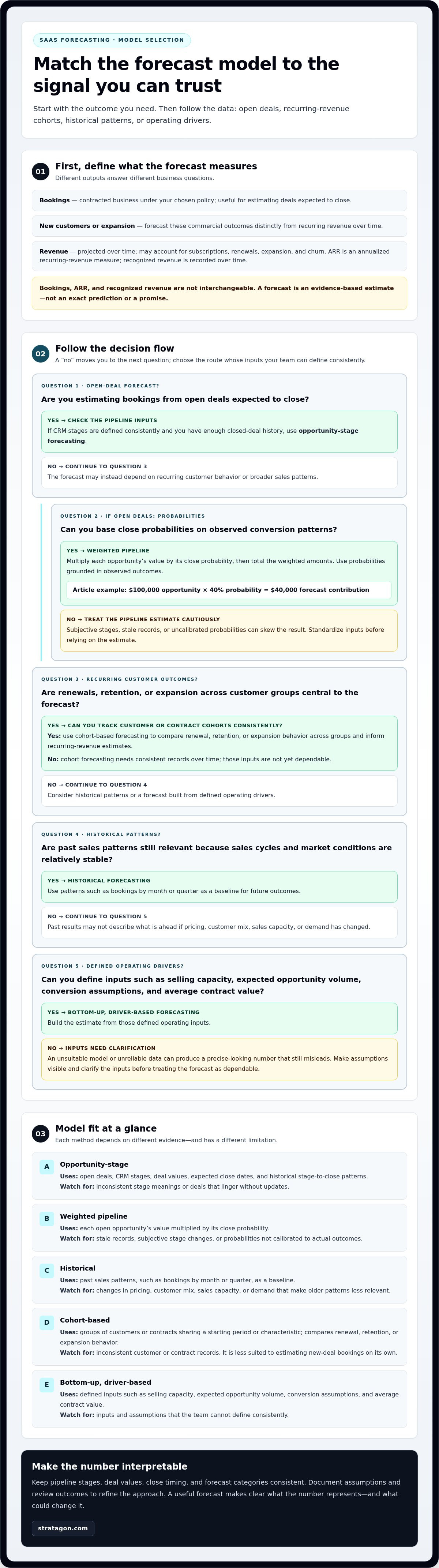
Each model turns a different set of inputs into an estimate. Some start with open deals; others use prior sales patterns, customer behavior, or operational drivers. Choose based on your revenue motion and whether your CRM and historical records provide inputs the team can define consistently. No approach is inherently accurate: an unsuitable model or unreliable data can produce a precise-looking number that still misleads.
Pipeline, opportunity-stage, and weighted pipeline models
Opportunity-stage forecasting uses open deals, their CRM stages, deal values, and expected close dates. It estimates future bookings by applying historical stage-to-close patterns to current opportunities. This suits teams with defined stages and enough closed-deal history to assess how often deals progress. If stages mean different things to different reps, or deals linger without updates, the estimate loses meaning.
Weighted pipeline forecasting multiplies each open opportunity’s value by a probability of closing, then totals the weighted amounts. For example, a hypothetical $100,000 opportunity assigned a 40% close probability contributes $40,000 to the forecast. Base probabilities on observed conversion patterns, not unsupported confidence. Stale records, subjective stage changes, or probabilities that aren’t calibrated to actual outcomes can skew the total.
Historical, cohort-based, and bottom-up models
Historical forecasting applies patterns from past sales, such as bookings by month or quarter, to estimate future outcomes. It can provide a useful baseline when sales cycles and market conditions are relatively stable. If pricing, customer mix, sales capacity, or demand has changed, older patterns may no longer describe what’s ahead.
Cohort-based forecasting follows groups of customers or contracts that share a starting period or characteristic. With suitable records, a SaaS team can compare renewal, retention, or expansion behavior across cohorts, then use those patterns to inform future recurring revenue. This approach is most useful when customer and contract data can be tracked consistently over time. It is less suited to estimating new-deal bookings on its own.
Bottom-up, driver-based forecasting builds an estimate from defined inputs such as selling capacity, expected opportunity volume, conversion assumptions, average contract value, and sales-cycle timing. It helps with planning when leaders need to see how changes in a driver affect the result. Its limitation is the number of assumptions it requires: if capacity or conversion inputs lack evidence, the projection may reflect a plan more than a likely outcome.
Keep the model separate from its horizon and scenarios. A stage-based model can estimate next month or a quarter; the horizon changes, but the mechanics remain. Scenarios vary assumptions, such as slower deal timing or lower conversion, to show how outcomes could shift. This makes uncertainty visible without confusing a scenario with the core forecast.
Teams often combine approaches, using opportunity data for near-term bookings and cohort patterns for renewals. Before layering models together, define the output of each and confirm that their inputs align. Consistent CRM processes, CRM implementation, and sales enablement can help establish clearer forecasting practices across sales and marketing.
How to Compare SaaS Forecasting Models When Data Is Imperfect
A more complex model can’t repair unreliable CRM records, inconsistent stage definitions, or missing customer history. It may only make weak inputs harder to see. Compare models by asking what data they require, whether your team can maintain that data, and which business decision the forecast needs to support.
Use these distinctions as a starting point. “Useful context” describes conditions where each approach can inform a forecast, not a guarantee of accuracy.
| Model | Data needs | Useful context | Strength | Limitation |
|---|---|---|---|---|
| Opportunity-stage | Current deal stages, values, close dates, and stage history | Trackable opportunities and disciplined CRM updates | Connects the forecast to identifiable deals | Inconsistent stages or stale deals distort the view |
| Weighted pipeline | Open deal values and credible close probabilities | Teams with enough opportunity volume to compare probabilities with outcomes | Produces a clear, deal-level weighted total | Unsupported probabilities create false confidence |
| Historical | Comparable past sales results across consistent periods | Businesses with usable history and relatively stable sales conditions | Offers a straightforward baseline | Past patterns may not reflect changed conditions |
| Cohort-based | Customer or contract records grouped and tracked over time | Recurring revenue, renewal, or expansion analysis | Highlights differences in customer behavior over time | Requires consistent cohort and contract data |
| Bottom-up driver-based | Defined drivers such as capacity, opportunity volume, conversion, and deal value | Planning around explicit sales assumptions | Makes the effect of changing drivers visible | Weak assumptions can dominate the result |
Which model fits your SaaS sales motion?
Start with your sales motion and the evidence available. Opportunity-based approaches fit a business with trackable deals, meaningful stage history, and enough deal volume to interpret patterns. If the sales cycle is long, check whether close dates and stage changes stay current throughout it. In a low-volume pipeline, a few deals can shift the total sharply, so present the forecast with its assumptions rather than treating it as a stable trend.
Historical views need relevant past sales records; cohort analysis needs customer and contract data that can be followed over time. Bottom-up modeling is useful when teams can define drivers, explain the evidence behind each assumption, and review them regularly. CRM discipline matters across all approaches. If maintaining a detailed model creates more work than the team can sustain, a transparent baseline may be more useful than a sophisticated but fragile forecast. Stratagon’s CRM implementation and sales enablement services help teams apply shared definitions to forecasting inputs.
How to assess model reliability without false precision
Review prior forecasts against actual outcomes using the same output definition and comparable time periods. Assess a bookings estimate against bookings, not recognized revenue. Record what was known at the forecast date separately from assumptions about conversion, close timing, or future performance. This helps explain a miss without rewriting the original assumptions afterward.
Assess model reliability through consistent inputs and regular review against actual outcomes, not complexity alone.
Build and Maintain a SaaS Sales Forecast in Five Practical Steps
A forecast becomes useful when the team can explain how it was built and update it without creating unnecessary work. Use this five-step process to make forecasting a repeatable practice, with clear ownership and assumptions leaders can act on.
- Define the output. Specify what the forecast measures, such as bookings expected to close during a quarter or new customers likely to sign. Set the time period and explicitly include or exclude renewals and expansion so the team is answering the same question.
- Select the model. Match the method to your sales motion and the information you can maintain. A CRM-based approach needs current opportunity records; a driver-based view needs defined assumptions about capacity and conversion. Choose the simplest model that answers the business question.
- Establish consistent inputs. Document what each pipeline stage means and the evidence required to move a deal forward. Define how the team records contract value, expected close timing, and forecast categories such as commit or best case. Keep definitions consistent across teams and pipelines.
- Document assumptions and scenarios. Record the logic behind conversion probabilities, timing, and other estimates, along with the person responsible for each input. Build baseline, upside, and downside scenarios by changing stated assumptions, not by quietly adjusting the output. For example, an upside case might assume faster deal progression, while a downside case reflects delays or lower conversion.
- Review outcomes. Compare each forecast with actual results for the same output and period. Identify recurring sources of variance, then update assumptions when pipeline volume, conversion patterns, or sales-cycle timing changes. Set a review cadence the team can support with regularly refreshed inputs.
Set up inputs, ownership, and assumptions
Make the CRM or other agreed source the reference point for pipeline, stage, contract value, and close timing. Assign reps responsibility for maintaining deal records, and designate a forecast owner to document changes to shared assumptions. Flag missing, stale, or inconsistent information for follow-up; don’t replace gaps with invented certainty. Collect only the detail the model needs and the team can sustain.
Review forecast outcomes and recalibrate
Use reviews to explain variance, not to assign blame. Check whether deals slipped, conversion differed from the assumption, or the pipeline changed after the forecast was set. Preserve the original estimate and assumptions so the team can learn from the comparison. A useful review loop is simple: compare the forecast with actuals, explain the variance, and adjust assumptions.
Consistent CRM structure and sales enablement help teams maintain shared definitions and ownership. Explore Stratagon’s CRM implementation and sales enablement services to strengthen the processes behind your forecasting workflow.
Connect SaaS Sales Forecasts to CRM, Sales Enablement, and Decisions
A forecast earns trust when teams can trace its numbers back to shared definitions and current information. CRM structure supplies the common language: what qualifies as an opportunity, what each stage means, how deal value is recorded, and when a close date should change. With these definitions in place, sales can keep deal records current and leadership can interpret pipeline movement without mistaking a stage label for certainty.
That structure also connects forecasting to sales enablement and marketing alignment. Sales brings context on deal progress, risks, and buyer conversations. Marketing can help examine how opportunities entered the pipeline, whether lead-quality assumptions align with sales experience, and where progression differs across sources or segments. Together, teams can identify where definitions differ and agree on which shared inputs should inform the forecast. This makes the forecast a working view of commercial activity, not simply a sales number passed to leadership.
Make forecast data useful across teams
Clarify ownership before the forecast meeting. Sales representatives maintain deal updates; sales leaders review patterns and surface risks; leadership interprets scenarios against business priorities. Marketing contributes context on pipeline contribution and the definitions used to assess lead quality and progression. The aim isn’t to assign credit for every deal, but to establish a consistent view of how opportunities move and which assumptions teams share.
Keep the meeting focused on material changes: deals added or removed, timing shifts, changes in expected value, and assumptions that no longer hold. Connect each change to a decision or follow-up. A movement in expected bookings could prompt leadership to examine capacity, pipeline coverage, or timing. It isn’t, on its own, proof that performance has improved or declined. The underlying deal evidence and assumptions still matter.
Turn forecast insight into an operating rhythm
Use a consistent review cadence that matches the sales cycle and the team’s ability to refresh CRM information. Each review can establish what changed since the last view, why it changed, and whether the change affects a decision. If expected close timing shifts across several opportunities, investigate whether deal progression, sales-cycle assumptions, or record updates explain the pattern before changing the forecast approach.
Forecast changes can inform questions about sales capacity, pipeline coverage, marketing investment, and planning priorities. Treat them as prompts for discussion, not automatic instructions. For example, a weaker near-term pipeline may lead sales and marketing to review opportunity creation and progression together, while leadership considers timing and available capacity. The forecast supports judgment; it doesn’t replace it or guarantee a particular outcome.
Aligning CRM, sales processes, and marketing technology can help teams work from clearer shared inputs. Stratagon’s CRM implementation and digital transformation services address the systems and processes behind that alignment. For examples of integrated work designed around measurable business objectives, explore Stratagon’s examples of client work. Sales forecasting models for SaaS become more actionable when the people responsible for pipeline, marketing, and leadership decisions can interpret the same information and act on it together.
Make Your Forecast a Shared Growth Tool
Make forecasting part of how your organization learns and plans, not just a number reviewed at quarter-end. Use forecast discussions to identify where teams need clearer definitions, stronger CRM processes, or better alignment between sales and marketing. That shared operating discipline gives leaders more context for decisions while keeping assumptions visible.
Choosing a model is only one part of building a useful approach. The people, processes, and technology behind the inputs matter too. Stratagon brings together marketing, sales, and technology, including HubSpot CRM and CMS implementations and Sales Enablement aligned with marketing.
Explore how Stratagon aligns marketing, sales, and technology to support your next stage of growth. Build a stronger foundation for coordinated decisions and forward momentum.
Frequently Asked Questions
How often should a SaaS sales forecast be updated?
Update it often enough to reflect material changes before decisions depend on it. A team managing active quarterly deals might review the pipeline weekly, while a slower-moving sales cycle may call for a different cadence. Set a regular schedule, then refresh sooner when a major deal changes status or timing. Keep dated forecast snapshots so you can compare what the team expected at the time with what happened later.
Can a SaaS startup forecast sales without much historical data?
Yes. Start with a short forecasting horizon and build an estimate from observable inputs, such as sales capacity, active opportunities, expected contract value, and clearly labeled conversion assumptions. Avoid presenting assumptions as established trends. As closed deals accumulate, compare actual conversion and timing with the initial inputs and revise them. Scenarios can show how different assumptions affect the outlook without suggesting the startup has evidence it hasn’t yet collected.
What happens if actual sales differ from the forecast?
A variance is a reason to investigate, not proof that the model has failed. Compare the original forecast with actuals, then classify the difference: a deal slipped, a deal was lost, contract value changed, or new opportunities entered the period. Look for repeat patterns across forecast cycles before changing assumptions. A single unusual deal may not justify a broad adjustment, but repeated timing slippage could signal that close-date assumptions need review.
How should seasonality affect a SaaS sales forecast?
Include seasonality only when comparable historical periods show a recurring pattern relevant to your sales motion. Check whether changes in bookings align with fiscal planning cycles, holidays, renewal timing, or another identifiable factor, and distinguish those patterns from one-off events. If the company has limited history, label seasonal effects as assumptions and test scenarios with and without them. This keeps a calendar-based expectation from being mistaken for a proven sales trend.
Should sales representatives contribute to the SaaS forecast?
Yes. Representatives can add current deal context that a CRM field may not capture, such as a buyer’s decision process or a newly identified blocker. Ask them to support updates with specific evidence, then have sales managers apply shared definitions across the team. This balances frontline knowledge with consistent review. A rep’s confidence is useful context, but it shouldn’t replace documented deal progress or be treated as a guaranteed outcome.
Is a weighted pipeline forecast enough for a SaaS business?
It can provide a useful view of expected near-term bookings from open deals, but it may not answer broader planning questions on its own. Choose models based on which revenue motions leadership needs to understand. If renewals and expansion materially inform planning, track those separately rather than assuming open new-business opportunities represent total revenue. Also review how probabilities are assigned, since unsupported weights can make the total look more certain than the evidence warrants.