The 2026 CRM Migration Plan: A Strategic Framework for Digital Transformation

Most CRM migrations fail not because the technology is flawed, but because they're treated as simple IT tickets instead of strategic revenue initiatives. It's a common trap to view a platform shift as a mere data transfer. In reality, a successful crm migration plan represents a fundamental realignment of your entire commercial engine. You've likely felt the friction of data silos between marketing and sales, or perhaps you're navigating the legitimate fear that decades of historical customer insights could be lost in the shuffle.
We understand that internal resistance often stems from a lack of clarity, not a lack of talent. This article outlines a sophisticated framework for 2026 that moves beyond tactical checklists to deliver a clean, unified source of truth for your customer data. You'll learn how to preserve data integrity, foster seamless organizational alignment, and build a foundation for predictable revenue forecasting. We're going to preview the roadmap for a HubSpot implementation that prioritizes the human element, ensuring your digital transformation results in immediate adoption and long term growth.
Key Takeaways
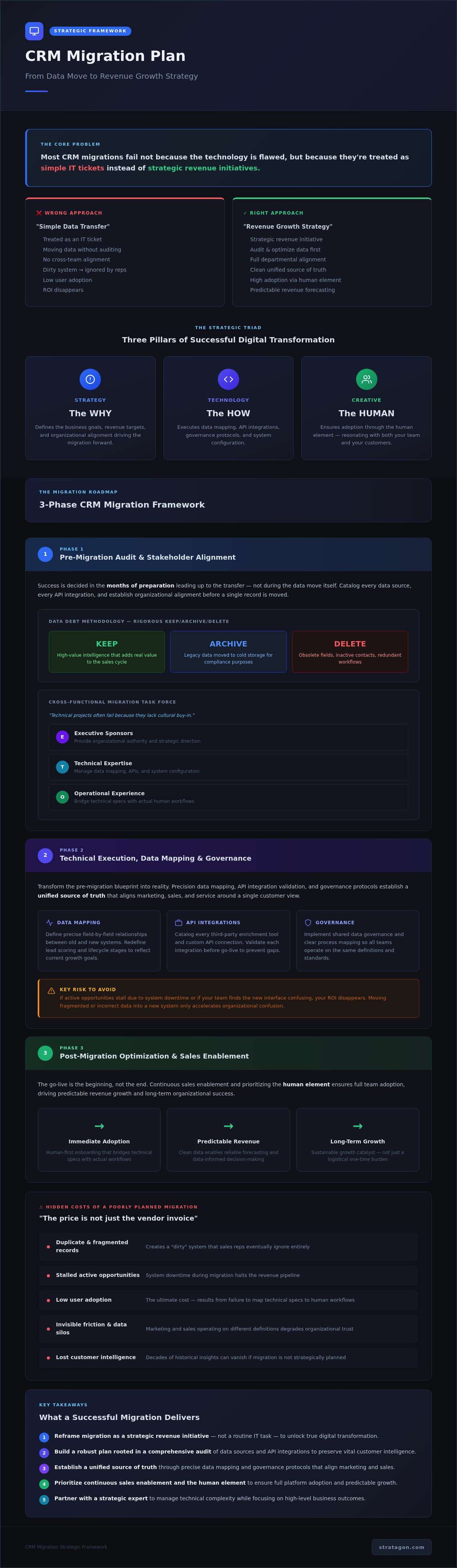
- Reframe CRM migration as a strategic revenue initiative rather than a routine IT task to unlock true digital transformation.
- Build a robust crm migration plan rooted in a comprehensive audit of data sources and API integrations to preserve vital customer intelligence.
- Establish a unified source of truth through precise data mapping and governance protocols that align marketing and sales functions.
- Prioritize continuous sales enablement and the human element to ensure your team fully adopts the new platform and drives predictable growth.
- Partner with a strategic expert to manage technical complexity while focusing on the high-level business outcomes that define organizational success.
Why a CRM Migration Plan is Your Digital Transformation Catalyst
CRM migration is often misunderstood as a technical chore. It's actually the strategic relocation of your organization's collective intelligence. Integrating Customer Relationship Management (CRM) data into a new environment provides a rare moment to audit your entire commercial philosophy. Without a comprehensive crm migration plan, you aren't upgrading; you're just moving your mess to a more expensive house. A well-executed plan transforms a static "data dump" into a high-velocity revenue engine by aligning your internal teams around a single source of truth.
This shift from siloed operations to a unified customer-centric model requires more than just a software login. It demands a holistic approach. We view successful digital transformation through a thematic triad: Strategy, Technology, and Creative alignment. Strategy defines the "why," Technology provides the "how," and Creative ensures the "human element" resonates with both your team and your customers. When these three pillars intersect, the migration becomes a catalyst for sustainable growth rather than a logistical burden.
Shifting from "Data Move" to "Revenue Growth Strategy"
A migration is the perfect time to look under the hood. It exposes gaps where leads fall through the cracks or where sales cycles have bloated unnecessarily. This transition allows you to redefine lead scoring and lifecycle stages so the new system reflects your current growth goals rather than your past limitations. You're not just moving names and numbers. You're optimizing the path to purchase. A strategic migration is an intentional investment in data-informed decision-making that empowers every department to act with precision.
Identifying the Hidden Costs of a Poorly Planned Migration
The price of a failed migration isn't just the invoice from a vendor. It's the invisible friction that slows your business down. Duplicate records and fragmented data entries create a "dirty" system that sales reps eventually ignore. If active opportunities stall due to system downtime or if your team finds the new interface confusing, your ROI vanishes. Low user adoption is the ultimate cost of poor process mapping. It usually results from a failure to bridge the gap between technical specifications and actual human workflows. A robust crm migration plan anticipates these hurdles, ensuring that your data remains an asset rather than a liability.
Phase 1: The Pre-Migration Audit and Stakeholder Alignment
The success of your crm migration plan isn't determined during the actual data transfer. It's decided in the months of preparation leading up to it. An exhaustive pre-migration audit serves as the bedrock for your entire digital transformation strategy. You must catalog every existing data source, from third-party enrichment tools to custom API integrations, to understand the current architecture. This phase is about establishing a clean slate. Moving fragmented or incorrect data into a new system only accelerates organizational confusion and degrades the trust your teams have in their tools.
Organizational alignment between marketing, sales, and service departments is non-negotiable. If these teams operate on different definitions of a qualified lead or customer success, the migration will mirror that dysfunction. A strategic partner can help facilitate these high-level conversations, ensuring the technical build supports a unified customer journey. At Stratagon, we specialize in HubSpot CRM Implementation that bridges these departmental gaps through shared data governance and clear process mapping.
Auditing Your Current Database for "Data Debt"
Data debt accumulates when obsolete fields, inactive contacts, and redundant workflows clutter your system over time. We recommend a rigorous keep, archive, or delete methodology to address this. This process ensures only high-value intelligence enters the new platform, reducing storage costs and improving system performance. By creating a definitive Source of Truth inventory, you provide your revenue teams with the clarity they need to execute with confidence. You should identify which legacy data adds actual value to the sales cycle and which should be moved to cold storage for compliance purposes. For enterprises navigating broader data pipelines and enterprise architecture, partnering with data specialists like Momentum Data Labs can help ensure clean data modeling and integration across all business systems.
Building a Cross-Functional Migration Task Force
Technical projects often fail because they lack cultural buy-in. You need a task force that balances technical expertise with operational experience. This group should include:
- Executive Sponsors: To provide high-level accountability and resource allocation.
- Technical Leads: To manage API connections, data mapping, and system architecture.
- Power Users: To offer practical feedback on how the system will be used in daily workflows.
Involving these stakeholders early addresses the human element of change management. It prevents technical friction and ensures the system serves the people using it rather than the other way around. Your team should align on specific KPIs, such as data accuracy rates and user adoption timelines, before the first record moves. This proactive approach ensures that the migration is viewed as a victory for the entire organization rather than a burden imposed by IT.
Phase 2: Technical Execution, Data Mapping, and Governance
Technical execution is the pivot point of your crm migration plan. It's the high-stakes moment where strategic vision meets system architecture. Modern customer relationship management systems function as interconnected ecosystems rather than simple databases. Moving from a legacy system to a modern architecture like HubSpot requires surgical precision in field-to-field mapping. Ensuring data type consistency is critical. If a date field or a custom picklist doesn't align perfectly across platforms, your downstream reporting and automation will fail. We use advanced automation to maintain data integrity during the move, enforcing validation rules that prevent "dirty" data from entering the new environment.
Rigorous testing in a sandbox environment is mandatory before any final cutover. This isolated stage allows our technical leads to identify and resolve conflicts without risking active sales cycles. It's a dress rehearsal for the data, ensuring that every workflow and trigger performs exactly as expected. By the time the live migration occurs, the process should be a predictable, well-rehearsed transition that minimizes operational downtime and protects your commercial momentum.
Developing a Robust Data Mapping Schema
Custom objects and complex relational data represent the unique logic of your business. Mapping these elements requires a deep understanding of how marketing and sales data intersect. You aren't just moving contact names; you're preserving the context of every interaction, from email opens to historical deal stages. For organizations with intricate data requirements, engaging Stratagon services for complex implementation support ensures that historical engagement and notes remain intact. This level of detail is what turns a new platform into a reliable source of truth for your leadership team.
Managing the API and Integration Ecosystem
A CRM doesn't live in a vacuum. Your migration plan must account for every third-party tool in your stack, including ERP systems, billing platforms, and email marketing software. This phase offers a strategic window to audit your integration ecosystem for "tool sprawl." Many legacy integrations are fragile, redundant, or underutilized. We evaluate the health of current connections to determine which should be rebuilt, which should be consolidated, and which can be retired. Streamlining this ecosystem ensures a seamless post-migration flow of intelligence across your entire organization.
Phase 3: Post-Migration Optimization and Sales Enablement
The real work of a crm migration plan begins after the technical cutover. This "Day 2" reality is where many organizations lose momentum, yet it's the most critical period for securing long-term ROI. Successful optimization requires shifting focus from the data itself to the people who interact with it. A clean, unified CRM acts as the fuel for advanced Sales Enablement strategies. It allows your team to move beyond manual entry and focus on high-value activities like strategic prospecting and relationship building.
To maintain this momentum, we establish a continuous feedback loop between end-users and the RevOps team. This ensures the system evolves alongside your business needs rather than becoming a static relic. When sales reps see their feedback translated into system improvements, adoption rates climb and data integrity remains high. This collaborative environment fosters a culture of performance where data is seen as an asset rather than a chore.
Training for Adoption: From Resistance to Proficiency
Effective training isn't a generic webinar; it must be segmented by role. Executive leadership requires reporting training to drive data-informed decisions, while sales reps need tactical workflow training that simplifies their daily tasks. We advocate for personalized automation that handles the "admin burden" of logging activities or updating deal stages. Technology is a tool for human success, not a replacement for it. By reducing friction, you transform the CRM from a digital filing cabinet into a competitive advantage.
Establishing Long-Term Data Governance Standards
Data quality is a perishable asset. Without strict standard operating procedures (SOPs) for data entry and lead management, your new system will quickly revert to a cluttered state. Establishing these standards is a core component of a sustainable crm migration plan. We recommend a rigorous schedule for monthly database health checks and automated deduplication routines. These protocols ensure that your source of truth remains reliable for quarterly forecasting and revenue planning. You can explore Stratagon work to see how we've built these sustainable ecosystems for complex organizations.
Optimizing your platform is an ongoing journey that requires both technical precision and strategic vision. Partner with us for HubSpot CRM Implementation to ensure your post-migration environment is built for scale.
Navigating Complexity with a Strategic Implementation Partner
Executing a high-stakes crm migration plan requires more than technical proficiency. It demands a partner who possesses the quiet confidence to navigate unforeseen roadblocks and the professional enthusiasm to drive organizational change. While internal IT teams are capable of data mapping, a strategic partner brings an outside perspective that is essential for aligning disparate revenue functions. This collaboration ensures that your new platform isn't just a repository for contacts, but a sophisticated engine for B2B revenue growth.
Positioning your CRM as a living part of your business technology stack is a long-term commitment. It's not a project with a defined end date, but a continuous evolution of your commercial operations. A strategic implementation partner provides the vision needed to look beyond the initial cutover, ensuring your systems remain agile enough to adapt to shifting market demands. This forward-thinking approach transforms a complex operational challenge into a predictable path for expansion.
Why Executive Leadership Values HubSpot Diamond Expertise
Executive leadership teams prioritize reliability and measurable outcomes. Working with a HubSpot Diamond Partner provides the assurance that your digital transformation is in expert hands. This level of expertise is the gold standard for organizations that require a deep understanding of the intersection between strategy, technology, and creative alignment. We don't just perform tactical execution; we provide a visionary strategy that bridges the gap between marketing, sales, and service departments.
This alignment is critical for maintaining a unified customer journey. By focusing on the underlying reasoning behind your data, we ensure that every technical decision supports a broader business objective. Our role is to act as a high-level strategic partner, helping you move away from siloed operations and toward a culture of performance and accountability.
Moving Beyond Implementation to Continuous Optimization
The conclusion of a crm migration plan is actually the beginning of your optimization journey. Once the foundation is established, the focus shifts to maximizing the value of your investment through ongoing technology management and campaign execution. Agency retainers offer a strategic advantage here, providing the consistent expertise needed to refine automation, update lead scoring models, and maintain database health. This proactive management prevents the system from becoming stagnant or cluttered over time.
We invite you to explore Stratagon solutions to see how we support long-term growth through personalized consulting and technical excellence. Our team is eager to engage directly in the collaborative work required to turn your technology into a tool for professional success. When you're ready to secure your commercial future, contact Stratagon to discuss your CRM migration roadmap and discover how a strategic framework can accelerate your revenue engine.
Secure Your Commercial Future Through Strategic Alignment
A successful crm migration plan is the cornerstone of modern digital transformation. It moves beyond technical data transfer to create a unified source of truth that aligns marketing, sales, and service departments. By prioritizing the human element and establishing rigorous data governance, you turn a complex software shift into a sustainable growth catalyst. This strategic approach ensures that your revenue engine remains clean, predictable, and ready for scale.
With over 20 years of digital transformation experience, Stratagon brings deep expertise to every implementation. Our status as a HubSpot Diamond Partner reflects our commitment to delivering measurable results for organizations in complex sectors like financial services and higher education. We understand that your data is your most valuable commercial asset; we treat its relocation with the precision it deserves.
Partner with a HubSpot Diamond Agency for your CRM Migration to transform your technology stack into a tool for professional success. We're ready to help you navigate the complexities of your next growth phase with confidence and clarity.
Frequently Asked Questions
What are the essential steps in a CRM migration plan?
The essential steps in a crm migration plan begin with a comprehensive pre-migration audit and stakeholder alignment to ensure organizational buy-in. This foundation is followed by technical execution, which involves precise data mapping and governance to maintain integrity. Rigorous testing in a sandbox environment is mandatory before the final cutover. Finally, the process concludes with post-migration optimization and sales enablement to drive long term user adoption and predictable revenue growth.
How long does a typical CRM migration take for a mid-market B2B company?
The duration of a CRM migration depends on the complexity of your data architecture and the number of third party integrations. For a mid-market B2B company, the timeline typically spans between three and six months from the initial audit to the final cutover. This period allows for thorough data cleansing, mapping of custom objects, and user acceptance testing. Rushing this timeline often leads to data debt and low adoption rates among sales teams.
What is the biggest risk during a CRM data migration?
The most significant risk during a migration is the transfer of "dirty" or fragmented data, which erodes user trust in the new platform. If sales and marketing teams encounter duplicate records or broken historical activity, they'll likely revert to manual spreadsheets. This technical friction undermines the entire digital transformation effort. Protecting data integrity through strict governance and validation rules is the only way to ensure the new system serves as a reliable source of truth.
How do you ensure sales team adoption after moving to a new CRM?
Ensuring adoption requires prioritizing the human element over the software itself. You should focus on personalized automation that reduces the administrative burden on sales reps, allowing them more time for active selling. Segmented training sessions that address specific tactical workflows are far more effective than generic system overviews. Establishing a continuous feedback loop between end-users and the RevOps team ensures the platform evolves to meet real world operational challenges.
Should we handle CRM migration internally or hire a consulting agency?
High-stakes migrations often require a level of strategic oversight that internal IT teams aren't equipped to provide. While internal staff understand your current processes, a strategic implementation partner brings the experience of hundreds of successful transitions. Working with a HubSpot Diamond Partner like Stratagon ensures that your crm migration plan is treated as a revenue initiative rather than a technical chore. This partnership provides the visionary strategy needed to align disparate internal departments.
What is the role of data governance in a migration project?
Data governance serves as the regulatory framework that maintains the health of your customer intelligence. During a migration, it dictates how fields are mapped, how duplicates are handled, and who has permission to modify records. Without these standard operating procedures, your new CRM will quickly accumulate data debt. Long term governance includes regular database health checks and automated deduplication routines to ensure your reporting remains accurate for executive decision-making.
How much does a CRM implementation and migration cost in 2026?
The cost of a CRM implementation and migration depends entirely on the scope of work, data volume, and the complexity of your integration ecosystem. Most strategic partners utilize project-based implementation fees for the initial transition, followed by monthly agency retainer fees for ongoing optimization. These investments are scaled to the specific needs of your digital transformation roadmap. You should evaluate the cost relative to the long term revenue growth and operational efficiency the new system provides.
Can we migrate historical email engagement and activity data?
Yes, migrating historical activity and email engagement is possible and often essential for maintaining a complete customer history. This process requires a robust data mapping schema to ensure that legacy notes, tasks, and interaction logs align with the architecture of your new platform. Preserving this intelligence allows your sales and service teams to maintain continuity in their relationships. It prevents the "reset" that occurs when teams lose visibility into years of valuable customer context.