The Strategic Benefits of HubSpot Operations Hub: A 2026 Guide to RevOps Excellence

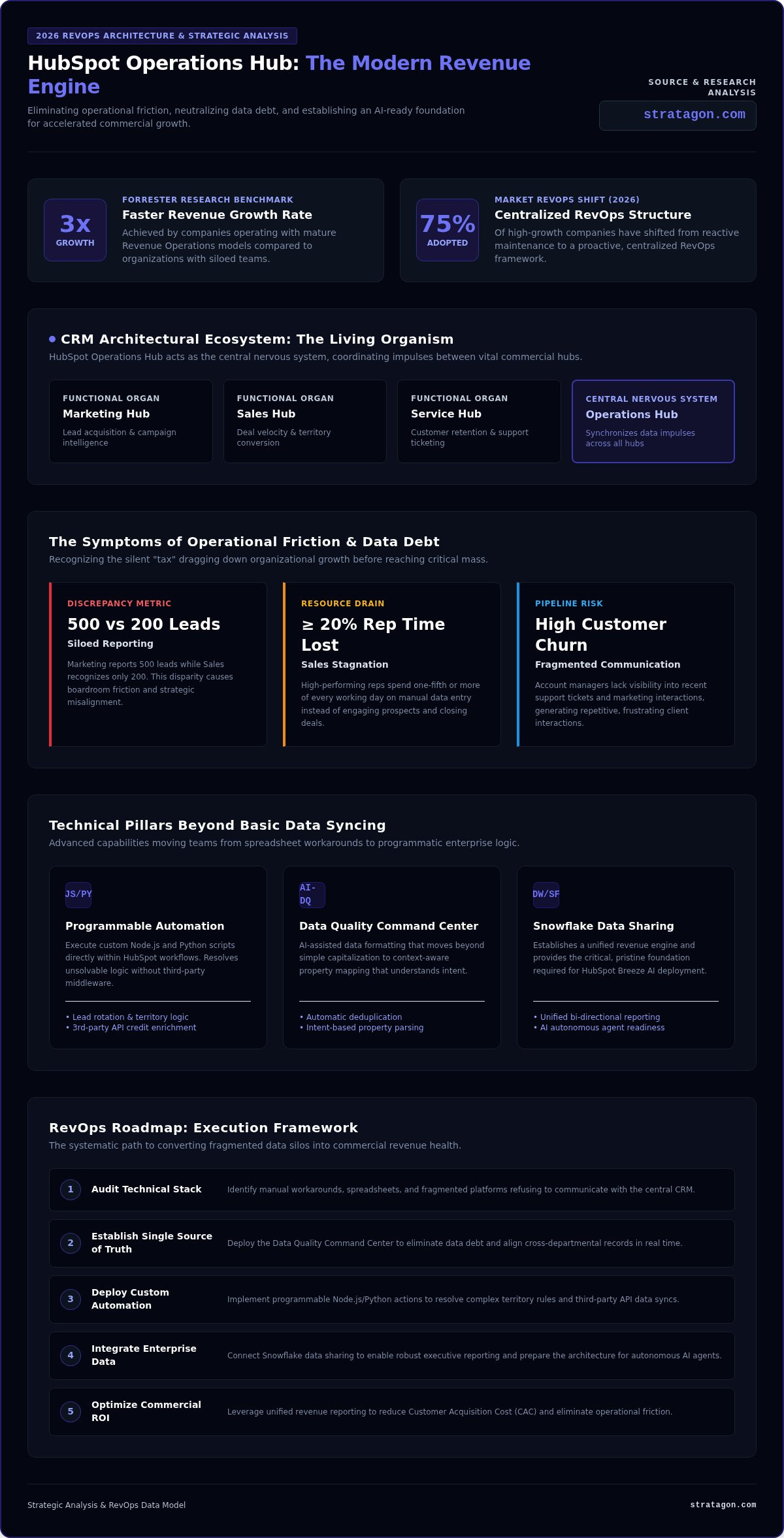
Recent research from Forrester reveals that companies with mature Revenue Operations models achieve up to 3x faster revenue growth compared to organizations operating with siloed teams. You've likely experienced the frustration of inconsistent data across departments or a fragmented tech stack that refuses to communicate with your CRM. It's a common challenge; manual data cleaning tasks shouldn't be the primary focus of your talented strategic leaders. Understanding the core benefits of HubSpot Operations Hub, now evolving into the HubSpot Data Hub, is the first step toward reclaiming your team's time and precision.
We'll demonstrate how this platform transforms fragmented data into a unified revenue engine through advanced automation and seamless departmental alignment. You'll learn how to establish a single source of truth that scales alongside your business while providing crystal-clear reporting on revenue health. This 2026 guide covers everything from the new Data Quality Command Center to Snowflake data sharing. We'll also examine how these tools provide the necessary foundation for AI readiness, ensuring your technology serves as a bridge for human and professional success.
Key Takeaways
- Capture the strategic benefits of hubspot operations hub by converting fragmented data silos into a high-performance revenue engine that fuels organizational growth.
- Neutralize data debt through programmable automation and custom-coded actions that maintain a pristine, automated CRM environment without manual intervention.
- Improve your bottom line by quantifying the ROI of automated data management and leveraging unified reporting to lower your Customer Acquisition Cost.
- Build a scalable RevOps roadmap by auditing technical infrastructure and mapping a data-driven customer journey that eliminates internal friction.
- Move beyond basic software implementation by aligning your technical systems with a human-centric strategy that prioritizes long-term commercial health.
The Data Debt Crisis: Why Operations Hub is No Longer Optional
Think of your CRM as a living organism. If Marketing, Sales, and Service Hubs are the vital organs, HubSpot Operations Hub serves as the central nervous system. It coordinates the data impulses that keep your entire organization moving in sync. Without this coordination, businesses inevitably accumulate "Data Debt." This debt represents the hidden cost of manual workarounds, duplicate records, and fragmented processes that quietly drain your revenue potential. One of the primary benefits of hubspot operations hub is its capacity to establish a single source of truth, ensuring that every strategic decision is backed by verified, real-time intelligence.
Data debt often goes unnoticed until it reaches a critical mass. It manifests as a "tax" on every new initiative you launch. When your data is fragmented, your teams move slower, your marketing reaches the wrong people, and your sales forecasts become guesswork. Implementing this infrastructure is a core component of digital transformation, allowing your business to scale without the weight of technical and operational inefficiencies holding you back. It acts as the essential bridge between your core hubs, ensuring that a lead's journey from marketing to sales is seamless and visible.
Identifying the Symptoms of Operational Friction
Manual spreadsheets often serve as a temporary bridge, but they fail to scale once your customer journey becomes multi-dimensional. You'll recognize the tipping point when departmental reports no longer align at the executive level, leading to friction in the boardroom. Other symptoms include:
- Siloed reporting: Marketing reports 500 leads while Sales only sees 200, creating internal distrust and strategic misalignment.
- Fragmented communication: High customer churn occurs because account managers can't see recent support tickets or marketing interactions, leading to repetitive, frustrating conversations.
- Sales stagnation: High-performing reps spend 20% or more of their day on manual data entry rather than engaging prospects and closing deals.
When these silos emerge, Operations Hub acts as the bridge that allows your technical stack to finally speak the same language as your CRM, removing the friction that stalls commercial momentum.
The Shift from Reactive to Proactive Operations
Modern growth requires a transition from reactive troubleshooting to proactive architecture. In 2026, the most successful organizations aren't just fixing errors; they're architecting growth. This shift is the heart of a true RevOps mindset. With 75% of high-growth companies now operating with a centralized RevOps structure, the move toward proactive data management is well underway. Another of the critical benefits of hubspot operations hub is how it prepares your infrastructure for tools like HubSpot Breeze AI. Since autonomous agents require pristine data to execute correctly, the Data Quality Command Center becomes a mandatory prerequisite for enterprise AI deployment. By automating these processes, you transform your operations from a maintenance function into a high-velocity engine for commercial success.
The Technical Pillars: Beyond Simple Data Syncing
While many platforms offer basic integrations, one of the standout benefits of hubspot operations hub is its ability to handle complex logic that standard no-code tools simply can't touch. By 2026, AI-assisted data formatting has evolved from simple capitalization fixes to sophisticated, context-aware property mapping that understands the intent behind customer inputs. For teams looking to scale these capabilities across the enterprise, visit Summit Automation to explore AI-driven digital operations solutions. This shift allows your team to focus on high-level strategy rather than manual cleanup. These advancements ensure that your CRM remains an asset rather than a liability as your data volume grows.
Programmable Automation: Solving the 'Unsolvable' Workflows
Standard workflows often hit a ceiling when bespoke business logic is required. Programmable automation allows your developers to write custom Node.js or Python scripts directly within HubSpot, executing actions that previously required external middleware. This is particularly transformative for advanced lead rotation and complex territory management where rules change based on real-time external data. You can integrate third-party APIs directly, pulling in credit scores or enrichment data to trigger specific internal actions without leaving the ecosystem. This level of customization ensures your technical stack bends to your business needs, not the other way around.
Data Quality Tools: Automating the Janitorial Work
Dirty data is a silent productivity killer. Research highlights the staggering cost of poor data quality, which drains trillions from the global economy annually through missed opportunities and wasted effort. Operations Hub mitigates this by standardizing phone numbers, names, and addresses automatically. Its deduplication logic looks past basic email matching to identify complex record overlaps across your database. Data Quality Automation is the foundation for reliable reporting, ensuring your executive dashboard reflects reality rather than noise.
For larger organizations, the native Snowflake data sharing integration is a game-changer. It refreshes hourly across all major cloud regions, allowing RevOps teams to sync product usage data or billing information without third-party iPaaS connectors. This creates a bi-directional flow that empowers sales reps with product intelligence and marketing teams with actual revenue data. When your sales team isn't manually fixing formatting errors, they're engaging in meaningful conversations that drive growth. A strategic approach to HubSpot CRM implementation ensures these technical features serve your people, ensuring technology acts as a catalyst for professional success.
The Strategic Benefits: Revenue Efficiency and Alignment
Establishing a unified data ecosystem isn't just a technical achievement; it's a commercial imperative. While earlier sections detailed how to clean and sync data, the true strategic benefits of hubspot operations hub emerge when you translate that technical health into measurable revenue velocity. When your data is reliable, your leadership team stops debating the accuracy of reports and starts making high-stakes decisions with confidence. This clarity transforms the CRM from a passive database into a proactive revenue engine that drives sustainable growth cycles.
Driving Revenue Efficiency Through Automation
Revenue efficiency is won or lost in the gaps between your business processes. Operations Hub allows you to quantify the ROI of reduced manual data management by eliminating the "hidden costs" of administrative overhead. When your operations are automated, you significantly lower your Customer Acquisition Cost (CAC) by ensuring marketing spend is directed toward high-fidelity audience segments rather than duplicate or outdated records. According to HubSpot Research, tightly aligned revenue teams achieve 38% higher sales win rates and 36% higher customer retention rates. These gains directly impact Customer Lifetime Value (LTV), as a unified view of the customer journey allows for more precise cross-sell and up-sell opportunities. By accelerating the sales cycle through cleaner handoffs, you ensure that momentum is never lost to manual data entry or internal friction.
Organizational Alignment: The RevOps Advantage
The most successful organizations in 2026 recognize that technology is a tool for human success. Operations Hub acts as the definitive bridge between Marketing, Sales, and Service, establishing shared data standards that break down long-standing departmental silos. This alignment isn't just about software; it's about creating a culture of performance where every team member has access to the same intelligence. When you remove the friction from internal processes, you empower your staff to focus on high-value strategic work rather than repetitive janitorial tasks. This human-centric approach to technical systems ensures that your digital transformation leads to tangible professional satisfaction and organizational momentum. To achieve this level of maturity, many leaders explore our strategic services for RevOps alignment to ensure their platform architecture supports their long-term commercial vision. By prioritizing this "single source of truth," you create an environment where data-informed decision-making becomes the standard, not the exception.
A RevOps Roadmap: Implementing Operations Hub for Growth
Transitioning from a fragmented tech stack to a unified revenue engine requires more than just a software subscription. While the benefits of hubspot operations hub are extensive, realizing them demands a structured approach that moves beyond basic data syncing. Implementation velocity is a key advantage here. A solo administrator can often stand up foundational data sync and automated hygiene rules in 2 to 4 weeks; this is a significant contrast to the 12 weeks or more typically required for custom enterprise CRM deployments. To achieve this speed without sacrificing quality, your organization needs a clear path from initial audit to enterprise-level governance.
Phase 1: The Foundation (Audit and Cleanup)
Success begins with a cold, hard look at your current technical debt. Identifying redundant applications and "dirty" data sources is the first hurdle. Most high-growth companies possess a "frankenstack" of piecemeal connectors and standalone deduplication tools that don't talk to each other. During this phase, you must:
- Audit existing silos: Map every piece of software that touches customer data and identify where information gets trapped.
- Establish baseline KPIs: Define what operational success looks like, whether it's a 20% reduction in duplicate records or faster lead-to-sales handoffs.
- Build the business case: Present these metrics to internal stakeholders to secure the resources needed for a full-scale digital transformation.
By setting these baselines early, you ensure that your RevOps strategy remains rooted in measurable commercial outcomes rather than technical vanity metrics.
Phase 2: The Architecture (Automation and Integration)
Once the foundation is clear, you can begin architecting the workflows that will drive your growth. This phase moves you from the "Starter" tier's basic sync capabilities into the "Professional" and "Enterprise" tiers' sophisticated business logic. You aren't just moving data; you're mapping the "ideal" customer journey and ensuring the data flows perfectly to support it. This involves deploying Data Sync for your core tech stack while simultaneously architecting custom automation for unique business rules, such as complex commission structures or multi-territory lead routing. Ensuring data integrity during these transitions is critical, especially during complex CRM migrations where legacy data can easily corrupt new systems. See our work in complex CRM implementations to discover how we've helped organizations navigate these technical pivots successfully.
The final step in your roadmap is establishing ongoing data governance. Operations Hub isn't a "set it and forget it" tool. It requires a continuous cycle of monitoring through the Data Quality Command Center and adjusting your programmable automation as your business evolves. If you're ready to turn these features into a customized revenue engine, partner with us for a strategic HubSpot implementation that aligns your technology with your human talent.
Maximizing ROI: Why a Strategic Partner is Essential
Owning a high-performance tool is a prerequisite for growth, but executing a cohesive strategy is what actually captures market share. While the core benefits of hubspot operations hub include automated data hygiene and programmable workflows, these features only yield maximum ROI when they're woven into a broader digital transformation roadmap. Many organizations mistake software implementation for operational excellence. True excellence requires a partner who understands the underlying reasoning behind the data, ensuring that your technical stack acts as a catalyst for human success rather than an administrative burden.
Moving Beyond Tactical Execution
Strategic consulting transforms your CRM from a passive repository into an active revenue engine. At Stratagon, we move beyond tactical fixes to address the root causes of operational friction. It's one thing to sync properties; it's another to bridge the gap between technical automation and human performance. We focus on how these systems change the daily workflow of your marketing and sales teams, ensuring that automation removes friction rather than adding complexity. By avoiding common deployment pitfalls like over-engineered logic or siloed reporting, we help you maintain long-term commercial momentum. Our role is to ensure your executive leadership has the clarity needed for data-informed decision-making at every stage of the growth cycle.
The Stratagon Approach to Digital Transformation
Our methodology integrates sophisticated marketing strategy with high-level technology solutions. As a HubSpot Diamond Partner, we bring over 20 years of strategic experience to every engagement, specializing in the complex CRM migrations and roadmapping required for enterprise-level success. We don't just offer a service; we provide a visionary framework tailored to the unique demands of sectors like higher education and financial services. This specialized focus ensures that your RevOps model is built to scale alongside your evolving business needs. If you're ready to move from owning a tool to leading a market, book a discovery call to audit your RevOps maturity and discover how the benefits of hubspot operations hub can be fully realized through expert architectural design.
Architecting Your Future Growth Engine
Mastering your data infrastructure is the definitive step toward sustainable commercial momentum. We've explored how transitioning from reactive cleanup to proactive architecture eliminates the technical debt that stalls most high-growth organizations. By leveraging the benefits of hubspot operations hub, your team can finally move past manual spreadsheets and into a world of automated, high-fidelity intelligence. This isn't just about software; it's about aligning your human talent with technical precision to drive measurable revenue health.
As a HubSpot Diamond Partner with over 20 years of digital transformation experience, Stratagon specializes in custom RevOps roadmapping for enterprise growth. We ensure your technology serves as a bridge for professional success rather than a source of operational friction. It's time to turn your CRM into a sophisticated, unified revenue engine. Scale your revenue engine with Stratagon's HubSpot expertise and begin your journey toward operational excellence. Your organization’s potential is limitless when your data is clear and your strategy is sound.
Frequently Asked Questions
Is HubSpot Operations Hub worth the extra cost if I already have Sales Hub?
Yes, because Sales Hub manages your deal pipeline while Operations Hub manages the data health that fuels those deals. One of the primary benefits of hubspot operations hub is its ability to automate the "janitorial" data work that otherwise falls on your sales reps. This allows your team to focus on high-value closing activities instead of manual record cleanup and administrative maintenance.
How does Operations Hub differ from standard HubSpot data syncing?
Standard syncing is often limited to basic field mapping, whereas Operations Hub provides bi-directional, real-time synchronization with advanced filtering and programmable logic. It allows you to transform data as it moves between systems. This ensures your CRM isn't just receiving raw data, but receiving clean, formatted information that is immediately actionable for your marketing and sales teams across the organization.
Do I need a developer to use Programmable Automation in Operations Hub?
While the "Starter" tier is designed for non-technical users, the "Professional" and "Enterprise" tiers' programmable automation typically requires knowledge of Node.js or Python. Partnering with a HubSpot Diamond Partner like Stratagon allows you to leverage these advanced features without hiring internal developers. We architect the custom code blocks for you, ensuring your bespoke business logic is implemented correctly and scales effectively.
Can Operations Hub help with data migration from legacy CRMs like Salesforce?
It's an essential tool for complex CRM migrations. It provides the data quality tools needed to clean, format, and deduplicate records before they enter your new environment. By using custom-coded actions, you can map complex legacy architectures to HubSpot's Smart CRM platform. This ensures a seamless transition that preserves your historical data integrity and minimizes downtime during the digital transformation process.
What are the primary differences between the Professional and Enterprise tiers?
The Professional tier introduces programmable automation and data quality automation, which are foundational for RevOps maturity. The Enterprise tier expands these capabilities by adding Snowflake data sharing and increased limits for custom-coded actions. Enterprise is built for large-scale organizations that require deep data lake integrations and the most sophisticated level of bi-directional synchronization across a complex, global technical ecosystem.
How does HubSpot Operations Hub improve reporting accuracy?
Reporting is only as reliable as the underlying data. Operations Hub establishes a single source of truth by standardizing formatting and automating deduplication across your entire database. This eliminates the "data debt" that often leads to conflicting reports between departments. With cleaner inputs, your executive dashboards provide a more precise view of revenue health, enabling better strategic decision-making for long-term growth.
Does Operations Hub integrate with non-standard or custom-built software?
Yes, its programmable automation allows for direct integration with virtually any software that has an accessible API. Unlike standard connectors that are limited to pre-defined fields, custom-coded workflow actions can send and receive data from your proprietary internal systems. This flexibility ensures that one of the core benefits of hubspot operations hub is its ability to serve as the central nervous system for your entire technical stack.
How long does it typically take to see ROI from an Operations Hub implementation?
Most organizations begin seeing operational efficiency gains within the first 2 to 4 weeks as automated cleanup rules take effect. Strategic ROI, such as reduced customer acquisition costs and improved sales velocity, typically manifests within the first full sales cycle after implementation. By removing manual friction, your team can reallocate hundreds of hours toward revenue-generating activities, providing a rapid return on your investment.