Using CRM to Align Sales and Customer Success on Expansion Revenue

Your next revenue opportunity may already be in your customer base. Expansion revenue is additional income from existing customers through upgrades, complementary products, add-ons, or usage-based charges. Using CRM for expansion revenue helps sales and customer success share account context, track opportunities, and connect customer growth with revenue performance.
Growth from current customers is more than a sales target: it can show that customers are getting greater value from a product or service. But when sales and customer success work from separate records, teams can miss useful signals and send disconnected messages. A shared CRM gives both teams a clearer view of customer needs, product engagement, renewal context, and open opportunities.
This article explains how expansion revenue works in B2B SaaS, how CRM supports coordinated account growth, and which metrics help teams assess results. You’ll also see how shared customer records and opportunity tracking can turn relevant customer signals into timely, informed conversations, without treating every account as an upsell.
Key Takeaways
- Expansion revenue comes from growing existing accounts through upgrades, complementary offerings, and increased product usage.
- Shared customer records help sales and customer success coordinate around customer goals, account health, and renewal context.
- Product engagement and plan-limit signals can help teams identify relevant expansion opportunities and time conversations more effectively.
- Measure account growth alongside renewals and churn to understand whether expansion is strengthening recurring revenue.
- A well-aligned CRM process gives teams clearer ownership, more useful customer insights, and a consistent way to track opportunities.
What is Expansion Revenue in B2B SaaS?
Expansion revenue is additional income from existing customers through upgrades, complementary purchases, or usage-based charges. For SaaS teams, it connects customer growth to revenue growth rather than relying only on new accounts.
Upsells, Cross-Sells, and Add-Ons
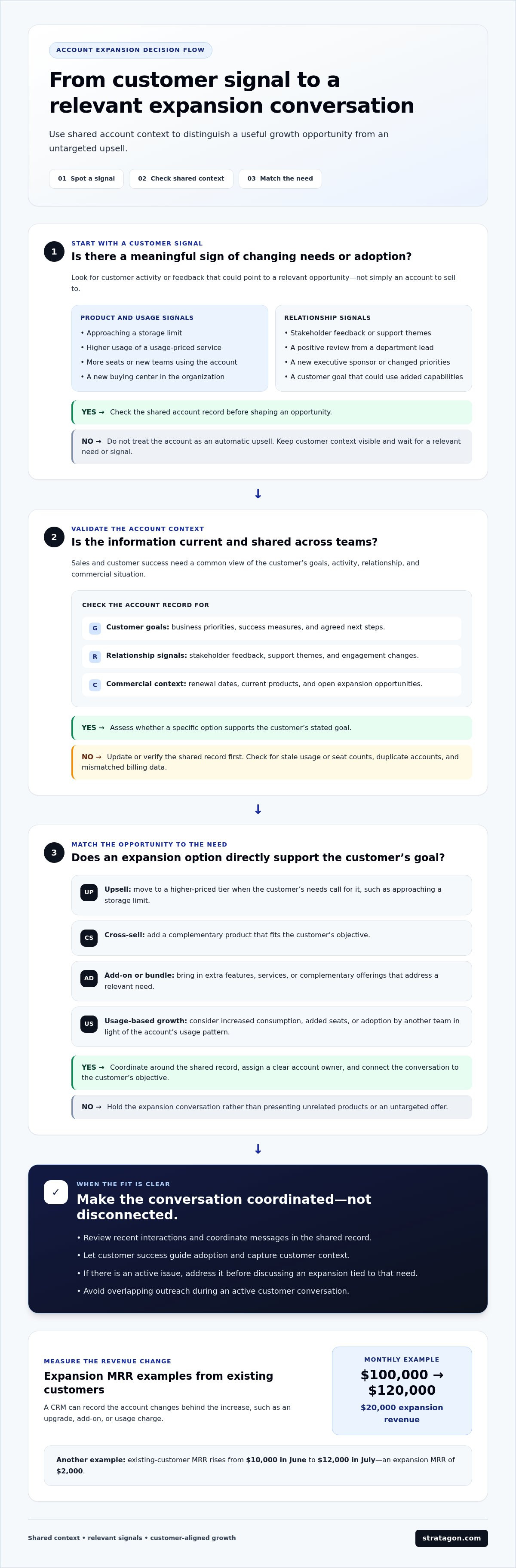
An upsell moves a customer to a higher-priced tier, while a cross-sell adds a complementary product. Add-ons provide extra features or services. These options align selling with a customer’s evolving needs instead of treating every account like a new sale. For example, a team approaching a storage limit may need an upgrade, while a customer seeking a related capability may benefit from an add-on.
Choose a CRM that supports shared account records, separate renewal and expansion opportunities, and connections to product, support, and billing data. Compare platforms based on how well these functions fit your sales process and keep customer context useful across teams.
For example, if existing-customer MRR rises from $100,000 at the start of a month to $120,000 at month-end, expansion revenue is $20,000 for that month. Using a CRM for expansion revenue can help teams record the customer changes behind that increase, such as an upgrade, add-on, or usage charge.
Usage Growth and Account Expansion
Usage growth can increase revenue when customers consume more of a usage-priced service, add seats, or bring new teams into the account. Each signal suggests a different opportunity: higher consumption may call for a suitable plan, added seats can reflect team adoption, and a new buying center may signal demand elsewhere in the organization.
For a clear example, expansion MRR is $2,000 when existing-customer MRR rises from $10,000 in June to $12,000 in July. Tracking seat counts, usage patterns, and account teams together helps sales and customer success distinguish sustained demand from a short-lived spike.
Product Bundles and Expansion Opportunities
A product bundle combines complementary offerings in a package that existing customers can adopt as their needs grow. Cross-selling a relevant bundle can simplify the buying decision and bring capabilities together around a customer objective, rather than presenting unrelated products. Make the added value clear and target accounts whose goals fit the bundle.
CRM data, privacy, and integration risks include duplicate accounts, outdated usage records, excessive access, and mismatched billing data. A stale seat count, for instance, can trigger an irrelevant offer. Role-based access and consistent customer identifiers help teams manage these risks.
Shared customer records for sales and customer success
A shared CRM record gives sales and customer success a common account view, including goals, product activity, support history, and commercial context. For example, a customer success manager can document an adoption challenge so sales has that context before discussing an upgrade.
That shared view matters because net revenue retention accounts for renewals and expansions, offset by churn. When expansion revenue reflects customer growth or useful product features, it can support retention and increase customer lifetime value. The record should show both the commercial outcome and the customer need behind it.
Useful account records connect three kinds of information:
- Customer goals: business priorities, success measures, and agreed next steps.
- Relationship signals: stakeholder feedback, support themes, and changes in engagement.
- Commercial context: renewal dates, current products, and open expansion opportunities.
Sales, marketing, and customer success can coordinate around the same account instead of running separate outreach. Marketing can tailor education to customer needs, customer success can guide adoption, and sales can discuss an upgrade when it supports the customer’s objectives. Account-Based Marketing (ABM) can help target communication across stakeholders, while Sales Enablement and Marketing Automation can organize team processes and relevant follow-up.
Customer success can support expansion by helping customers realize value before proposing additional products. A team might document that a customer has adopted a core feature but needs guidance to use it across another department. That context makes a discussion about added seats or complementary capabilities more informed and less like an untargeted pitch.
Customer sentiment and stakeholder changes also belong in the account view. A positive review from a department lead may signal stronger engagement, while a new executive sponsor can change priorities or buying authority. Record who raised each need, the outcome they want, and when the team will follow up to preserve context across handoffs.
To avoid over-contacting customers, assign a clear account owner, coordinate messages in the shared record, and tie outreach to a relevant customer signal. Review recent interactions before contacting an account, and pause overlapping campaigns during an active conversation. A renewal reminder, product education message, and sales offer should support one customer plan, not arrive as disconnected requests.
For example, when a customer reports a workflow problem, customer success can log the issue and own the immediate response. Sales can wait until the issue is addressed before discussing an expansion that directly supports the customer’s stated goal. This sequence protects the relationship while keeping suitable opportunities visible to both teams.
CRM tracking of account expansion opportunities
A CRM turns account signals into trackable expansion opportunities by connecting product activity, customer interactions, and commercial records. Teams can assign owners, set follow-up actions, and distinguish potential growth from an active sales conversation.
Monitoring Accounts for Expansion Signals
Account intelligence combines customer and product signals to help teams identify relevant expansion opportunities. Rising feature use alongside limited licenses, for example, may point to a need for more seats. A CRM can also flag customers approaching plan limits, helping account owners prioritize timely, personalized conversations over broad outreach.
Use customer segments to target accounts by plan, product usage, adoption, or relationship context. This helps teams tailor an expansion campaign to account needs, such as presenting an add-on to customers whose usage patterns fit the product’s intended use.
Account Health and Product Usage
Account health scoring brings together product usage, support, commercial, and relationship signals to show where an account needs attention. To identify an upsell opportunity, compare feature engagement and plan limits with renewal status and support activity. High usage with limited licenses may indicate growth potential; falling engagement may mean customer success should intervene first.
When a customer approaches more than 80% usage of a limit, the recommended response is to start an upsell conversation within five business days. That timing gives the team a clear trigger, while the account record provides context for a relevant discussion.
Automated Expansion Outreach
CRM workflows can automate cross-sell and upsell outreach by triggering tasks or messages when defined account signals appear. For example, a workflow can alert an owner when usage reaches a plan threshold, create a follow-up task, and pause promotional messages while a customer issue is open.
To find upsell opportunities, combine CRM health scores with product usage data, then prioritize accounts showing sustained engagement and a relevant need. A SaaS company using this approach to identify SMB accounts for a higher-tier marketing automation plan achieved a 25% conversion rate among those accounts.
A useful CRM pipeline tracks each opportunity through lead, contacted, qualified, proposal made, and won or lost stages. Keep expansion opportunities separate from renewal opportunities so teams can forecast account growth without confusing it with contract continuation. For each record, note the signal, owner, next action, and outcome.
For a focused campaign, segment existing customers by plan, usage, engagement, and product fit, then match each segment to a specific offer. A customer approaching a limit may receive an upgrade discussion, while an account with a related need may enter a cross-sell workflow. Review engagement and outcomes to improve future targeting.
Expansion rates and net negative churn
Expansion rates show how effectively a SaaS business grows revenue from existing accounts. Net revenue retention (NRR) measures that growth alongside renewals and revenue lost through churn. Investors consider NRR above 120% an indicator of a healthy, growing company with product-market fit. It means expansion more than offsets churn across the existing customer base.
Track expansion revenue alongside churn rate, customer lifetime value, monthly recurring revenue, and annual recurring revenue. Each metric answers a different question: expansion revenue shows added account revenue, while NRR includes renewals and churn. A CRM can report renewal and churn forecasts by customer segment, helping leaders see where growth is increasing and where retention needs attention.
Compare expansion revenue monthly using the same customer group at the beginning and end of the month. Exclude churned accounts from the starting figure so the comparison isolates growth among the accounts being measured. Keep the customer cohort and calculation consistent across reporting periods. Otherwise, changes in account mix can make growth appear stronger or weaker than the underlying performance.
Net negative churn occurs when expansion revenue more than offsets revenue lost from customers who cancel. For example, a cohort may lose recurring revenue from cancelled subscriptions while other accounts add seats, upgrade, or buy complementary features. The result is growth from the existing base, even before new customer acquisition. Expansion and retention are therefore connected parts of revenue health, not separate scorecards.
Expansion targets should be read alongside pipeline quality and customer outcomes. A general benchmark describes expansion revenue at around 10% of total revenue over a 12-month period, while another target recommends at least 30% of total revenue. Treat these as different reference points, not interchangeable guarantees. CRM reporting can show whether a target fits the company’s product, customer mix, and growth strategy.
Churn risk signals help teams act proactively. A customer engagement drop lasting more than 30 days is identified as a high-urgency signal for intervention. Other warning signs can include declining product usage, unresolved support issues, or a renewal forecast showing increased risk. A health score can combine product, support, commercial, and relationship signals to make account priorities visible.
A CRM playbook can turn a high-risk score into an assigned owner, a customer check-in, and a documented follow-up. Customer success can investigate adoption barriers before sales discusses an upgrade. If the account’s goal is unmet, address that first. If engagement is strong and needs have grown, coordinate a relevant growth conversation. This sequence protects loyalty while keeping expansion opportunities in view.
Pipeline coverage adds a commercial view. One benchmark recommends maintaining expansion pipeline coverage at a 3x ratio, while a best-in-class expansion win-rate range is 35-50%. Track these alongside churn signals and NRR, then review results by segment. The combination helps leaders distinguish a growing, retained customer base from expansion activity that masks customer losses.
Revenue expansion and its business impact
Expansion revenue changes how a SaaS company grows: it generates more revenue from the customer base it has already earned. That growth can complement acquisition, increase recurring revenue, and show whether customers gain enough value to deepen their relationship. Its strategic impact depends on more than sales volume. Teams need to connect account behavior, customer outcomes, and revenue measures.
Acquiring a new customer can cost up to seven times as much as retaining an existing customer. This comparison helps explain why expansion strategies matter, but it doesn’t make every upsell worthwhile. An offer should address a customer need, such as adding seats for a growing team or expanding access to a useful feature. When the offer fits, customer and company growth can advance together.
Expansion also changes the economics of a customer base over time. A business consistently achieving 120% net revenue retention can double its revenue base in under four years without adding new customers. In another example, a business with $1 million in starting ARR reaches $1.73 million by year three at 120% net revenue retention. These examples show how retained accounts and account growth can compound.
Expansion revenue’s share of overall revenue offers another view of its business impact. Successful companies often generate 20-30% or more of overall revenue from expansion. A general benchmark places expansion revenue around 10% of total revenue over a 12-month period, while another recommendation sets a target of at least 30%. These are distinct reference points, not a single universal goal. A company should interpret them in light of its product, customer mix, and growth model.
Measure expansion alongside churn and retention, rather than looking at sales wins alone. Net negative churn occurs when expansion revenue more than offsets revenue lost from cancellations. For example, if existing accounts add products while other customers leave, compare added revenue with churned revenue to see whether the customer base grew overall.
Segment reporting makes this analysis more useful. Compare expansion, churn, and renewal patterns by customer type, product, or account size. A segment with strong product engagement but low expansion may need clearer offers; one with declining engagement may need a retention response before a sales approach. CRM records can connect these patterns with account activity, helping teams test strategies and refine how they generate growth.
The practical takeaway: expansion is a growth engine when it reflects customer value, not simply more selling. Align account behavior with revenue outcomes, review results by segment, and coordinate customer success with sales before acting on an opportunity. To connect CRM processes with a broader revenue growth strategy, explore strategic services for growth.
Stratagon: HubSpot CRM Implementation
Stratagon helps organizations align customer data and commercial processes through HubSpot CRM Implementation. It’s a natural next step when sales and customer success rely on disconnected records, inconsistent opportunity stages, or unclear account ownership. A structured CRM setup can help teams organize customer context, track expansion opportunities, and measure revenue activity against shared goals.
For broader operational change, Digital transformation can connect CRM decisions with the organization’s wider processes. Account-Based Marketing (ABM) and Sales Enablement can also support coordinated account engagement and consistent sales execution. The right focus depends on where customer information or team handoffs break down.
Explore Stratagon’s CRM and growth services or contact Stratagon to discuss your priorities.
Build Your Next Stage of Customer Growth
Make expansion a shared operating priority, not an isolated sales motion. Decide which customer outcomes matter most, then shape account ownership, reporting, and follow-up around them. Using CRM for expansion revenue is more effective when teams treat customer context as a basis for useful decisions, not simply a prompt to sell more.
Stratagon can help align that operating model through HubSpot CRM Implementation, connecting the platform’s structure to how teams manage customer relationships and opportunities. Digital transformation can support broader process alignment, while Account-Based Marketing (ABM) can coordinate relevant engagement across priority accounts. The focus is a CRM approach that supports clear decisions and customer-centered growth.
Ready to define how your teams can work together around expansion? Contact Stratagon to discuss your CRM and the priorities shaping your next stage of growth. A clear plan can give your teams the direction to move forward with confidence.
Frequently Asked Questions
How can a CRM help identify expansion revenue opportunities?
A CRM helps surface accounts whose behavior or circumstances suggest a relevant next offer. For example, a customer adding departments may need more user seats, while a team that repeatedly uses an advanced feature may be ready for a higher-tier plan. Compare these signals with the customer’s goals and recent conversations, then create an opportunity only when there’s a clear business reason to follow up.
What customer data should a CRM track to support account expansion?
Track the information teams need to understand account fit and timing: active products, plan details, seat counts, usage trends, renewal dates, key contacts, stated goals, support themes, and prior offers. For example, rising usage and a new department lead in the account record can help explain why broader access may be needed. Assign data owners and update rules so teams can distinguish current signals from outdated records.
How do sales and customer success teams coordinate expansion revenue in a CRM?
Sales and customer success can coordinate by sharing account context, agreeing on ownership, and recording the next action in one customer record. Customer success, for example, can document an adoption milestone and the customer’s stated priorities; sales can then assess whether a relevant commercial conversation makes sense. Define opportunity statuses clearly and record recent outreach so two teams don’t approach the same stakeholder with competing messages.
What CRM reports and metrics measure expansion revenue, NRR, and upsell conversion?
Use cohort-based reports to separate existing-customer growth from revenue generated by new accounts. Expansion revenue rate compares expansion revenue with starting recurring revenue for the same customer group. NRR compares starting recurring revenue plus expansion, less contraction and churn, against the starting amount. Upsell conversion can track won upsell opportunities against qualified ones, with filters for customer segment, product, and period.
How can a CRM forecast expansion revenue by account and pipeline stage?
Build forecasts from account-level opportunities with a defined amount, expected close date, owner, and pipeline stage. Apply stage probabilities based on the company’s historical outcomes, then review weighted and unweighted totals. For example, a qualified opportunity awaiting stakeholder approval should forecast differently from one with an accepted proposal. Break forecasts down by segment and close period to identify where assumptions or deal movement need attention.
Which CRM platforms are best for managing expansion revenue, and how do their features compare?
Choose a platform that supports shared account records, separate renewal and expansion opportunities, and connections to product, support, and billing data. Compare platforms based on how well these features fit your sales process and keep customer context useful across teams.