How to Create a Martech Integration Roadmap for Your Goals

A strong martech roadmap starts with business goals, not software. To understand how to create a martech integration roadmap, first connect those goals to the customer data, systems, and processes that need to work together, then prioritize initiatives across a three-year plan.
A complex technology stack can obscure where customer information stalls, which tools overlap, and which investments support growth. The answer is not simply to add more technology. Build an integrated foundation that helps marketing, sales, and IT act on shared data and measure progress against shared goals.
This guide explains how to assess the current stack, identify integration priorities, and build a business case for each initiative. It also covers how to sequence the work, plan for change, and set measures that keep the roadmap useful as business needs evolve.
Key Takeaways
- Map how customer data moves between systems to expose integration gaps and shape a more flexible architecture.
- Build each initiative’s business case around measurable value, adoption, and the effort required to maintain it.
- Phase the three-year roadmap so teams can deliver near-term improvements while preserving room for future needs.
- Set shared performance measures and revisit them regularly to identify which integrations need refinement.
What is a Martech Roadmap and Why Does It Matter in 2025?
A martech roadmap translates business goals into prioritized initiatives, integration decisions, and a three-year sequence. Start with native connectors for standard data exchanges, then assess APIs or an integration platform for broader flows. Use custom development when those options cannot meet defined requirements.
-
How a Professional Team Assesses the Existing Stack and Data Flows
Inventory each platform, owner, contract, renewal date, license, dependency, usage level, and supported outcome. Then trace customer and campaign data from website content management through marketing automation into CRM and analytics. With an average of 35 tools in marketing stacks, duplicate functions and broken handoffs can obscure priorities. Map each flow against a business goal before recommending changes.
-
How a Professional Team Integrates Systems and Applies Data Governance
Connect systems based on the complexity of their data exchanges and operating requirements. Native connectors may suit standard transfers; APIs or integration platforms can coordinate broader flows. Custom development can address requirements those approaches cannot meet. Define data ownership, access, quality rules, and handling expectations before transferring information. Align integration and data practices with GDPR, CCPA, and applicable state or industry-specific requirements.
-
How a Professional Team Uses Consolidated Data for Personalization
Unify relevant customer records so marketing and sales can interpret a person’s journey across channels. For example, a team can use a known account’s engagement and CRM context to tailor campaign messaging instead of treating each interaction as unrelated. For brands and retailers exploring modern data and marketing solutions, consultancies like s360digital.com provide frameworks to turn unified audience insights into measurable growth. Set shared definitions for audience attributes and consent-related data, and measure whether personalization supports engagement and pipeline goals, not just campaign activity.
-
Design a Composable Architecture and Measure Adoption
Separate capabilities into modular components connected through APIs and shared data infrastructure. A basic setup links web content management, marketing automation, and CRM, while a centralized, portable data layer helps preserve the foundation when execution tools change. Set adoption, data-quality, and pipeline measures before launch. If tool adoption falls below 50%, reassess, retrain, replace, or rethink the tool.
What belongs in each initiative’s business case?
A sound business case explains why an initiative merits investment, how it supports the integrated-stack vision, and what flexibility it preserves. For teams deciding how to create a martech integration roadmap, each case should clarify outcomes and trade-offs before tools are selected.
-
How a Professional Team Anchors Priorities to Business Outcomes
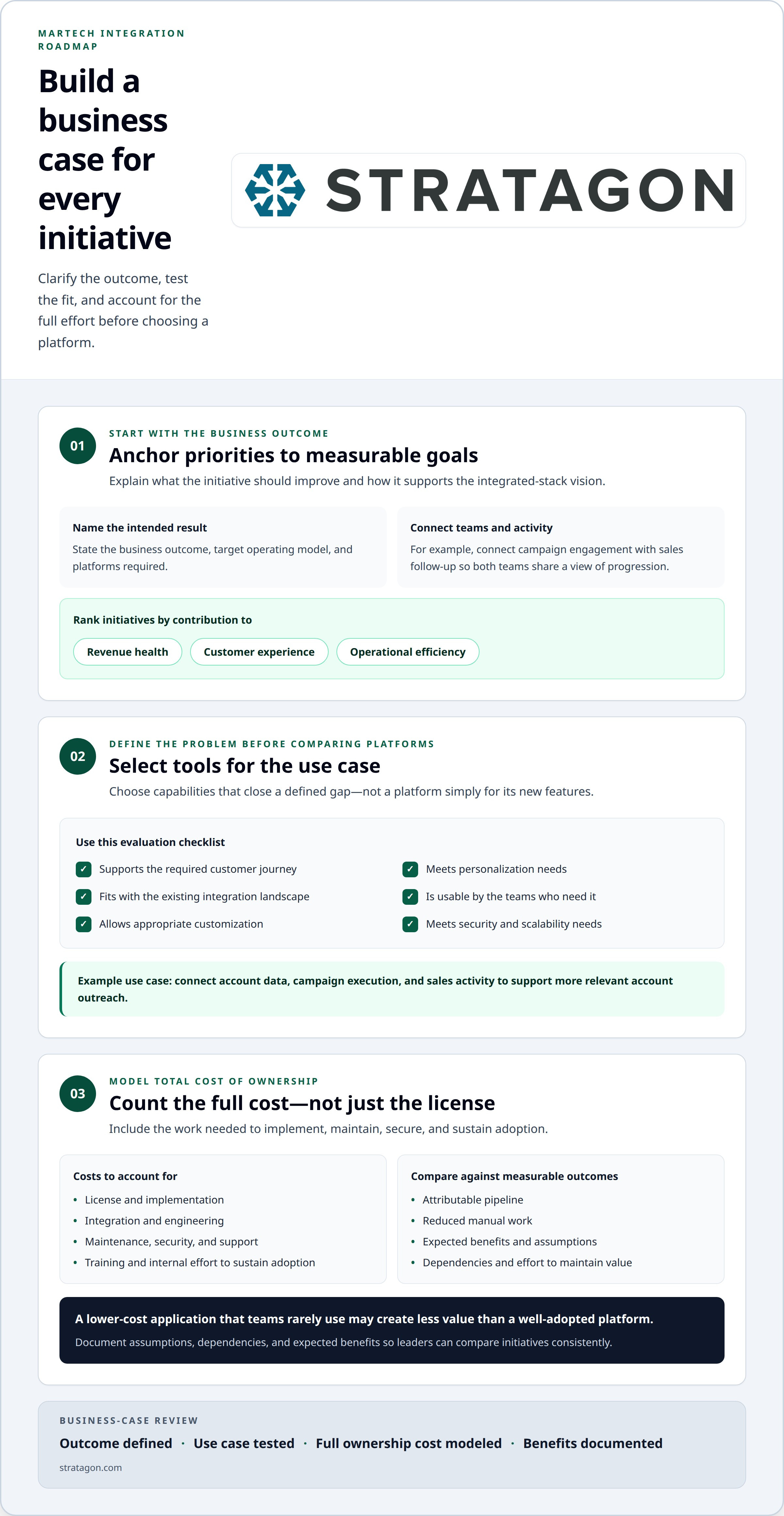
Set the integration vision by naming the business outcome, target operating model, and platforms required. For example, a digital transformation initiative might connect campaign engagement with sales follow-up, giving marketing and sales a shared view of progression. Rank initiatives by their expected contribution to revenue health, customer experience, or operational efficiency. For a team asking how to create a martech integration roadmap, this outcome map makes it easier to explain why one initiative should come before another.
-
How a Professional Team Selects Tools for Business Problems
Define the problem before comparing platforms, then assess whether each option supports the required customer journey and personalization needs. A team seeking more relevant account outreach, for example, should evaluate how tools connect account data, campaign execution, and sales activity. Compare integration fit, usability, customization, security, and scalability against that use case. Avoid adding a platform simply for new features; choose capabilities that close a defined gap.
-
How a Professional Team Calculates Initiative Costs and Total Cost of Ownership
Model the full cost of ownership, not just the license. Include implementation, integration, engineering, maintenance, security, support, training, and the internal effort required to sustain adoption. Then compare those costs with measurable outcomes, such as attributable pipeline or reduced manual work. A lower-cost application that teams rarely use may create less value than a well-adopted platform. Document assumptions, dependencies, and expected benefits so leaders can compare initiatives consistently.
How can a professional team create a martech roadmap for the next 3 years?
A professional team phases initiatives across three years, then reviews execution and outcomes as business needs change. Common risks include incompatible systems, weak data quality, security gaps, and low adoption; staged integration, clear ownership, and access controls help address them.
-
How a Professional Team Addresses Security and Compliance Measures
Build security requirements into each initiative before integration begins. Protect stored and moving data with encryption, secure authentication, and access controls. Align data handling with GDPR, CCPA, and applicable state or industry-specific requirements. Assign responsibility for reviewing permissions and data flows so controls remain part of ongoing operations, not just a one-time launch task.
-
How a Professional Team Identifies and Mitigates Integration Risks
Test dependencies and data mappings before expanding an integration across the stack. Incompatible fields can disrupt records, while unclear ownership can leave errors unresolved. Document source systems, affected capabilities, decisions, and recovery steps for each phase. Plan training and change management too, since even a technically sound platform can underperform if teams do not adopt its workflows.
-
How a Professional Team Measures Integration Benefits and ROI
Set a baseline and connect each initiative to an outcome, such as sourced pipeline, revenue progression, data quality, or reduced manual work. Track whether the integration changes that measure, rather than relying only on platform activity. One example company reported a 15% reduction in MarTech operating expense and a 22% increase in sourced pipeline in Year 3. Treat those figures as an example, not a forecast.
-
How a Professional Team Refines Integrations and the Roadmap
Review execution plans quarterly and revisit strategy annually. Compare actual adoption, data quality, and pipeline performance with each initiative’s intended result. When a tool’s adoption falls below 50%, reassess, retrain, replace, or rethink it. Document paused initiatives, including dependencies and restart requirements. This keeps future priorities grounded in performance while preserving options across the three-year horizon.
Benefits of an integrated martech stack
Connected marketing technology can reduce operational friction and make campaign performance easier to evaluate. Its value depends on how teams use shared data, automation, and clear measures to improve decisions.
- Reduce duplicate work across teams. When campaign, CRM, and analytics data connect, marketing and sales can work from consistent customer records. An example company reduced duplicate records by 42% in Year 1 while stabilizing its data. That improvement can help stakeholders spend less time reconciling information and more time acting on customer needs.
- Improve execution speed. Shared workflows can reduce manual handoffs between campaign planning, audience selection, and sales follow-up. The example company cut cycle time by 31% in Year 1. Automation is most useful when it removes a specific delay, such as transferring qualified engagement data into sales workflows.
- Connect personalization to progression. A consolidated view lets teams tailor campaign content to customer behavior, then assess whether engagement advances the journey. After launching a customer data platform and experimentation, the example company increased MQL-to-SQL conversion by 18% in Year 2. Track the outcome alongside audience relevance and follow-up quality.
- Make campaign performance easier to evaluate. Integrated analytics help stakeholders connect channel activity with business outcomes instead of reviewing isolated reports. High-growth teams launch campaigns in under 30 days in 70% of cases. Treat speed as one measure, alongside data quality, conversion, and sourced pipeline, to avoid rewarding activity without impact.
- Build a foundation for continuous improvement. Set shared measures before launch, assign owners, then review performance after each campaign cycle. If a workflow creates duplicate tasks or unreliable attribution, refine the data exchange before expanding automation. A focused marketing automation engagement can help align campaign execution with the customer journey and stakeholder goals.
Stratagon
Stratagon helps organizations connect martech decisions with business priorities, customer experience, and revenue goals. Its digital transformation work can help shape a coherent direction when teams need to align technology planning with broader operational change. HubSpot CRM Implementation and Sales Enablement can support connected customer and sales processes, while Account-Based Marketing (ABM) aligns marketing and sales around priority accounts.
Consider Stratagon when disconnected systems, unclear ownership, or competing priorities make coordinated execution difficult. The work starts by understanding the business outcomes and operational needs the technology must support, then aligning relevant capabilities with those goals. Contact Stratagon to discuss your martech integration priorities.
Turn the Roadmap Into Forward Momentum
A roadmap creates value when teams use it to make better decisions, not merely to document planned integrations. Treat it as a working agreement between marketing, sales, and technology: each initiative needs an owner, a business outcome, and a clear way to assess progress. As priorities shift, revisit the assumptions behind the plan and adjust execution without losing sight of the customer experience.
The question of how to create a martech integration roadmap becomes more useful when paired with a commitment to learn from each release. Use those lessons to refine workflows, strengthen adoption, and direct future investment toward capabilities that support growth. Stratagon can connect martech decisions with wider business priorities through its digital transformation, HubSpot CRM Implementation, and Account-Based Marketing services.
Start a conversation with Stratagon about your roadmap and take the next step toward a more connected marketing operation.
Frequently Asked Questions
Who owns the roadmap?
Marketing should own business priorities and roadmap outcomes, while IT is accountable for technical design and integration execution. Analytics, operations, sales, and security specialists contribute requirements affecting measurement, workflows, and data controls. An executive sponsor resolves trade-offs across departments. For example, marketing may define a campaign outcome, while IT and sales confirm the data and process changes needed to support it.
What is a martech integration roadmap and what should it include?
A martech integration roadmap is a sequenced plan for connecting marketing systems to business goals. It should document intended outcomes, systems involved, key dependencies, accountable owners, milestones, and success measures. Include decisions that could change the plan, such as a contract renewal or a new customer journey requirement. This makes the roadmap useful for investment reviews as well as technical planning.
How does a professional team audit and map an existing martech stack and data flows?
Trace how information moves between platforms, from its original source to the people and processes that use it. Record important fields, transformations, update timing, exceptions, and downstream users. For example, if a form submission enters CRM with an inconsistent account identifier, the map can show where matching fails and which teams rely on that record.
How does a professional team define business goals and prioritize martech integrations?
Translate leadership objectives into measurable outcomes before ranking integration work. Assess each initiative’s expected business impact, dependencies, readiness, adoption needs, and risk. For example, if sales teams cannot see meaningful campaign engagement, connecting that activity to account workflows may take priority over a new reporting feature. Stakeholders can then agree on trade-offs and the evidence needed to assess progress.
How does a professional team design a martech integration architecture and customer data model?
A professional team designs the architecture around agreed data definitions and clear system responsibilities. It establishes which platform is authoritative for each record or attribute, how identities match across systems, and how changes are handled. For example, the team can define whether an account identifier or contact identifier links campaign activity to CRM records. These decisions help prevent conflicting profiles and ambiguous reporting.
What are the steps and phases a professional team follows to implement a martech integration roadmap?
Move from discovery to design, controlled implementation, broader rollout, and ongoing evaluation. First confirm goals and dependencies, then validate data mappings and workflows in a limited release. After resolving issues, expand deployment, support affected users, and monitor agreed measures. This phased approach helps surface operational problems before they affect every connected process.