HubSpot RevOps Implementation Guide for 2026
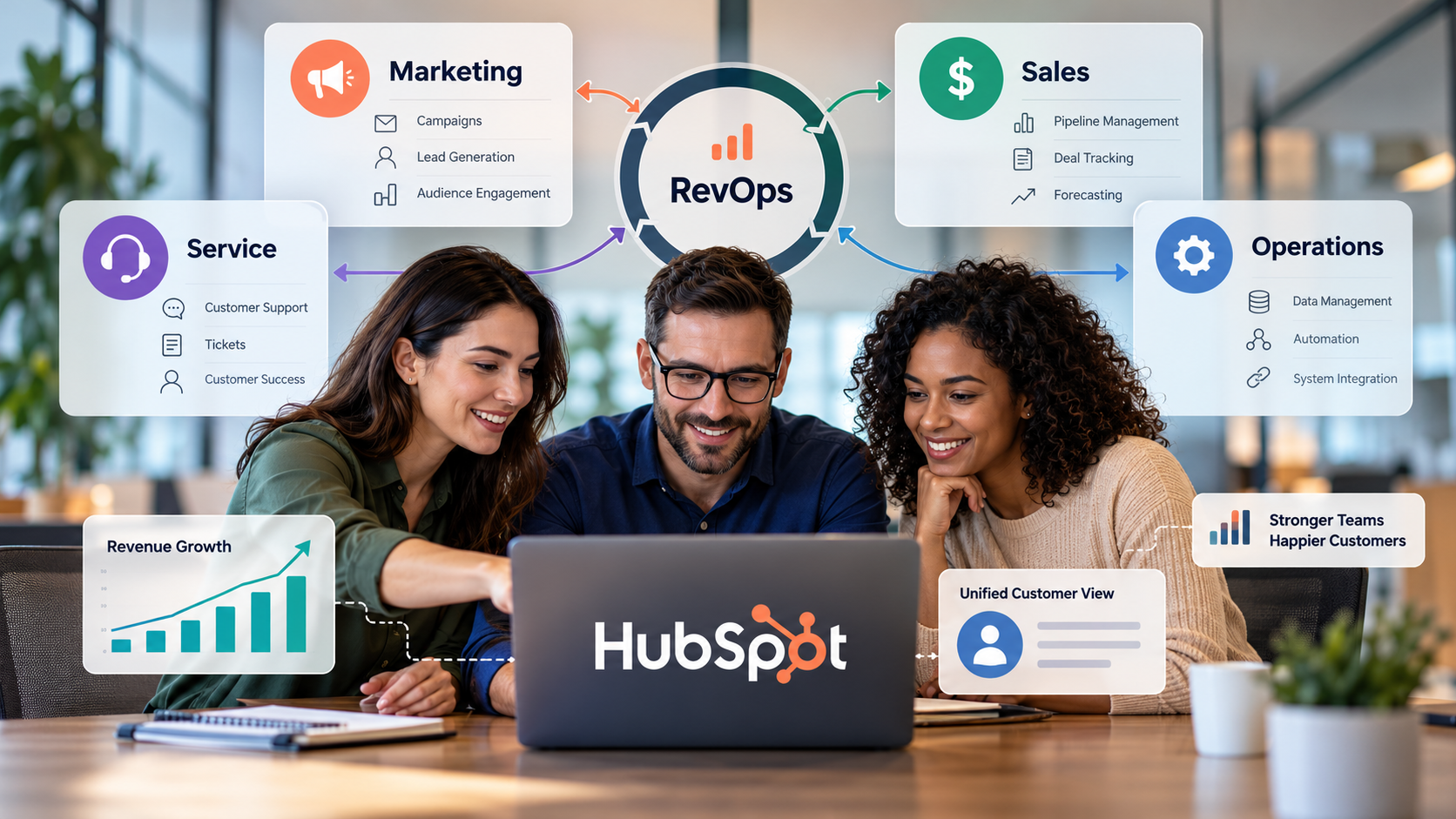
Most B2B organizations don't struggle with choosing HubSpot implementation as their CRM platform. The real challenge starts after that decision, when marketing, sales, and service teams each configure their corner of the system with different definitions, disconnected pipelines, and conflicting reports. The result is a fragmented tech stack that works against revenue growth instead of fueling it.
RevOps changes that dynamic by treating your CRM as a single connected system rather than a collection of departmental tools. This guide walks through how to plan, configure, and adopt HubSpot across marketing, sales, and operations with a RevOps-first mindset. You'll find structured phases, practical steps, and the alignment strategies that separate productive implementations from expensive shelf-ware.
Key Takeaways: HubSpot RevOps Implementation
- A RevOps approach to HubSpot implementation aligns marketing, sales, and service around shared data and definitions from day one.
- Cross-functional discovery before configuration reduces technical debt, duplicate properties, and conflicting lifecycle stages.
- Stratagon helps B2B teams build a RevOps-ready HubSpot environment grounded in measurable business outcomes.
- Data governance, including property standards and naming conventions, is foundational to reliable reporting and AI readiness.
- Adoption depends on role-specific training and change management, not a single launch-day walkthrough of the platform.
What Is HubSpot RevOps Implementation?
HubSpot RevOps implementation is the process of configuring HubSpot's CRM, Marketing Hub, Sales Hub, Service Hub, and Operations Hub as a unified revenue system. Rather than setting up each Hub in isolation, a RevOps implementation connects data models, lifecycle stages, and automation across every customer-facing team.
The goal is a single source of truth for your entire revenue operation. That means one set of lifecycle definitions, one lead-scoring model, and shared dashboards that give marketing, sales, and leadership the same view of pipeline health and customer engagement.
This approach matters because disjointed CRM setups create compounding problems. When marketing defines an MQL differently than sales, lead handoffs break down. When service tickets aren't linked to deal records, renewal risk goes undetected. A RevOps implementation addresses those gaps structurally, before they become expensive to fix.
Why RevOps Matters for Your HubSpot CRM Strategy
RevOps is not just a reporting framework. It's an operational model that changes how teams plan, execute, and measure across the customer lifecycle. For mid-market B2B organizations, adopting a RevOps approach to HubSpot can mean the difference between a CRM that drives decisions and one that collects dust.
According to HubSpot's 2025 ROI Report, 92% of surveyed customers reported high organizational adoption, and 95% achieved positive ROI. Those outcomes aren't accidental. They correlate with organizations that treat implementation as a cross-functional initiative rather than a departmental software install.
When your CRM data is unified, your teams can act on shared signals: which accounts are engaging, where deals stall, and how service interactions affect renewal rates. That visibility turns reactive firefighting into proactive revenue management.
How to Assess Readiness Before You Configure HubSpot
Configuration should never be the first step. Before anyone opens HubSpot's settings, your organization needs clarity on business goals, team alignment, and the current state of your data and processes.
Define Business Goals and Success Metrics
Start by answering three questions with stakeholders from marketing, sales, service, and leadership: What business problems are we solving? How will we measure success? What should be true six months after launch that isn't true today?
Document those answers. They become the filter for every implementation decision, from whether to create a custom property to how many deal pipelines you actually need. Without this alignment, you'll accumulate custom objects and workflows that serve individual requests rather than shared objectives.
Audit Your Current Processes and Tech Stack
Map how work moves through your organization today. Trace the customer journey from first inquiry through closed deal and ongoing account management. Note where leads change hands, where information gets lost, and where departments follow different processes for the same outcome.
This audit often uncovers gaps that would otherwise become embedded in your CRM. Marketing and sales may define a qualified lead differently. Customer success may rely on information that isn't consistently captured. Surfacing these misalignments before CRM implementation leads to a simpler portal, smoother adoption, and a platform that supports how your business actually operates.
Evaluate Data Quality and Migration Needs
A CRM implementation is one of the best opportunities you'll have to improve your data. Don't waste it by migrating everything from your legacy system. Before moving records into HubSpot, audit for duplicates, outdated contacts, inconsistent naming conventions, and unused properties.
Every unnecessary record adds complexity. Cleaner data improves reporting accuracy, strengthens workflow automation, and helps your teams trust the information they work with from day one. If your migration involves significant volume or complexity, consider working with an implementation partner to manage the process.
Phase 1: Cross-Functional Discovery and Planning
Discovery is where the foundation gets built. This phase requires participation from every team that will use HubSpot, not just the team that requested it.
Align Lifecycle Stages and Definitions Across Teams
One of the most common RevOps gaps is inconsistent lifecycle stage definitions. Marketing may consider a contact an MQL based on content engagement, while sales only recognizes contacts who have requested a demo. Those misalignments create friction at every handoff.
Agree on shared definitions for each stage: subscriber, lead, MQL, SQL, opportunity, customer, and evangelist. Document what qualifies a contact for each stage, who owns the transition, and what action triggers the move. This shared language becomes the backbone of your reporting and automation.
Map Lead Routing and Handoff Protocols
Define how leads move between teams and at what stage. Automated lead routing reduces response time and removes ambiguity about ownership. Build rules based on territory, industry, deal size, or product interest, depending on your revenue operations structure.
Handoff protocols should include what information the receiving team needs, how notifications work, and what the expected response time is. When these details are documented before configuration, the workflows you build in HubSpot will reflect real operational needs rather than assumptions.
Establish a Data Governance Framework
Data governance is not a one-time cleanup task. It's an ongoing practice that determines the reliability of every report, workflow, and AI-powered feature in your CRM. Establish standards for property naming conventions, required fields, and data entry formats before you start building.
Create a Data Dictionary that documents every custom property: its purpose, acceptable values, and which team owns it. This prevents the property sprawl that plagues CRM portals over time and ensures your data stays clean enough to support advanced analytics and operations automation.
Phase 2: HubSpot Architecture and Configuration
With your strategy documented and your teams aligned, configuration becomes dramatically more straightforward. You're building a system around agreed-upon processes, not designing around assumptions.
Configure Your CRM Data Model
Start with the standard objects: contacts, companies, deals, and tickets. Then determine whether you need custom objects to represent entities unique to your business, such as products, projects, or locations. According to HubSpot's own data modeling guidance, planning your entity relationships before building prevents costly restructuring later.
Map associations between objects carefully. A deal should connect to the right company, the relevant contacts, and any associated line items. These associations power the reporting and automation that make your CRM useful beyond basic contact storage.
Build Deal Pipelines Around Buyer Decision Stages
Your deal pipeline stages should reflect how your buyers actually make decisions, not an internal sales process that existed before CRM. Each stage needs a clear definition, an entry action, and an exit criterion. Keep the initial pipeline simple: most organizations need fewer stages than they think.
If you serve multiple lines of business or distinct buyer segments, consider separate pipelines for each. This keeps reporting clean and allows you to build stage-specific automation without creating conflicts between unrelated deal types.
Set Up Marketing Hub for Demand Generation
Marketing Hub configuration should connect directly to the lifecycle stages and lead-scoring models defined during discovery. Build forms, landing pages, and email workflows that capture the data your shared definitions require.
Segment your contact database using active lists tied to lifecycle stage, engagement level, industry, and any other criteria relevant to your ABM or demand generation strategy. These segments power your content personalization, nurture sequences, and campaign reporting.
Configure Sales Hub for Pipeline Visibility
Sales Hub should give your reps a frictionless experience for managing deals and logging activities. Configure required properties at each deal stage to enforce data discipline without creating unnecessary administrative burden.
Build custom views, saved filters, and task queues that match how your reps actually work. Set up sequences for outreach cadences and meeting links for scheduling. The goal is a system where reps spend less time on data entry and more time on high-value selling activities, all while producing the pipeline data leadership needs for accurate forecasting.
Activate Operations Hub for Data Quality
Operations Hub, now rebranded as Data Hub, is the connective tissue of a RevOps implementation. Use data sync to connect HubSpot with your other business systems: ERP, billing, project management, and any other tools your teams depend on.
Set up data quality automation to standardize property values, deduplicate records, and flag inconsistencies. Programmable automation through custom-coded actions allows you to build logic that matches your specific business rules, not just generic templates.
Phase 3: Integration and Workflow Automation
With your core architecture in place, this phase connects HubSpot to your broader tech stack and automates the repetitive processes that slow your teams down.
Connect Your Tech Stack Through Native and Custom Integrations
Most mid-market B2B organizations use between 10 and 15 tools across marketing, sales, and operations. HubSpot's App Marketplace offers native integrations for many of these. For tools without native connectors, custom API integrations or middleware platforms can bridge the gap.
Prioritize integrations that directly support your revenue workflows: CRM-to-ERP for order data, marketing-to-CRM for lead attribution, and service-to-CRM for customer health scoring. Each integration should have a documented purpose, an owner, and a plan for monitoring data flow.
Automate Lead Lifecycle Transitions
Build workflows that automatically move contacts through lifecycle stages based on the criteria your teams agreed on during discovery. When a contact meets MQL threshold through lead scoring, the workflow should update the lifecycle stage, notify the assigned sales rep, and create a task for follow-up.
These automated transitions eliminate manual status updates, reduce handoff delays, and ensure your reporting reflects real pipeline activity rather than stale data. They also create a foundation for AI-powered features like predictive lead scoring and marketing-to-sales alignment insights.
Build Cross-Functional Reporting Dashboards
RevOps reporting differs from departmental reporting because it tracks the full revenue journey, not just one team's contribution. Build dashboards that show pipeline velocity, conversion rates across lifecycle stages, customer acquisition cost, and revenue attribution by channel.
Give each team access to shared dashboards alongside team-specific views. Marketing needs campaign performance. Sales needs pipeline forecasts. Leadership needs revenue trend analysis. When everyone works from the same data foundation, conversations shift from "whose numbers are right?" to "what do we do next?"
Phase 4: Team Adoption and Change Management
A technically sound CRM creates value only when people use it consistently. Adoption deserves as much attention as strategy and configuration.
Deploy Role-Specific Training Programs
Generic HubSpot training doesn't build adoption. Role-specific training does. Sales reps need to see how HubSpot makes their daily work easier: fewer manual updates, better lead context, and faster deal progression. Marketing teams need confidence measuring campaign performance and attribution. Leadership needs trust in the dashboards driving business decisions.
Build training around actual workflows, not feature tours. Show each role how their specific tasks map to HubSpot tools, and provide hands-on practice with the data and processes they'll use every day.
Manage Change Through Communication and Quick Wins
Resistance to CRM adoption often stems from a lack of understanding about why the change is happening and how it benefits the individual user. Communicate the business case clearly and early. Share quick wins as they happen: a faster lead response, a cleaner report, a workflow that saves hours of manual work.
Appoint champions within each team who can answer questions, model best practices, and provide feedback to the implementation team. These internal advocates are often more effective than external trainers at driving consistent platform use.
Measure Adoption and Address Gaps Post-Launch
Track adoption metrics in the weeks and months after launch. Monitor login frequency, activity logging rates, deal stage progression, and report usage. Where adoption lags, investigate whether the issue is training, process design, or tool configuration.
Treat launch as the beginning of optimization, not the end of the project. The organizations that get the most from HubSpot continually refine workflows, improve reporting, simplify processes, and introduce new capabilities as their business evolves. Stratagon works alongside organizations through this ongoing refinement, treating HubSpot optimization as an extension of the customer lifecycle management strategy.
Common HubSpot RevOps Implementation Mistakes to Avoid
Even well-planned implementations can go off track. Recognizing these common pitfalls early helps you steer clear of costly rework.
Over-Configuring at Launch
One of the most frequent mistakes is building every possible workflow, dashboard, and automation before launch. This creates complexity that overwhelms users and increases the likelihood of errors. Start with the essentials your teams need on day one, then expand based on adoption data and evolving business requirements.
Skipping the Data Governance Plan
Without a governance plan, your CRM data quality degrades quickly. Duplicate records multiply, property values drift, and reports become unreliable. Invest in governance from the start: define ownership, set standards, and automate quality checks using Operations Hub features.
Treating Implementation as a Technology Project
CRM implementation is a people-and-process project with a technology component, not the other way around. Organizations that spend 80% of their effort on configuration and 20% on strategy and adoption typically see lower returns than those who distribute effort more evenly across all three areas.
How Stratagon Approaches HubSpot RevOps Implementation
Stratagon's approach to HubSpot implementation is rooted in the belief that a CRM should serve as the operating system for your revenue team, not a reporting tool that sits alongside your actual processes. We work as an extension of your internal team, thinking alongside you to build a system that reflects your business model, your buyer journey, and your growth objectives.
Our methodology integrates marketing, sales, and service from the first strategy session. We don't configure Marketing Hub and hand it off to a different team for Sales Hub. Every implementation decision, from lifecycle stage definitions to workflow automation, is made with cross-functional alignment in mind.
As a certified HubSpot Platinum Solutions Partner with deep expertise in B2B commercial, higher education, and agribusiness verticals, Stratagon brings sector-specific knowledge to every engagement. Your CRM isn't built around generic templates. It's built around how your market operates and the outcomes that matter to your leadership. Contact us to start the conversation.
FAQs About HubSpot RevOps Implementation
How long does a HubSpot RevOps implementation typically take?
Most mid-market HubSpot RevOps implementations take between 8 and 16 weeks, depending on the number of Hubs, integration complexity, and data migration scope. Stratagon structures each phase around your team's capacity to ensure adoption keeps pace with configuration.
What is the difference between HubSpot onboarding and a RevOps implementation?
HubSpot onboarding focuses on getting individual Hubs configured and usable. A RevOps implementation connects those Hubs into a unified revenue system with shared data models, cross-functional automation, and aligned reporting. Stratagon builds both the technical foundation and the team alignment needed for lasting results.
Do we need all HubSpot Hubs for a RevOps implementation?
Not necessarily. Your Hub selection depends on your current needs and growth plans. Many organizations start with CRM, Marketing Hub, and Sales Hub, then add Service Hub and Operations Hub as their RevOps maturity grows. Stratagon helps you scope the right combination for your stage of growth.
How does RevOps implementation improve marketing and sales alignment?
RevOps implementation creates shared lifecycle definitions, unified lead scoring, and connected reporting between marketing and sales. When both teams work from the same data and agree on what qualifies a lead for handoff, pipeline quality improves and conversion rates increase.
What role does data governance play in HubSpot RevOps?
Data governance ensures your CRM remains a reliable decision-making tool over time. It includes property naming standards, required fields, deduplication rules, and ongoing quality automation. Stratagon establishes these governance practices during implementation and trains your team to maintain them independently.
Can we implement HubSpot RevOps without an external partner?
You can, though the process often takes longer and carries more risk of technical debt when handled entirely in-house. An experienced implementation partner like Stratagon brings cross-industry knowledge, proven frameworks, and the ability to anticipate configuration decisions that affect long-term scalability.
